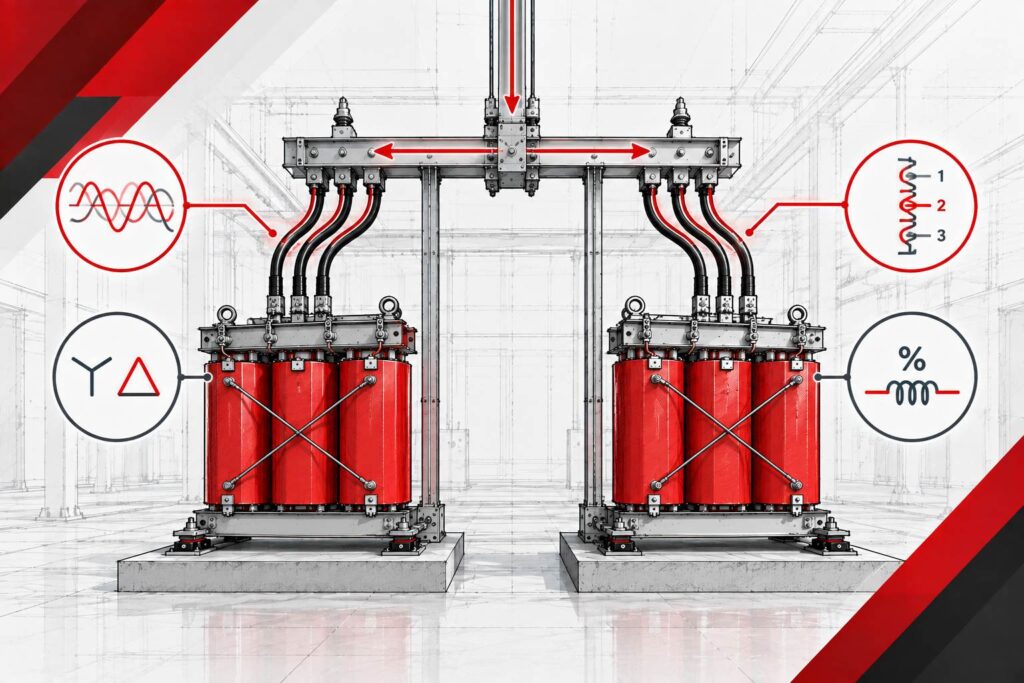
Operating transformers in parallel is a common way to increase capacity, build in redundancy, and stage capacity additions over time. Rather than relying on a single larger unit, multiple transformers supply a common bus and share the load.
The concept is straightforward. Execution is less so. Parallel operation depends on several parameters being aligned within tight limits, and small mismatches produce disproportionate problems — circulating currents, uneven loading, and accelerated insulation aging in the unit that ends up carrying more than its share. Paralleling should be treated as a verification-driven design decision, not a default configuration.
Core Requirements
Five parameters must be aligned:
- Voltage ratio must match within about 0.5%. Mismatches drive circulating currents because each transformer tries to impose a slightly different secondary voltage.
- Polarity must be identical. Opposite polarity creates a direct short circuit at the moment of energization.
- Phase sequence must be the same on both sides. A-B-C paralleled with A-C-B produces a bolted fault when the tie breaker closes.
- Vector group must match, or must produce the same phase displacement. A Dyn11 transformer cannot be paralleled with a Dyn1 unit — the 60° phase difference guarantees destructive circulating current.
- Percent impedance must be similar on a per-unit basis, typically within 7.5%. Transformers do not need identical kVA ratings to parallel, but their per-unit impedances must match. This parameter determines how load is actually divided.
How Load is Actually Sharing
Load divides between paralleled transformers in inverse proportion to per-unit impedance. The same bus voltage appears across both units, so the one with the smaller internal voltage drop pushes more current — the lower-impedance transformer carries more load.
A worked example makes the sensitivity clear. Two 1000 kVA transformers supply a 1500 kVA load. If both are rated at 5.75% impedance, each carries 750 kVA — clean 50/50 split. If one is at 5.5% and the other at 6.0% — a mismatch well within manufacturing tolerance — the lower-impedance unit carries 785 kVA and the other 715 kVA. That 5% overload at full system load is enough to matter for insulation life over time.
For transformers of different kVA ratings, proportional sharing requires equal per-unit impedances, not equal ohmic impedances. The common field error is comparing nameplate percentages without confirming both are referenced to their own kVA base. Two transformers with the same 5.75% nameplate value but different kVA ratings have different per-unit impedances on a common base, and they will not share proportionally.
Circulating Currents
Circulating currents flow between paralleled transformers through the loop formed by the secondary windings and the common bus. They contribute nothing to load delivery — they only add copper losses and heating in both units.
They come from three sources: voltage ratio mismatch, tap settings out of alignment, and phase angle discrepancies between vector groups.
The concerning feature is that they don’t appear in panel load readings. A technician measuring secondary current at the breakers sees normal load current. Inside each transformer, however, load current and circulating current are stacking — both units run hotter than the measurements suggest. This silently consumes the capacity headroom that paralleling was supposed to provide.
Tap Settings
All paralleled transformers must be on the same tap position. A single 2.5% tap step covers the entire typical voltage-ratio tolerance, so one tap out of alignment produces significant circulating current even in transformers that are otherwise identical.
This is where paralleled systems most commonly fail in service. A maintenance crew adjusts a tap to correct a low-voltage complaint at one panel, not recognizing that the other transformer supplies the same bus and now disagrees about secondary voltage. The result is exactly the silent circulating current described above.
The procedural rule is firm: any tap change on one paralleled transformer must be replicated on all others, and the match verified before re-energization.
Installation Details
Cable length and routing between each transformer and the common bus add impedance to each current path. Unequal runs produce unequal external impedance, and once that happens, load sharing no longer tracks transformer impedances alone — the cable becomes part of the equation.
The effect is most pronounced at low-voltage secondary levels, where conductor impedance is a meaningful fraction of total transformer impedance.
The rule is symmetrical routing: equal cable lengths, identical terminations, matching conductor arrangements. In retrofits where physical constraints force asymmetry, the imbalance should be measured at commissioning and, if significant, compensated through tap adjustment.
When to Parallel, When Not To
Paralleling makes sense when the load exceeds a single economically available transformer, when N+1 redundancy is required, or when capacity needs to be staged over time. When the units are specified together from the start — same manufacturer, matched impedances, identical vector groups — it’s often the right answer.
It becomes problematic when units weren’t designed to operate together. Mismatched impedances, different vector groups, incomplete nameplate data, or mixing older and newer designs all push the system toward the failure mode where everything appears to work at commissioning while circulating currents quietly consume insulation life. In those cases, a single appropriately sized replacement is usually more reliable and, over equipment lifetime, less expensive.
Commissioning
Verification matters more than design intent here. Before energization, confirm voltage ratio on each tap via turns ratio test, polarity on each bushing, phase rotation on both sides, tap position on all units, and vector group against nameplate.
After energization, measure load sharing under actual operating load. Circulating current, if present, shows up as a difference between measured secondary current and computed load current — worth looking for explicitly rather than assuming its absence.
Conclusion
Transformer paralleling works reliably when the underlying requirements are met. The failure mode is not dramatic. It’s a slow, invisible cost paid in copper losses, thermal aging, and lost capacity headroom — exactly the resources paralleling was supposed to add.
Most problems trace to small mismatches: half a percent on voltage ratio, one tap out of alignment, a few percent on impedance. The remedy is the same in every case. Verify at every stage. Match what the design actually requires rather than what looks close enough on the nameplates. Treat every tap change on a paralleled transformer as a change to the whole system.