Transformers are everywhere in the electrical grid, yet most people who specify, install, or work near them rarely think about how they actually function. The principle is over a century old and conceptually simple. The implications for system design are not.
Understanding what a transformer does — and, just as importantly, what it cannot do — is the foundation for nearly every voltage decision in a power system, from utility transmission down to the panelboard in a mechanical room. This article walks through the working principle, the components that make it practical, and the role transformers play at each stage of the power system.
What a Transformer Does
A transformer transfers electrical energy between two circuits through a magnetic field, while changing the voltage level. The frequency stays the same. There is no direct electrical connection between the input and output sides — energy crosses the gap through magnetic coupling alone.
That single property is what makes the modern grid possible. It allows voltage to be raised for efficient transmission and lowered for safe use, and it provides electrical isolation between circuits as a side effect.
In facility and industrial systems, transformers operate within low and medium voltage ranges, typically supporting distribution rather than transmission. Dry-type construction is common in these environments because it works well indoors and integrates cleanly into building electrical systems.
The Working Principle
Transformer operation is based on electromagnetic induction.
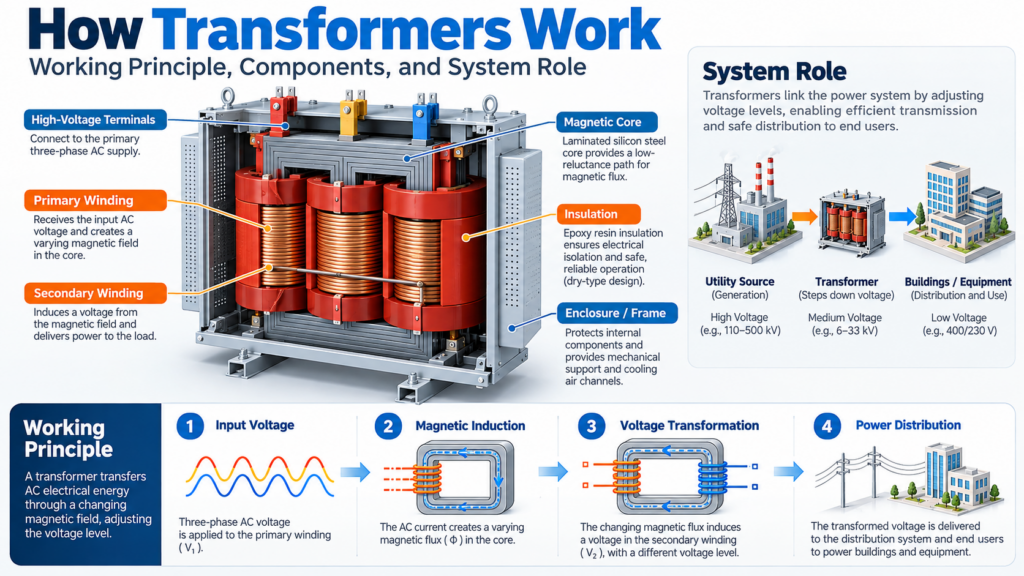
When alternating current flows through the primary winding, it creates a time-varying magnetic field in the core. That changing flux passes through the secondary winding and induces a voltage across it. Connect a load to the secondary, and current flows.
The sequence is straightforward:
Input voltage → current in the primary winding → changing magnetic field in the core → induced voltage in the secondary winding → output to the load
Energy moves through the magnetic field, not through a wire between the two sides. That distinction is the reason transformers also provide galvanic isolation — a useful property that gets exploited deliberately in some applications.
Why Transformers Need AC
Induction depends on a changing magnetic field. With direct current, the field becomes static after the initial energization, no further voltage is induced, and the transformer stops doing useful work.
This is why conventional transformers operate only on alternating current. Modern DC systems — solar arrays, battery storage, HVDC links — handle this through power-electronic conversion stages that produce AC at the transformer interface. The transformer itself doesn’t change.
How Voltage Transformation Works
The voltage ratio between primary and secondary is set by the turns ratio: more turns on the secondary produces higher voltage, fewer turns produces lower voltage.
Voltage and current move in opposite directions for a given power level. When voltage doubles, current halves. This inverse relationship is the entire reason high-voltage transmission exists — lower current means lower I²R losses in the conductors, which means power can travel further without wasting itself as heat in the wires.
A transformer doesn’t create energy. It trades voltage for current, or current for voltage, with a small fraction lost as heat in the core and windings.
Core Components
The principle is simple. Making it work efficiently at scale is where the engineering lives.
Magnetic core. Provides a controlled path for magnetic flux. Built from thin laminated steel sheets to reduce eddy-current losses, with grain-oriented silicon steel common in higher-efficiency designs.
Primary and secondary windings. Conductive coils — usually copper or aluminum — that carry the current and set the turns ratio. Conductor sizing, geometry, and insulation between layers all influence performance.
Insulation system. Separates the windings from each other and from the core. Dry-type transformers use solid insulation and air; liquid-filled transformers use oil or other dielectric fluid. The insulation system is often what determines the transformer’s voltage class and thermal rating.
Cooling system. Transformer losses turn into heat, and that heat has to go somewhere. Dry-type designs use natural or forced air (AN or AF). Without adequate cooling, insulation degrades and service life drops sharply.
Where Transformers Sit in the Power System
| Stage | Voltage Range | Transformer Role |
|---|---|---|
| Generation | Moderate generator voltage (typically 13.8–25 kV) | Step up to transmission voltage at the plant |
| Transmission | 115 kV to 765 kV | Long-distance transport at high voltage to minimize losses |
| Sub-transmission | 35 kV to 138 kV | Step down between transmission and regional distribution |
| Primary distribution | 4 kV to 35 kV | Step down to feed neighborhoods, campuses, industrial sites |
| Secondary distribution / facility | 208 V to 600 V | Step down to utilization voltage for buildings and equipment |
| End use / specialty | Varies | Isolation, voltage matching, distributed energy interconnection |
At each transition, a transformer does the same fundamental job — changes the voltage level — but the specification, construction, and protection requirements differ significantly across the stages.
Categories Used in Practice
Transformers are usually categorized by how they’re applied rather than by anything fundamental in their operating principle:
Step-up transformers raise voltage from a lower to a higher level. Common at generator outputs, and increasingly common at the output of solar inverters, battery storage systems, and on-site generation tying into medium-voltage distribution.
Step-down transformers reduce voltage for distribution and end use. The largest category by far, covering everything from utility pad-mounts at the curb to indoor dry-type units feeding panelboards and motor control centers inside facilities.
Isolation transformers separate two circuits without significantly changing voltage. Used in hospitals, data centers, and sensitive electronic environments to limit fault currents, reduce common-mode noise, and provide a separately derived system for grounding purposes.
The same physics underpins all three. The application drives the specification.
Where They Actually Get Installed
Categories describe what a transformer does. Where they get installed describes how facilities actually use them. A few of the most common installation contexts:
Utility distribution. Pad-mount and pole-mount transformers at the edge of the grid handle the final step down from medium voltage to the 208 V, 480 V, or 600 V supply that buildings actually use.
Commercial and industrial facilities. Indoor dry-type transformers feed panelboards, motor control centers, and process equipment. Most facility electrical rooms have at least one, and large industrial plants often have dozens supporting different load groups and voltage levels.
Distributed energy interconnection. Solar PV, battery storage, and on-site generation all produce power at low voltage that has to be stepped up to the facility bus or utility distribution. This is one of the fastest-growing application areas for dry-type construction.
Equipment voltage matching. Imported machinery, specialty process equipment, and laboratory loads frequently require voltages that don’t match the facility’s distribution. A dedicated transformer matches the supply to the equipment without rewiring the building.
Test and specialty systems. OEM test cells, equipment test stands, and laboratory benches often need non-standard voltages within a contained footprint, supplied by purpose-built transformers — including step-up units that feed medium-voltage equipment from a low-voltage lab supply.
In each case the transformer is doing the same fundamental job. What changes is the surrounding system — voltage levels, environment, load characteristics, and the integration requirements that follow from them.
Conclusion
Transformers run on a principle that fits in a single sentence: a changing magnetic field induces a voltage in a nearby winding. Everything about modern electrical infrastructure is built on top of that fact.
The ability to raise voltage for efficient transmission and lower it for safe use is what makes long-distance power delivery practical. Without transformers, conductor sizes and system losses would be impossible to manage at any meaningful scale. With them, the same basic device — scaled and specified appropriately — handles every voltage transition from the generator to the receptacle.
Understanding the working principle is straightforward. Understanding how it shapes specification, system behavior, and equipment selection is what makes the difference in practice.