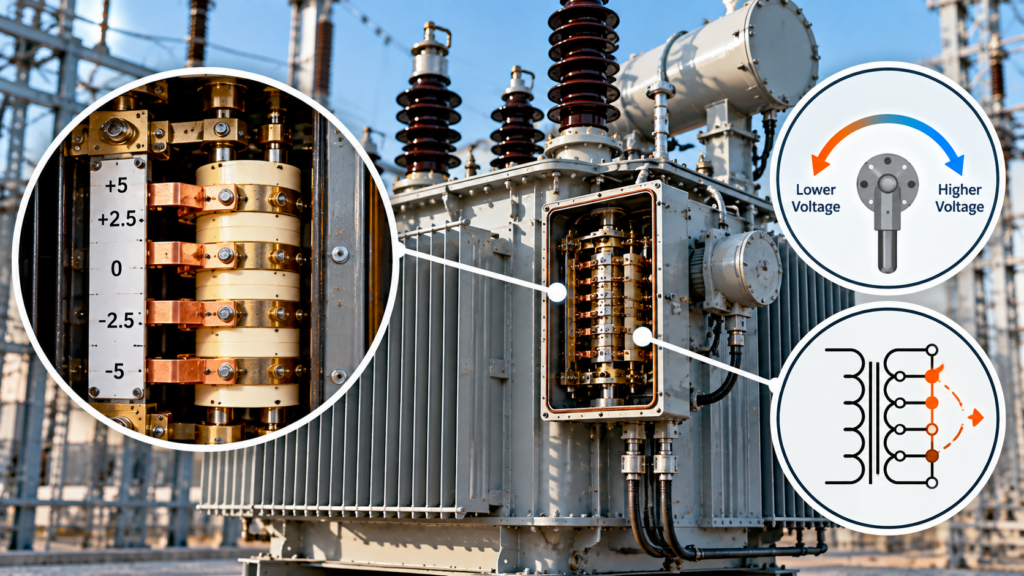
Supply voltage is rarely exactly what the nameplate says. Utility variation, feeder length, load growth, and seasonal changes all push the voltage at a facility’s electrical room away from the design point — sometimes by a few percent, sometimes by more. Transformer taps exist to compensate for that, allowing the turns ratio to be adjusted in fixed increments without replacing the equipment.
The concept is simple. The application is where things go wrong, usually because someone changes a tap to fix a symptom rather than a measured problem. This article covers what taps actually do, the difference between off-circuit and on-load tap changers, how to pick a tap position, and the mistakes that come up most often in dry-type installations.
What Taps Actually Do
Taps are connection points along a transformer winding that let the effective number of turns be changed. Selecting a different tap changes the turns ratio, which changes the secondary voltage proportionally.
The relationship is direct:
A tap that reduces primary turns increases the secondary voltage for a given input. A tap that increases primary turns decreases secondary voltage. This is the source of the most common point of confusion in tap selection — the relationship is inverse, and the nameplate doesn’t always make it obvious.
Taps are placed on the energized winding rather than always on the high-voltage side. In a conventional step-down transformer, those are the same thing — the primary is both energized and high voltage. In step-up applications, the energized side may still be the medium-voltage winding even though it’s now the secondary in power-flow terms. The current-carrying advantage of locating taps on the higher-voltage winding (lower current, smaller mechanical design) still applies in both cases.
Tap increments are typically:
- ±2.5% in single steps (most common on dry-type units)
- ±5% in single steps
- Combinations like four 2.5% taps spanning ±5%
Off-Circuit vs. On-Load Tap Changers
There are two fundamentally different ways to change a tap, and they serve different applications.
Off-circuit (de-energized) tap changers require the transformer to be fully de-energized before the tap can be moved. They are mechanical selectors operated by hand, usually through an external handle, and they cost very little to include in a transformer design. The trade-off is obvious — you can’t change the tap while the transformer is in service.
This is the standard configuration for dry-type transformers, distribution transformers, and most industrial power transformers. Off-circuit taps suit applications where voltage variation is slow and predictable, where tap changes happen during commissioning or after major load changes, and where the cost and complexity of an OLTC isn’t justified.
On-load tap changers (OLTC) can change taps while the transformer is energized and supplying load. They use a switching arrangement with transition resistors or reactors that briefly bridge two tap positions during the change, preventing both load interruption and contact arcing. The mechanism is significantly more complex — more moving parts, more wear, more maintenance.
OLTC is standard on utility transmission and large substation transformers, where voltage has to track load changes in real time and the transformer can’t be taken out of service for adjustments. It’s rare on dry-type units. The application typically doesn’t require dynamic regulation, and the added cost, mechanical complexity, and maintenance burden aren’t justified by the small operational benefit.
How to Actually Pick a Tap
Tap selection is a measurement-driven decision, not a guess. The procedure:
- Measure the actual secondary voltage under representative load conditions — not at no-load, and not based on what the utility reports at the meter
- Compare the measured value to the required nominal voltage for the connected equipment
- Calculate the percentage adjustment needed
- Select the tap position that compensates for the measured deviation
Worked example. A 480 V three-phase secondary measures 467 V under typical operating load. That’s roughly 2.7% low. A transformer with ±2.5% taps on the primary winding has a tap position that effectively reduces primary turns by 2.5%, which raises the secondary voltage by approximately that same percentage. Moving to that tap brings the measured secondary to about 479 V — within tolerance, without overshooting.
The key detail: changing a tap on the primary winding has an inverse effect on the secondary. Taking primary turns down raises secondary voltage. Tap nameplates typically show primary voltage values (e.g., « 492 V, » « 480 V, » « 468 V » for a 480 V nominal primary), not the resulting secondary effect. Reading the nameplate correctly takes a moment of attention.
When Taps Get Used
Taps compensate for predictable voltage offsets, not for transient problems. The realistic use cases:
- Long feeder voltage drop. A facility at the end of a long utility run consistently sees lower-than-nominal supply voltage. Taps raise the secondary to match equipment requirements.
- Utility supply variation. Some service areas run consistently a few percent high or low. Taps shift the entire operating range back to nominal.
- Commissioning adjustment. Initial measurement after installation often reveals that actual voltage differs from the design assumption. Taps correct for the difference.
- Sustained load changes. Major load additions or removals shift the steady-state voltage profile. A tap change can restore the original operating point.
What taps don’t fix: harmonic distortion, transient sags or swells, brief utility events, or power quality problems generally. Taps adjust steady-state magnitude. Anything dynamic or non-fundamental requires a different solution.
Common Mistakes
A few patterns come up repeatedly in the field:
Changing taps without measurement. The most common error. Someone reports low voltage at a panel; the tap gets adjusted; the problem persists because the actual issue was a long branch circuit run, not the transformer supply. Tap adjustment should always follow a measurement that confirms the transformer secondary is actually off-nominal.
Failing to de-energize before an off-circuit tap change. Off-circuit tap changers are not rated to break load current. Operating one under load can cause arcing, contact damage, and in some cases a winding fault. Lockout/tagout is mandatory.
Forgetting that paralleled transformers must move together. If two transformers parallel into a common bus and one tap is changed without matching the other, circulating currents develop immediately. Any tap change on a paralleled system has to be replicated on all units.
Overcompensating for transient events. Tap changes correct steady-state offsets. They don’t fix events that come and go within minutes or hours.
Dry-Type Considerations
For dry-type transformers, tap adjustments happen rarely — usually at commissioning, occasionally after major load changes. Off-circuit construction means every adjustment requires de-energizing the unit, which in turn requires coordinating an outage. The procedural overhead alone keeps unnecessary changes in check.
Environmental factors deserve attention before the final tap is locked in. Ambient temperature, harmonic loading, and expected load growth all influence the right operating point. A tap selected during a cool commissioning visit may not be the right tap for the building once it’s at full occupancy and full summer ambient.
Tap changes on dry-type units should be performed only by qualified personnel with proper lockout/tagout in place and the position verified against the nameplate after the change.
Conclusion
Tap changers are a simple, durable solution to a real problem: matching transformer output to the voltage the system actually needs, rather than the voltage the design assumed. Off-circuit taps handle steady-state corrections at low cost; on-load tap changers handle dynamic regulation where the application demands it.
The mechanism works reliably when it’s used for what it’s designed for. Most tap-related problems trace back to changing a tap without measuring first, or to using taps to chase problems they were never meant to solve. Measure under load, change deliberately, verify the result — and the tap does its job for the life of the transformer.