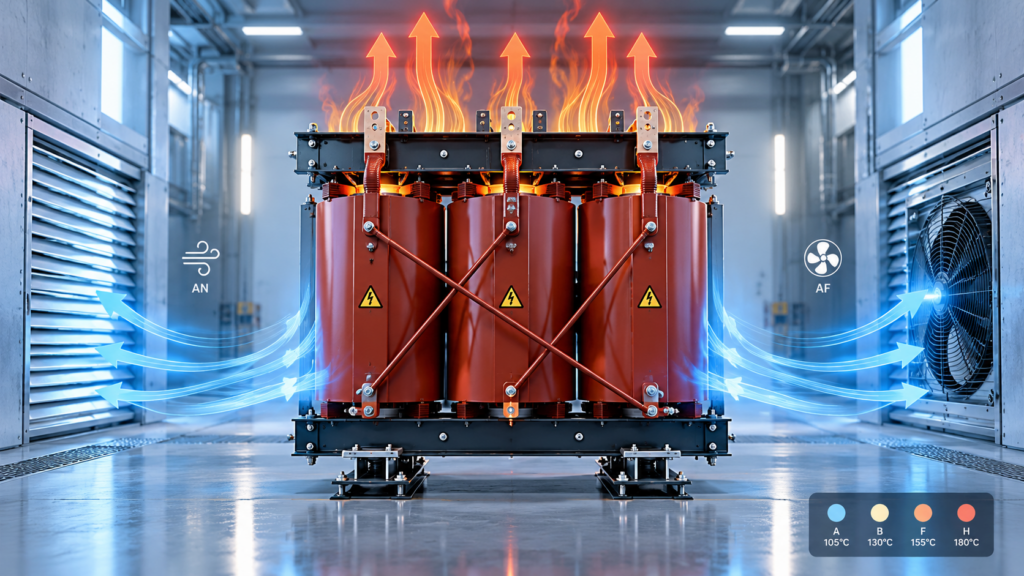
Effective thermal management is one of the most critical aspects of transformer design and performance. Every ampere that flows through a transformer generates heat — the result of conductor and core losses. In dry-type transformers, where no liquid coolant is used, managing that heat through air circulation and material design is essential for safe operation, efficiency, and long service life.
Unlike liquid-filled units, dry-type transformers rely on air as the cooling medium, either through natural convection or forced circulation. Understanding the available cooling methods, temperature rise limits, and insulation coordination is key to selecting the right transformer for a given application or environment.

The Role of Thermal Management
Transformer losses — both core (no-load) and conductor (load) — are converted to heat. If not properly dissipated, this heat raises the temperature of the windings and insulation, accelerating aging, increasing resistance, and reducing efficiency.
Proper thermal design ensures that:
- Operating temperatures remain within insulation class limits.
- The transformer achieves expected life expectancy under rated conditions.
- Efficiency remains high, even under varying load and ambient conditions.
In dry-type designs, airflow paths, insulation materials, and coil geometry are all engineered to promote efficient heat transfer and maintain uniform temperatures throughout the transformer structure.
Cooling Classes for Dry-Type Transformers
Dry-type transformer cooling is defined by standardized designations that describe how air is used to remove heat from the windings and core.

Increased Capacity with Forced Cooling
Forced-air cooling can increase a transformer’s capacity by 25–50% compared to its natural-air rating. Fans are often temperature-controlled, activating only when winding temperatures approach a preset threshold, minimizing energy use and noise.
Temperature Rise and Insulation Coordination
- Transformer nameplates specify temperature rise, which represents the average increase in winding temperature above the ambient air temperature at full load.
- This rise, combined with insulation class and ambient conditions, determines the total operating temperature.
Example:
- Insulation class: 220°C (Class R)
- Temperature rise: 150°C
- Ambient temperature: 30°C
- Total operating temperature: 180°C
- This operating point is well below the insulation’s 220°C limit, leaving thermal margin for environmental or operational variations.
The hot-spot temperature — typically 10–15°C higher than the average winding temperature — is also monitored to ensure localized heating remains within safe limits.
Influence of Ambient Conditions
Thermal performance is affected by external environmental conditions. Designers and specifiers should account for the following:
High Ambient Temperature
Most transformers are rated for a 30°C average ambient (with a 40°C maximum). Higher ambient temperatures, such as mechanical or electrical rooms, can reduce thermal margin. Selecting a transformer with lower designed temperature rise or higher insulation class compensates for these conditions.
High Altitude
At altitudes above 1,000 m (3,300 ft), air density decreases, reducing cooling effectiveness. Transformers must be derated or equipped with forced-air systems to maintain proper cooling performance.
Enclosures and Airflow
Ventilated enclosures (NEMA-rated) restrict airflow and increase internal temperature. Properly designed ventilation paths, louvers, or optional fan systems ensure adequate heat removal.
Advanced Cooling Techniques
Modern dry-type transformers use several technologies to enhance thermal management and adaptability to operating conditions:
Temperature-Activated Fans
Automatically engage at a defined winding temperature, providing additional airflow only when necessary. This helps reduce energy consumption, wear, and acoustic noise.
Thermal Sensors and Monitoring
Resistance Temperature Detectors (RTDs) or thermistors are embedded in windings to monitor real-time temperature. These sensors feed temperature data to local or remote monitoring systems, supporting predictive maintenance and alarm functions.
Smart Fan Control Systems
Integrate thermal sensors with intelligent fan controllers that modulate fan operation based on load or temperature. This approach maintains consistent cooling while optimizing energy use.
Enhanced Materials and Impregnation
Advanced VPI (Vacuum Pressure Impregnation) and VPE (Vacuum Pressure Encapsulation) processes ensure uniform resin penetration and excellent heat transfer. The solidified resin enhances thermal conductivity and provides mechanical stability.
Relationship Between Cooling, Efficiency, and Life Expectancy
The link between operating temperature and insulation life is well established: every 10°C reduction in operating temperature approximately doubles insulation life.
Operating below the insulation system’s temperature limit — for instance, using Class R (220°C) insulation but designing for 115°C or 150°C temperature rise — provides substantial longevity and reliability benefits.
This approach compensates for real-world challenges such as:
- Elevated ambient temperatures.
- Restricted ventilation or enclosure use.
- Additional losses from harmonics and non-linear loads.
Efficient thermal management not only extends life but also supports NRCan 2019 energy performance compliance by maintaining optimal efficiency and stable operation under all load conditions.
Rex Power Magnetics Approach
At Rex Power Magnetics, transformers are engineered with advanced thermal design principles to ensure consistent, long-term performance.
Our approach includes:
- Thermal modeling and analysis to optimize air paths and minimize temperature gradients.
- Certified Class R (220°C) insulation systems coordinated with appropriate temperature rise ratings.
- Dual-rated AN/AF (ANN/AFN) designs for adaptable capacity.
- Integrated thermal monitoring and fan control systems for real-time management.
- Temperature rise testing per IEEE C57.12.01 and CSA C9 to verify compliance and performance.
Each unit is thoroughly tested and validated to ensure predictable thermal performance, even under elevated ambient or harmonic conditions.
Conclusion
Thermal management defines the reliability and service life of every dry-type transformer. Understanding cooling methods — whether AN/ANN or AF/AFN — along with proper insulation coordination and ambient considerations, ensures safe and efficient operation in all environments.
Through advanced design, certified insulation systems, and rigorous testing, Rex Power Magnetics produces dry-type transformers that run cooler, operate more efficiently, and deliver proven reliability throughout their service life.