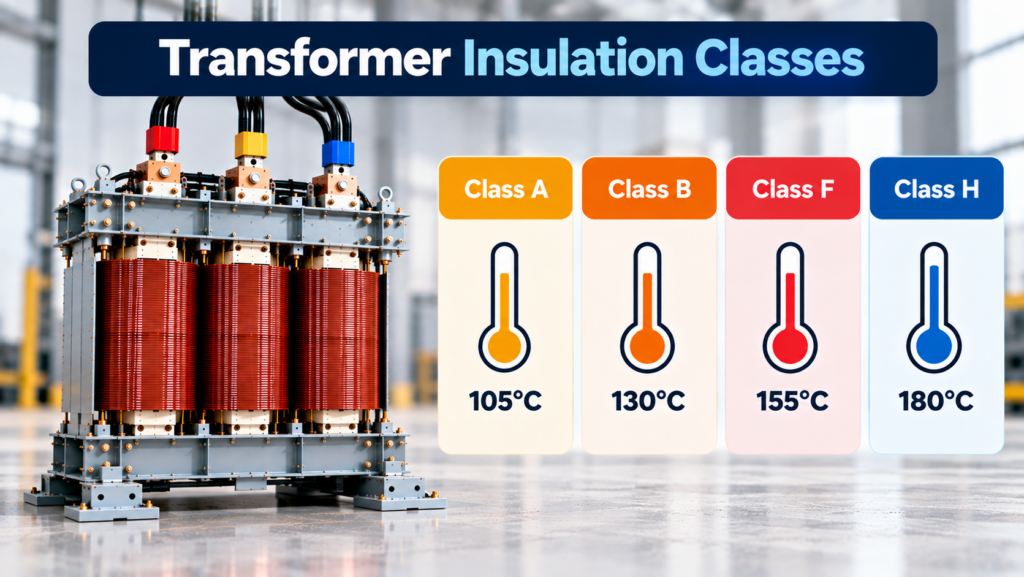
The insulation system is one of the most critical components in a dry-type transformer. It determines how much heat the transformer can safely handle, how long it will last, and how reliably it performs over time.
Insulation classes define the thermal endurance of materials used within the transformer — the winding insulation, core barriers, and impregnation systems. Understanding these classes and their relationship to temperature rise is essential for specifying transformers that deliver long service life under real-world conditions.
Modern dry-type transformers use Vacuum Pressure Impregnated (VPI), Vacuum Pressure Encapsulated (VPE), or cast-coil insulation systems, typically rated for Class R (220 °C) or Class H (180 °C) operation. But how those insulation systems are applied — not just their temperature limit — largely determines transformer longevity.
What Is an Insulation Class?
An insulation class is a thermal rating that indicates the maximum total temperature the transformer’s insulation system can safely withstand over its expected lifetime.
This total temperature is made up of:
- Ambient temperature (usually 30 °C)
- Average winding temperature rise above ambient
- Hot-spot allowance, accounting for localized heating
For example, a Class R insulation system rated for 220 °C may operate with a 150 °C temperature rise above 30 °C ambient and still remain within its limit. Exceeding these limits accelerates insulation aging exponentially, reducing life expectancy and potentially leading to premature failure.
Common Insulation Classes in Dry-Type Transformers
Dry-type transformers are built to recognized standards such as IEEE C57.12.01, IEEE C57.12.91, and CSA C9. The most common insulation classes are summarized below:

Standard for VPI and VPE dry-type transformers
In modern manufacturing, Class R insulation systems are standard for VPI and VPE dry-type transformers, providing superior thermal margin and durability. Class H systems are typically used in cast-coil designs, where epoxy encapsulation offers enhanced dielectric and environmental protection.
The Relationship Between Temperature and Transformer Life
The relationship between operating temperature and insulation life is exponential — for every 10 °C increase beyond the rated insulation temperature, the expected insulation life roughly halves.
This relationship underscores the value of thermal headroom: operating a transformer well below its insulation limit significantly extends its service life. For example:
- A transformer built with Class R (220 °C) insulation but designed for a 150 °C temperature rise under standard ambient conditions may easily outlast its nominal 25-year life expectancy.
- If that same transformer is instead designed for a 115 °C rise, using the same Class R insulation, its expected lifespan can more than double, due to reduced thermal stress. This approach — pairing higher-class insulation with lower operating temperature — provides reserve capacity against thermal stress caused by ambient extremes, harmonics, or limited ventilation.
Why Higher Insulation Class at Lower Temperature Rise Extends Life
Several real-world conditions can elevate operating temperature beyond design assumptions. Using a higher insulation class with a conservative temperature rise allows transformers to tolerate these stresses without accelerated aging:
High Ambient Temperature
Standard ratings assume 30 °C average ambient, but installations in mechanical rooms, rooftops, or industrial settings may experience sustained ambients of 40–50 °C. The additional thermal margin of Class R insulation preserves life expectancy under these conditions.
High Operating Altitude
At elevations above 1,000 m (3,300 ft), air density decreases, reducing cooling efficiency. A transformer with higher insulation class and lower designed rise compensates for reduced heat dissipation, maintaining safe winding temperatures.
Harmonic Distortion
Non-linear loads such as VFDs, UPS systems, and LED lighting introduce harmonic currents that increase conductor and stray losses. These additional losses raise winding temperatures beyond nameplate rise. A higher insulation class ensures that the system remains within thermal limits even under distorted load conditions.
Overload or Intermittent Duty
Some applications experience short-term overloads or cyclic loading. Transformers built with higher-class insulation can accommodate temporary temperature excursions without accelerated degradation.
Restricted Ventilation or Enclosure Effects
Enclosed or compact installations may have reduced air flow. The additional margin provided by Class R insulation protects the transformer under less-than-ideal cooling conditions.
Components of the Insulation System
A dry-type transformer’s insulation system includes several integrated elements designed to manage electrical stress, mechanical forces, and heat:
- Conductor insulation: Enamel coatings or fiberglass wraps on copper or aluminum windings.
- Inter-turn and inter-layer insulation: Nomex®, mica, or glass-fiber materials for dielectric separation.
- Core-to-coil barriers: Rigid insulation boards that provide clearance and support.
- Impregnation or encapsulation: Resin (VPI/VPE) or epoxy (cast-coil) systems that bond and protect windings.
Each component is chosen to ensure compatibility with the target insulation class and to maintain integrity throughout thermal cycling.
Selecting the Appropriate Insulation Class
Transformer insulation class should be selected based on both application environment and design philosophy:
- Class 220 (R) — Standard for VPI and VPE dry-type transformers. Provides superior thermal endurance, long life expectancy, and tolerance for non-ideal conditions (high ambient, altitude, harmonics).
- Class 180 (H) — Used in cast-coil units where encapsulated construction provides moisture and contaminant protection.
- Class 155 (F) — Appropriate for smaller or specialty transformers with light thermal loading.
- Designing for a lower rise (e.g., 115 °C) using Class 220 insulation ensures a cooler operating temperature, longer life, and greater reliability margin — a best practice increasingly adopted across critical infrastructure, industrial, and commercial projects.
Rex Power Magnetics Approach
At Rex Power Magnetics, dry-type transformers are engineered with 220 Class insulation systems for all VPI and VPE designs, and 180 Class systems for cast-coil constructions.
Our design philosophy prioritizes long-term thermal reliability through:
- Controlled VPI and VPE resin impregnation ensuring complete dielectric coverage.
- Thermal modeling and testing per CSA C9 and IEEE C57.12.01.
- Design optimization for lower temperature rise operation to extend insulation life.
- Engineering consultation for installations with elevated ambient, altitude, or harmonic content.
The result is a transformer that runs cooler, lasts longer, and remains stable under real operating stresses.
Conclusion
Transformer insulation class defines not just a temperature rating, but the foundation of its reliability and life expectancy.
By combining higher temperature-class insulation systems with lower design temperature rise, engineers can achieve significantly longer transformer life — even in high ambient, high-altitude, or harmonic-rich environments.
At Rex Power Magnetics, we integrate Class R and Class H insulation systems with precision VPI, VPE, and cast-coil manufacturing processes to ensure every transformer delivers dependable, long-term performance — under any conditions.