Updated: August 17th, 2026
A transformer may meet the required kVA, voltage ratio and temperature-rise rating on paper, yet behave differently from another unit with the same nameplate values. The difference often begins in the windings.
Conductor material, winding geometry, insulation, cooling passages and mechanical support influence losses, impedance, voltage regulation, short-circuit strength, hot-spot temperature and insulation life. Improving one characteristic can make another more difficult. Tighter magnetic coupling can reduce voltage drop, for example, but it also lowers impedance and increases available fault current.
Understanding transformer windings therefore requires more than identifying the primary and secondary coils. It requires examining how electrical, thermal and mechanical decisions interact within the complete transformer.
What Transformer Windings Actually Do
Alternating current in the primary winding produces alternating magnetic flux in the core. That changing flux induces voltage in the secondary winding. The relationship between the number of turns establishes the approximate voltage ratio, while conductor size and cooling determine how much current each winding can carry within its temperature limits.
The same principle applies whether the transformer steps voltage up, steps it down or uses an approximately 1:1 ratio. In a general-purpose isolation transformer, the primary and secondary remain electrically separated even when their nominal voltages are equal.
The turns ratio is only the starting point. Windings must also withstand continuous current, dielectric stress, repeated thermal expansion and contraction, vibration and fault forces. A winding that produces the correct voltage but cannot control heat or mechanical movement is not a successful design.
Copper and Aluminum Are Design Choices, Not Quality Grades
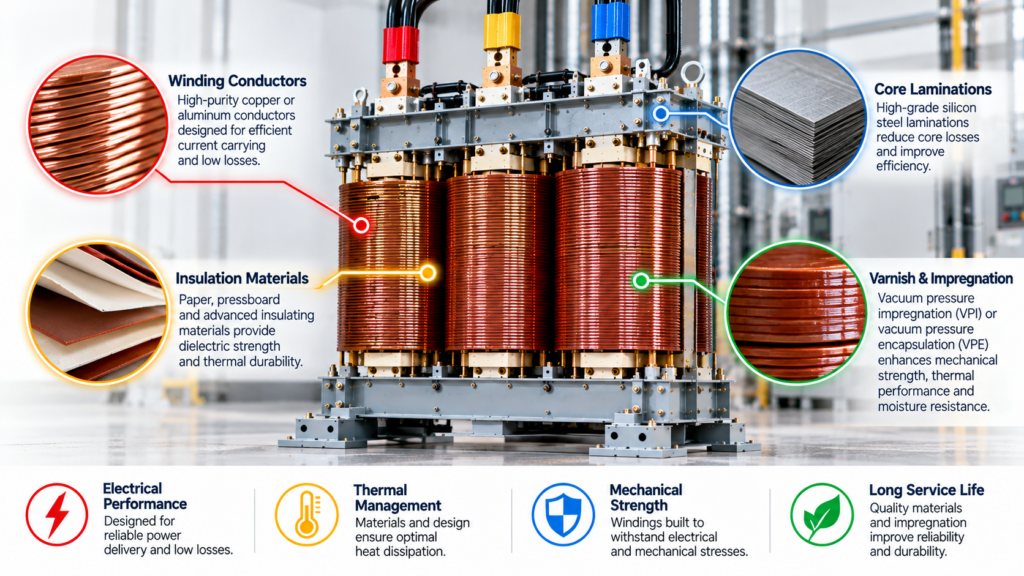
Transformer windings are commonly made from copper or aluminum. Copper has higher electrical conductivity, so it can carry a given current with a smaller cross-sectional area. Aluminum requires more conductor area for comparable performance, but its lower density can reduce winding weight, and its material cost is typically lower.

Neither material is universally better. The larger aluminum conductor affects winding dimensions, clearances, cooling spaces, supports and terminations. Copper may suit restricted spaces or compact designs. Aluminum may suit projects where weight and cost carry more importance. Either can provide reliable service when current density, losses, temperature rise, connections and mechanical support are engineered around it.
Conductor form matters as well. Round wire, rectangular wire, strip, foil and parallel conductors arrange the available conductor area differently. Foil is commonly used on low-voltage, high-current windings because its broad surface can suit the current level, geometry and heat-transfer requirements. Selection depends on voltage, current, insulation build, cooling and short-circuit forces.
Winding Geometry Sets the Electrical Trade-Offs
Primary and secondary windings are commonly arranged concentrically around a core leg, using layers, discs, foil sections or other configurations suited to the rating. Their physical relationship controls magnetic coupling and leakage flux.
Closer coupling generally reduces leakage reactance and percent impedance. This supports better voltage regulation because less voltage is lost internally as load current rises. The trade-off is higher available fault current. Increasing separation generally raises impedance, which limits fault current but can increase voltage drop.
Spacing cannot be selected from the impedance target alone. The design must also provide dielectric clearances, cooling ducts and mechanical support. A change made to improve airflow or insulation distance can also change impedance. Percent impedance is therefore a winding-design result, not simply a catalogue value added later.
Three-phase connection also changes system behaviour. Delta, wye and zig-zag arrangements affect voltage relationships, neutral availability, grounding, phase shift, harmonic paths and zero-sequence behaviour. The correct connection depends on the source, grounding method, load and protection strategy. For a closer look at how each connection affects voltage, grounding, phase shift and system behaviour, read our guide on wye vs. delta, discussing connection choices and what they mean in practice.
Insulation Is Part of the Winding Structure

Winding insulation separates adjacent turns, layers, winding sections, primary and secondary circuits, the core and grounded structural parts. These locations do not experience the same electrical stress. Turn-to-turn voltage may be relatively small during normal operation, while winding-to-ground and winding-to-winding insulation may need to withstand the full system voltage and transient overvoltages.
The insulation system must therefore be coordinated with voltage class, geometry, clearances, transient requirements and manufacturing process. Dry-type construction may use vacuum pressure impregnated (VPI) or vacuum pressure encapsulated (VPE) windings, cast coil windings or other resin-based systems.
Insulation class describes the thermal capability of the complete system. It does not remove the need to control temperature. Ambient conditions, winding rise, hot-spot allowance, loading and cooling must remain coordinated.
Medium-voltage winding design must also control partial discharge. Voids, sharp electrical stress concentrations or inadequate impregnation can allow localized discharge that gradually erodes insulation. Material selection alone does not solve this problem; geometry, processing quality and electric-field control also matter.
Heat Is Produced Unevenly Inside the Winding
Current produces conductor losses commonly expressed as I²R losses. Because these losses increase with the square of current, a modest overload can produce a much larger increase in winding heat. Leakage flux also creates stray and eddy-current losses, and those losses are not distributed uniformly.
The temperature pattern matters more than the average alone. A transformer can have an acceptable average winding temperature while a restricted cooling path or high-loss region creates a local hot spot. That hot spot ages insulation faster and can limit transformer life.
Conductor surface area, winding dimensions, cooling ducts, spacing, enclosure airflow and ambient temperature influence how heat leaves the winding. The winding must be evaluated with the dry-type transformer cooling strategy. Adding cooling space without checking its effect on impedance is as incomplete as reducing losses without providing a clear heat-transfer path.
Short-Circuit Strength Depends on Mechanical Restraint
During a short circuit, current can rise many times above rated value and produce severe radial and axial forces. These forces may expand an outer winding, compress an inner winding, telescope conductors axially or move leads and terminals.
The winding must remain electrically intact while these forces act. Bracing, axial clamping, conductor supports, spacers, controlled tolerances and secure lead connections are therefore part of electrical reliability, not merely mechanical details.
Cast coil transformers gain rigidity from the resin-cast winding assembly. VPI and VPE designs depend more directly on winding construction, impregnation quality, spacers, bracing and clamping. Encapsulated transformers can provide additional protection where moisture, dust or contamination are concerns. Each construction must still be matched to voltage, fault duty, thermal requirements and environment.
Harmonics Change the Winding Loss Pattern
Non-linear loads draw current containing harmonic components rather than only the 60 Hz fundamental. Higher-frequency currents increase winding and stray losses, can produce uneven current distribution and may raise neutral current in four-wire systems. The transformer can therefore run hotter than expected from fundamental-frequency load current alone.
A winding intended for a harmonic-rich system may require lower current density, different conductor geometry, additional thermal capacity, a larger neutral or revised cooling passages. The correct response depends on the harmonic spectrum, load profile and system connection. For a more detailed explanation of harmonic currents, their effects on transformer loading and the applicable power-quality considerations, explore our guide to harmonics in power systems.
The distinction between transformer solutions matters. A K-factor-rated transformer is designed to withstand additional heating associated with specified harmonic loading. It does not remove those harmonics from the system. A harmonic-mitigating transformer uses winding configuration and phase relationships to reduce selected harmonic currents. Selection should follow the actual power-quality objective.
Impedance Must Be Specified Before the Winding Is Built
Transformer percent impedance includes winding resistance and leakage reactance, with leakage reactance usually forming the larger component in distribution and power transformers. Radial spacing, axial height, conductor dimensions, cooling ducts and winding arrangement influence the final value.
Lower impedance generally improves voltage regulation but allows more fault current. Higher impedance limits fault current but can increase voltage drop. The selected value also affects protective-device ratings, coordination, arc-flash calculations, downstream equipment withstand ratings and load sharing in parallel operation.
Once the transformer is built, its internal impedance is effectively fixed. Changing it means changing the winding design or adding external impedance. The system study and transformer specification therefore need to agree before manufacturing begins. For calculations, practical examples and a closer look at how percent impedance affects voltage regulation and available fault current, read Rex Power Magnetics’ complete guide to transformer impedance.
What the Specification Needs to Define
A useful winding specification begins with the application rather than a preferred conductor or construction type. It should establish primary and secondary voltages, frequency, kVA, connection, neutral requirements, insulation level, impedance target, ambient conditions, temperature rise and expected load profile.
It should also identify conditions that change the internal design. Harmonic content, repeated overloads, high available fault current, parallel operation, restricted ventilation, contamination, vibration and unusual altitude or ambient temperature can affect conductor sizing, clearances, cooling and mechanical support.
Copper or aluminum, VPI/VPE, cast coil and encapsulated construction should then be selected in relation to those requirements. Specifying a material or process without describing the duty can lock the manufacturer into a construction that does not address the operating problem.
Long-term performance still depends on the installation. Clean cooling passages, secure connections, suitable protection and operation within intended load and ambient limits help preserve the design assumptions. The relationship between winding temperature, insulation ageing and service life is discussed in our article about the role of design and load in transformer lifespan.
Conclusion
Transformer windings establish the voltage relationship, but their engineering role extends further. Material, conductor form, geometry, insulation, cooling and mechanical restraint together determine losses, impedance, hot-spot temperature, fault withstand strength and reliability.
The trade-offs are connected. Closer coupling can improve regulation while increasing fault current. More insulation or cooling space can change impedance. A conductor material that reduces cost or weight can require additional space. Harmonic duty may require both electrical and thermal changes.
The specification should therefore define the system duty first. Voltage, current, impedance, fault level, harmonics, ambient conditions, connection and loading should drive the winding design. Clear inputs allow the manufacturer to balance electrical, thermal and mechanical requirements instead of optimizing one characteristic at the expense of the complete transformer.