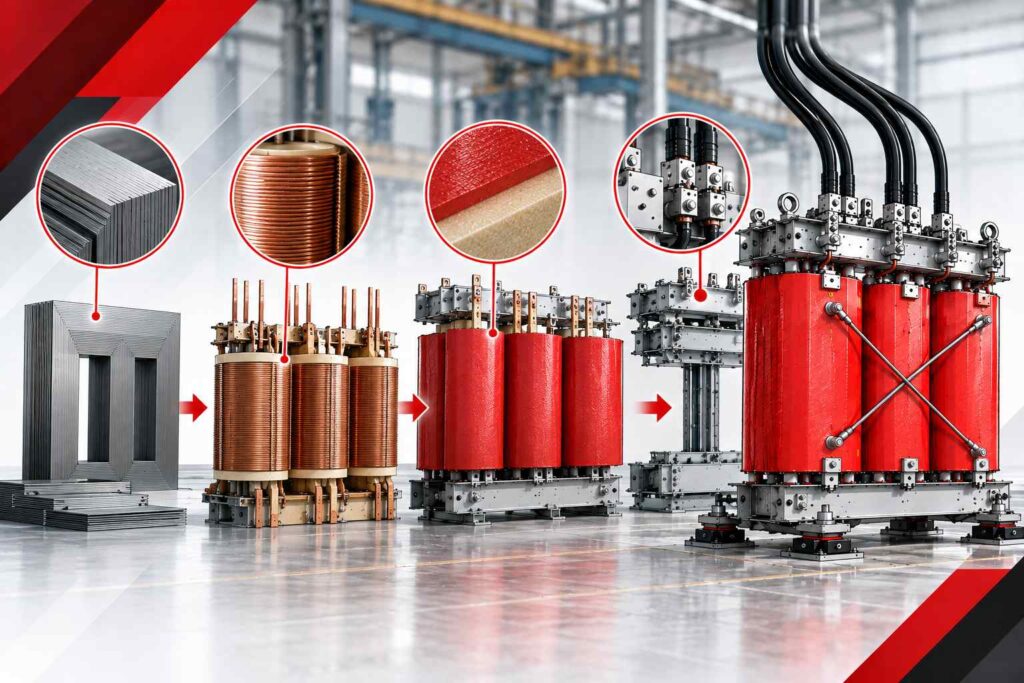
Transformers are fundamental to electrical infrastructure, enabling efficient transmission and controlled distribution of power across virtually every sector. While the operating principle is well understood, the construction of a transformer is often less visible — and significantly more complex than it appears from the outside.
For dry-type transformers in particular, construction is not just a manufacturing process. It is a series of tightly controlled design and assembly decisions that determine thermal performance, mechanical strength, dielectric integrity, and long-term reliability.
This article walks through how a dry-type transformer is built — from core lamination to final test — and how each stage contributes to the performance of the finished unit.
Core Construction: Managing Magnetic Flux
The core provides a low-reluctance path for magnetic flux and is central to efficiency and loss performance. Most power and distribution transformers use laminated steel cores, typically grain-oriented silicon steel. Laminations are stacked rather than solid to reduce eddy current losses, which would otherwise scale with the conductive cross-section.
Core construction involves precision cutting of laminations, stacking in specific geometries (core-type or shell-type), and clamping to maintain mechanical rigidity and minimize vibration. Modern core-cutting techniques such as step-lap mitering and distributed gap cutting reduce magnetizing current, no-load losses, and noise — typically yielding a 5–10% reduction in no-load losses compared to traditional butt-lap construction.
Material selection also drives loss performance. Standard grain-oriented silicon steel (typically M3 or M4 grade) is common for general-purpose units. High-permeability grain-oriented steel (Hi-B grades) reduces no-load losses further. Amorphous metal cores can cut no-load losses by 60–70% compared to silicon steel and are increasingly specified for utility distribution transformers and DOE 2016-compliant designs.
In dry-type transformers, core assembly must also account for vibration and acoustic performance, since there is no oil medium to dampen sound. Core construction technique therefore directly affects the audible noise level of the finished unit.
Winding Construction: Electrical and Mechanical Design
Windings are where electrical energy is transferred, but they are also the most mechanically stressed components during operation and fault conditions. Conductors are typically copper or aluminum, selected based on cost, conductivity, weight, and thermal considerations.
The winding design must balance several competing requirements: electrical insulation between turns and layers, mechanical strength to withstand electromagnetic forces, and thermal pathways for heat dissipation.
Different winding configurations are selected based on voltage class and application:
- Layer windings — most common for low and medium voltage, with conductors wound in concentric layers separated by insulation.
- Disc windings — used for higher voltage applications, providing better impulse voltage distribution and short-circuit strength.
- Foil windings — used for low-voltage, high-current applications, with broad copper or aluminum foil providing excellent surge response and short-circuit strength.
From a construction standpoint, winding involves controlled tension during conductor placement, precise spacing and alignment, and integration of insulation materials between layers. Tension that varies during winding produces uneven layers, which create thermal hotspots and weak points under fault conditions.
Insulation Systems: Defining Dielectric Integrity
Insulation must withstand operating voltage, transient overvoltages, and thermal aging over the life of the unit. In dry-type transformers, three primary insulation approaches are used:
- VPI (Vacuum Pressure Impregnation) — coils are impregnated with polyester or epoxy resin under vacuum and pressure, producing a moisture-resistant winding suitable for most indoor environments.
- VPE (Vacuum Pressure Encapsulation) — similar to VPI but with multiple impregnation cycles, producing a thicker, more robust resin envelope for harsher environments.
- Cast resin — windings are fully encapsulated in epoxy resin within a mold, producing a sealed, void-free winding suitable for the most demanding environmental and dielectric conditions.
Each approach affects moisture resistance, mechanical rigidity, partial discharge performance, and long-term aging behavior.
The full dielectric system extends beyond the impregnation: turn-to-turn insulation, layer insulation, and phase-to-phase and phase-to-ground clearances all contribute. Insulation systems are also classified by thermal capability (Class B, F, H, or N), with Class H (180°C) and Class R (220°C) being typical for modern dry-type designs.
Thermal Design and Cooling
Transformer losses — both core losses and winding losses — are ultimately converted to heat. Managing that heat is a central part of construction.
In dry-type transformers, cooling is achieved through air. AN (air natural) cooling relies on convection and is typical for smaller units. AF (air forced) cooling uses fans to increase heat removal, often providing a 33% capacity increase over the AN rating in the same physical envelope.
Thermal performance is influenced by winding geometry and spacing, ventilation paths through the core and coils, and enclosure design. Unlike liquid-filled transformers, dry-type designs do not benefit from oil as a heat transfer medium, which makes physical layout and airflow management especially important during construction. Hotspot temperature rise — the difference between the hottest point in the winding and the average winding temperature — must be controlled through coil geometry rather than fluid circulation.
Mechanical Structure and Short-Circuit Strength
Mechanical integrity is often underappreciated until a fault occurs. During short circuits, windings are subjected to electromagnetic forces that can reach several hundred times normal operating force, capable of deforming or displacing windings if mechanical design is inadequate.
Construction must therefore include rigid clamping systems, axial and radial support structures, and reinforcement of winding assemblies. These elements maintain geometry under stress, preventing changes in impedance or insulation failure.
In dry-type transformers, mechanical strength is achieved through structural bracing, resin systems (in cast coil designs), and tight assembly tolerances. Short-circuit performance is verified through type testing per IEEE C57.12.90 or IEC 60076-5 — and is as much a function of construction quality as electrical design.
Assembly and Integration
Once core and windings are complete, the transformer is assembled into its final configuration. This includes mounting the core and coil assembly, installing the enclosure, integrating terminals and bus connections, and providing grounding and structural supports.
For dry-type transformers, enclosure selection is integrated at this stage and has direct implications for cooling and environmental protection. Common configurations include ventilated (NEMA 1), non-ventilated (NEMA 2), weatherproof (NEMA 3R), and stainless-steel marine-duty enclosures (NEMA 4X). Enclosure choice affects allowable temperature rise, environmental rating, and audible noise.
Fit and alignment during assembly are critical. Mechanical stress introduced during assembly can persist into service and affect long-term performance.
Testing and Quality Verification
Construction is validated through testing. Routine tests performed on every unit typically include ratio and polarity verification, impedance measurement, no-load and load loss measurement, insulation resistance, applied and induced voltage tests, and partial discharge testing for cast coil and VPI/VPE units.
Type tests — including short-circuit withstand, lightning impulse, and temperature rise — are performed on representative units to validate the design rather than every individual transformer.
Compliance with standards such as IEEE C57, NEMA ST-20, and IEC 60076 provides the framework for these evaluations. Customer-witnessed testing is often available on request and is common for utility, data center, and critical industrial applications.
Conclusion
Transformer construction is a coordinated process that brings together magnetic design, electrical performance, thermal management, and mechanical integrity. Each element — core, windings, insulation, cooling, and structure — contributes to how the transformer performs over its service life.
For dry-type transformers, where cooling and insulation are tied directly to physical construction, these relationships are especially important. A transformer is not defined solely by its ratings, but by how it is built to achieve them.
Rex Power Magnetics is a vertically integrated dry-type transformer manufacturer with in-house enclosure fabrication, powder coat painting, semi-automated coil winding, step-lap mitered and distributed-gap core cutting, resin impregnation, vacuum-pressure epoxy encapsulation, and cast coil manufacturing — all under one roof in Concord, Ontario. Every unit is tested in our CSA-certified on-site facility before it ships. Contact our engineering team to discuss your application.