

Thursday, 6 August 2026
Seismic Certification of Dry-Type Transformers: What the Specification Actually Requires
Seismic requirements show up on transformer specifications constantly, and they're among the most ...
Low Voltage Distribution Transformers

Rex Power Magnetics Drive Isolation Transformers are engineered to provide electrical isolation, harmonic mitigation, and transient protection for variable frequency drive (VFD) applications. These transformers supply clean and balanced power to the drive while protecting both upstream and downstream equipment from voltage disturbances, system transients, and harmonic distortion.
Each transformer is designed with robust magnetic and electrical characteristics to handle the unique stresses associated with VFD operation, including non-linear loads and elevated harmonic content. The optimized winding configuration and low-leakage reactance design minimize voltage distortion and improve drive performance, while high thermal capacity ensures long life under continuous and demanding operating conditions.
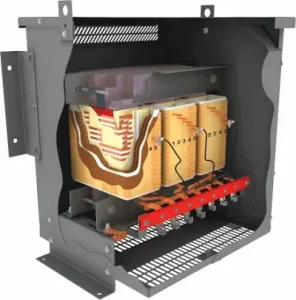
Constructed with premium electrical steel, precision-wound conductors, and durable insulation systems, Rex Drive Isolation Transformers are built for reliability and longevity. Standard and custom designs are available across a wide range of kVA ratings and voltage combinations, all tested to meet or exceed CSA and UL standards — delivering proven protection and performance in every installation.
| Capacity | 5 to 900 kVA |
| Voltage Class | 1.2kV |
| Cooling | Air Cooled (ANN / AN) |
| Frequency | 60Hz (50/60Hz Optional) |
| Conductors | Copper (Cu) or Aluminum (Al) Windings |
| Temperature Rise | 150°C rise (115°C & 80°C Optional) |
| Insulation System | 220°C |
| Impregnation | Polyester Resin Dipped and Baked |
| Efficiency | Meets North American Energy Efficiency Standards:
|
| K-Factor | Suitable for non-sinusoidal current load with a K-factor not to exceed 4 (K9, K13, K20 Optional) |
| Primary Taps | Typically +/-2 x 2.5% taps (refer to dry type distribution transformer catalogue) |
| Sound Level | Meets NEMA ST-20 |
| Enclosure Type | Type 1 or 3R Indoor (refer to catalogue) |
| Enclosure Finish | ANSI/ASA 61 Grey |
| Warranty | 12 Months (See Warranty and Limitations) |
| Quality System | ISO 9001:2015 Quality Management System |
| Certifications |
|
| Reference Standards |
|
| Optional Features & Accessories |
|
Distribution Transformer Catalog (English)
Distribution Transformer Catalog (French)
Maintenance, Operating & Installation Manual (English)
Maintenance, Operating & Installation Manual (French)
Configure a drive isolation transformer (DIT) to build its Rex catalog part number. Codes follow the Rex catalog numbering system.
Drive isolation transformers are exempt from US DOE 2016 efficiency. For use in Canada, select Z3 (NRCan 2019); Z3 may also be chosen voluntarily for higher efficiency.
This tool assembles a catalog part number from the options you select, following the Rex Power Magnetics catalog numbering system. Not every combination of options is necessarily a standard or available product, and some configurations may require review or a custom quote. For a voltage not listed, the code ‘X’ is used and the value specified separately. Rex Power Magnetics makes no representations as to the accuracy of the information generated by this tool; part numbers should be confirmed with Rex before ordering. Contact Rex Power Magnetics to verify availability, pricing, and specifications.
A drive isolation transformer is designed to provide electrical isolation between a power source and a variable frequency drive (VFD) or motor control system. It protects the line and load equipment from harmonics, transients, and common-mode noise generated by solid-state power electronics. The transformer also improves system reliability by mitigating voltage spikes and balancing phase loading. Rex Power Magnetics drive isolation transformers are built for heavy-duty industrial applications where VFDs are used to control motors in pumps, fans, conveyors, and other process equipment.
While both provide electrical isolation, a drive isolation transformer is specifically engineered for the non-linear, harmonic-rich loads associated with VFDs and other power electronic equipment. It features a robust core design with lower flux density, reduced stray losses, and higher thermal capacity to handle harmonic heating. Electrostatic shielding is typically included to block common-mode noise. The windings and insulation system are built to tolerate frequent current pulses and voltage stress from drive operation. This ensures stable performance and long life in demanding drive environments.
VFDs use high-frequency switching that can introduce electrical noise, transients, and ground currents into the power system. An isolation transformer provides galvanic separation between the drive and the utility supply, preventing these disturbances from propagating. It also protects sensitive upstream equipment from reflected harmonics and stabilizes voltage during transient events. Additionally, isolation minimizes the risk of ground loop interference and enhances the overall safety of the drive system. Rex Power Magnetics designs its transformers with low interwinding capacitance and high dielectric strength to achieve excellent isolation performance.
The drive isolation transformer is applied ahead of three families of power converter, and each asks something slightly different of it. A six-pulse diode or SCR VFD front end draws current in two pulses per half-cycle; its spectrum is dominated by the 5th and 7th harmonics and normally lands within the standard K4 capacity once the transformer’s own leakage reactance rounds off the pulses. A DC drive (SCR phase-controlled) draws similar harmonics but adds commutation notches on the supply voltage, so the transformer impedance is also acting as commutation reactance and should be stated on the order. An active front end or regenerative drive draws near-sinusoidal fundamental current but injects switching-frequency ripple and, when braking, pushes power back through the transformer toward the line; the K rating and shielding then matter more than the low-order harmonics. Soft starters present a short-duration SCR load followed by a bypassed linear motor load, so the design is sized for the motor and checked for the starting duty.
Both, but in different proportions than the names suggest. The K4 rating on a Rex drive isolation transformer is a survival rating: it declares that the windings can carry a non-sinusoidal current with a K-factor up to 4 at full nameplate without exceeding the 150°C rise, per IEEE C57.110. The reduction comes from impedance. A six-pulse rectifier with no series impedance draws very peaked current with a total harmonic distortion that can approach the fundamental in magnitude; inserting the transformer’s leakage reactance in series forces the rectifier to conduct over a wider angle, which pulls the 5th and 7th harmonic currents down substantially and lowers the peak current stress on the drive’s DC bus capacitors. The effect is the same mechanism as an AC line reactor of equivalent percent impedance. What the drive isolation transformer does not do is cancel harmonics; the remaining 5th, 7th, 11th and 13th flow through to the primary and onward to the point of common coupling. If the requirement is a specific total demand distortion at the service entrance, a Harmonic Mitigating Transformer with phase-shifted outputs, or a multi-pulse drive front end, is the tool that actually removes them.
A VFD’s inverter switches its DC bus at several kilohertz, and every switching edge produces a common-mode voltage step between the drive’s three output conductors and ground. That common-mode current returns to the source through cable capacitance, motor frame, ground grid and, if nothing blocks it, through the interwinding capacitance of the supply transformer onto the plant bus. The electrostatic shield in a Rex drive isolation transformer is a grounded conductive foil between the primary and secondary coils. Capacitive current from the secondary winding now lands on the shield and flows to ground locally instead of coupling into the primary, so noise-sensitive loads on the same upstream feeder, such as PLC power supplies, instrumentation and communication networks, see far less high-frequency disturbance. The shield is brought out to a terminal and must be bonded to the transformer enclosure ground, which in turn is bonded to the drive’s ground bar with a low-impedance conductor; a long, thin shield ground defeats the purpose at high frequency. Single shielding is standard on drive isolation designs; double or triple shields are available for laboratory, medical or data centre installations. The article How Electrostatic Shields Reduce Transformer Noise illustrates the capacitance paths.
The delta primary blocks the triplen (3rd, 9th, 15th) zero-sequence currents that unbalanced loading on the drive side would otherwise push into the supply, and it also lets the transformer be connected to a three-wire 600 V or 480 V feeder without a neutral. The wye secondary gives the drive a solidly grounded reference: the neutral point of the drive isolation transformer is grounded as a separately derived system, so line-to-ground voltage at the drive terminals is fixed at 277 V on a 480 V secondary, the drive’s internal EMC capacitors and MOV networks sit at their intended voltage, and ground-fault detection on the drive works as designed. This is the arrangement most drive manufacturers assume. A delta or ungrounded secondary is chosen deliberately in two cases:
1. where the process cannot tolerate a trip on the first ground fault and the drive is ordered for an ungrounded or high-resistance-grounded supply with its EMC filter jumpers removed
2. where the transformer feeds a group of drives on a system that is already corner-grounded by plant practice.
In those cases, ground-fault indication must be provided elsewhere. Rex builds either winding arrangement; state the required grounding scheme on the quote. The Wye vs. Delta article covers the trade-offs, and Transformer Grounding and Bonding Explained the code side.
Yes, and it is common in pump galleries, HVAC mechanical rooms and conveyor lines. The design changes in three ways. The current waveform is more peaked when the transformer is lightly loaded, because the series impedance the drives see is smaller relative to their own rating; a 300 kVA drive isolation transformer carrying only two of its five 40 HP drives sees a higher K-factor than the same unit at full load, so the K rating should be selected from the worst realistic loading, not the nameplate sum. The diversity factor must be justified: if all drives can run at full torque together (parallel pumps meeting a peak demand), size for the sum of drive input kVA; if the process guarantees only some run at a time, a smaller unit is defensible but the drive interlocks should enforce it. Finally, secondary protection becomes a feeder problem: each drive’s input fuses or breaker protects its own cable, and the transformer secondary conductor to the distribution point needs its own overcurrent device under the CEC and NEC tap rules.
There is, and it is in what Rex designs for rather than in the option list. A general purpose isolation transformer with the K4 code has its winding eddy-loss controlled so that it can carry a K4 spectrum from a mixed panel without overheating; the design target is a distribution load. A drive isolation transformer is designed around one converter type: the leakage reactance is set with the drive’s rectifier in mind so that the current pulses are usefully softened, the coil bracing assumes repeated starts and pulsed current rather than steady load, an electrostatic shield is part of the standard construction rather than an add-on, and IEEE C57.110 is a listed reference standard on the product. In many ratings the two units may look similar on a nameplate; the difference shows up in service life on a drive that starts twenty times a day, and in how the transformer impedance interacts with the drive. Where a transformer will feed a single drive or a drive group and nothing else, order the drive isolation product. Where it feeds a panel with drives, lighting and receptacles, the general purpose unit with a K rating, or a K-Factor Rated Transformer, is the better match.
Unless designed for special service conditions / environments, below are the standard service conditions for dry type distribution transformers:
To ensure proper operation, avoid installing transformers in environments with excessive moisture, extreme temperatures, or direct sunlight. Maintain recommended clearances and keep all ventilation panels unobstructed.
Temperature rise refers to average increase of temperature of the transformer windings at full load above the ambient temperature. when operating at full load. In addition to the average temperature rise of the windings, transformers also experience a “hot spot” temperature, which refers to the highest temperature point in the windings.
For example, a transformer with a 220°C insulation system may be designed with a 150°C average temperature rise and a 30°C hot spot allowance. This means that Above a 40C ambient, the total absolute temperature will not exceed 220°C. Transformers with lower temperature insulation systems (180°C or 200°C) will be designed with lower temperature rises (115° or 130°C) and hot spots so they can be installed in the same ambient temperature and still not exceed the temperature rating of the insulation system.
The table below shows the maximum average winding temperature rise, maximum hot spot temperature rise and maximum winding temperature for the most common insulation classes. Note that these are based on a max average ambient of 30°C during any 24-hour period and a maximum ambient of 40°C at any time.
| Insulation Class | Insulation Class | Average Winding Temperature Rise |
Hot Spot Temperature Rise |
Maximum Winding Temperature |
| Class 180 | F | 115°C | 145°C | 180°C |
| Class 200 | N | 130°C | 160°C | 200°C |
| Class 220 | H | 150°C | 180°C | 220°C |
Customers occasionally specify a transformer of a particular insulation class to be designed with an average temperature rise below the average temperature rise values shown in the table above. The benefits of doing so include:
Rex Power Magnetics’ ventilated distribution transformer terminals are rated 90°C. Conductors with at least a 90°C insulation rating at or below their 90°C ampacity rating should be utilized.
Each transformer uses high-grade silicon steel cores, precision-wound copper or aluminum conductors, and a polyester resin–dipped core and coil assembly for enhanced mechanical strength, insulation integrity, and moisture resistance. The resin coating helps secure windings against vibration caused by pulsed drive currents. Electrostatic shields between windings minimize common-mode noise transfer. The combination of thermal-resistant insulation and robust mechanical design ensures long service life even under high harmonic and cyclic loading conditions.
The kVA range translates to drive size through the drive input current. At the bottom of the range, a 5 kVA drive isolation transformer delivers 6 A at 480 V, enough for a 3 HP drive with margin, or a 5 HP drive with careful checking of the manufacturer’s input current. At the top, 900 kVA delivers 900,000 ÷ (1.732 × 480) = 1,083 A at 480 V, or 866 A at 600 V, which covers drives in the 800 to 900 HP class at 480 V and roughly 900 to 1,000 HP at 600 V, depending on the drive’s input kVA and whether it has a DC bus choke. Between those limits the standard kVA steps follow the Distribution Transformer Catalog; intermediate ratings are available as custom designs. Two boundaries should be respected. Above 900 kVA, or for drives whose input is at 2.4 kV or 4.16 kV, the application moves to a drive-duty design in the VPI/VPE power transformer range. And in a single-drive application, the transformer rating should stay close to the drive input kVA rather than being oversized by a wide margin, because a lightly loaded drive isolation transformer sees a more peaked current and provides less effective impedance.
Percent impedance on a transformer and on a reactor mean the same thing: the voltage drop across the device at rated current, expressed as a percentage of rated voltage. A drive isolation transformer with 5 percent impedance therefore gives a drive rated at the transformer’s full output the same harmonic-softening series reactance as a 5 percent AC line reactor. The catch is that the percentage is referenced to the transformer rating, not the drive rating. Worked example: a 150 kVA transformer at 5 percent impedance feeding a single drive drawing 120 kVA presents an effective impedance of 5 × (120 ÷ 150) = 4 percent to that drive; if the same transformer feeds a 60 kVA drive, the effective value drops to 2 percent, which is on the low side for harmonic reduction and DC bus protection. Rex does not publish one impedance for the whole range because it depends on kVA, ratio, conductor and shielding, but a specific value can be designed to and appears on the nameplate and test report. Specify it when a coordination study needs a fault-current figure, when the drive manufacturer states a minimum source impedance, or when a DC drive needs a defined commutation reactance. The Transformer Impedance article and the Line Reactors vs. Transient Filters explainer give the background.
The K rating and the temperature rise address heat from different directions. The K4 standard rating (or K9, K13, K20 optional) on a Rex drive isolation transformer means the winding eddy-current loss has been designed so that the stated harmonic spectrum at full load produces no more than the nameplate rise; a K rating is not spare thermal capacity, it is the assumption behind the rise. The rise itself is the margin below the 220°C insulation limit: at 150°C rise, full load in a 40°C peak ambient with the 30°C hot-spot allowance uses the whole limit; at 115°C rise there is roughly 35°C of headroom and at 80°C rise about 70°C. That headroom is what the product page calls high thermal capacity, and on a drive it is spent in three ways: absorbing a spectrum that is somewhat worse than assumed (for example a drive that later loses its DC bus choke or is joined by a second drive), riding through overload from a drive running above nameplate on a hot day, and extending life under continuous cyclic loading such as a conveyor that starts and stops all shift. A 115°C-rise unit is the usual compromise for a drive that runs continuously at rated torque; 80°C is chosen where the transformer must outlive several generations of drive. Rex’s Transformer Insulation Classes article and the Power Quality industry page provide context.
The product is a 1.2 kV class design, so any primary and secondary at 600 V and below can be built, and the common Canadian and U.S. combinations are stocked designs: 600 V to 480 V for 460 V-rated drives on a 600 V Ontario service, 600 V to 600 V and 480 V to 480 V one-to-one units where only isolation and impedance are needed, 480 V to 600 V for 575 V drives on a 480 V supply, and 600 V or 480 V to 208 V or 240 V for small drives and DC drives. Order the secondary at the nominal system voltage, not the motor or drive nameplate voltage: a 460 V drive is designed for a 480 V nominal system in the same way a 575 V drive is designed for a 600 V system, and the drive tolerances (typically plus or minus 10 percent) are built around that nominal. Ordering a 460 V secondary would run the drive 4 percent low before transformer regulation is accounted for. Non-standard values, for example 380 V for European drive packages, or a 50/60 Hz rating for export machinery, are specified through the Product Configurator, which is where drive isolation transformers are configured; the Part Number Builder covers the general purpose and K-factor families. The Transformer Turns Ratio article shows the ratio arithmetic.
Two inrush events happen in a drive lineup and they should be kept separate. The first is transformer magnetizing inrush when the primary breaker closes: depending on residual flux and the point on the voltage wave, the core saturates and the first half-cycle of current can reach many times rated, decaying over several cycles. Rex drive isolation transformers run at a reduced flux density, which tends to keep the multiple toward the lower end of what a low-loss general purpose core produces, but the primary protection must still be chosen to ride through it. Worked example: a 112.5 kVA, 600 V unit has a rated primary current of 108 A; a first-cycle inrush of ten times rated is about 1,080 A, which a 150 A time-delay fuse or a breaker with an instantaneous setting above that level will clear without tripping. The second event is the drive’s DC bus capacitor charge, which occurs when the drive is powered, is limited by the drive’s own precharge resistor or SCR ramp, and is normally well below the transformer inrush; it does, however, add a step of load a few cycles later. Energize the transformer with the drive disconnected or in a de-energized state on first commissioning so the two events can be observed separately. Rex’s Transformer Inrush Current Explained covers the mechanism and mitigation.
Any transformer which is not installed and energized immediately should be stored in a dry, clean space having a uniform temperature to prevent condensation on the windings. Dry type transformers with resin dipped or epoxy vacuum impregnated coils can be stored at ambient temperatures as low as -50C. Transformers with encapsulated or epoxy cast coils should not be stored at ambient temperatures below -20C to prevent cracking of the epoxy. Preferably, transformers should be stored in a heated building having adequate air circulation and protected from cement, plaster, paint, dirt, and water or other gases, powders, and dust. The floor on which the transformer is being stored should be resistant to the upward migration of water vapor. Precautions should be taken to prevent storage in an area that water could be present, such as roof leaks, windows, etc. Condensation or absorption of moisture can be greatly reduced by keeping the transformer enclosure 5⁰C-10⁰C above ambient temperature. This can be easily achieved by the installation and energization of space heaters (optional). If the transformer is not furnished with internal space heaters, then external, portable heaters can be used. Note: Lamps or heaters should never come in direct contact with the transformer coil insulation.
It is not advisable to store a dry type transformer outdoors, but in the case that it is unavoidable, protective measures should be taken to prevent moisture and foreign debris from entering the transformer enclosure. The plastic wrapping supplied during shipment should be left in place, and a suitable drying agent such as silica gel packs should be used. The unit should also be checked periodically for indications of condensation on the windings, coil support blocks, core, core clamping system and bus/cables.
In dry-type transformers, the surrounding air plays a critical role in their operation. Generally, low ambient temperatures do not negatively impact an energized transformer, as the no-load losses typically generate enough heat to maintain proper conditions, even in environments as cold as -30°C. However, transformers stored at low temperatures present two primary concerns:
Rex Power Magnetics recommends testing transformers (megger testing), warming them to above 0°C, or following a drying-out procedure if moisture is suspected. Refer to Rex Power Magnetics’ cold start procedures to ensure safe energization in cold conditions. Energizing a transformer with compromised insulation due to moisture can cause damage and potential safety hazards.
The minimum required clearances of a dry type transformer to walls, floors or other equipment must adhere to the local electrical code requirements.
In the absence of such requirements, Rex Power Magnetics recommends that dry type transformers be mounted so that there is an air space of no less than 150mm (6”) between the enclosures, and between the enclosure and any adjacent surface except floors. When the adjacent surface is a combustible material, the minimum permissible separation between the transformer enclosure and the adjacent surface should be 300mm (12”). Where the adjacent surface is the wall on which the transformer is mounted, the minimum permissible separation between the enclosure and the mounting wall should be 6mm (0.25”) so long as the surface is of a non-combustible material.
Drive isolation transformers are used in systems that employ VFDs, DC drives, or soft starters. Common applications include industrial motors in HVAC systems, compressors, pumps, extruders, and conveyors. They are also used in water treatment plants, refineries, and manufacturing facilities to protect both upstream and downstream electrical equipment. Rex Power Magnetics designs these transformers to operate reliably under the high harmonic conditions typically associated with multi-motor or high-power drive installations.
The conventional order is: primary disconnect and overcurrent device, drive isolation transformer, secondary overcurrent device where required, drive input fuses or breaker, the VFD, any output reactor or motor guarding transient filter, and the motor. The transformer is a supply-side device and there is no electrical reason for it to be within a set distance of the drive; the constraints are practical. Keep the secondary run short enough that the voltage drop at drive input current, added to the transformer’s regulation, stays inside the drive’s input tolerance, and route the secondary conductors and the shield-to-drive ground bond together so the common-mode return path has low impedance. Locating the transformer in the electrical room beside the drive MCC is normal; locating it at the remote motor is wrong, because the drive output, not the input, is what needs to be near the motor. Maintain Rex’s recommended 150 mm (6 in) air space around the enclosure, 300 mm (12 in) from combustible surfaces and 6 mm (0.25 in) from a non-combustible mounting wall, and ensure the room ventilation removes the transformer losses and the drive losses together, since both are rejected into the same space. The Transformer Clearance Requirements article and the Enclosure Drawings page give the dimensional inputs.
A wye secondary on a drive isolation transformer is a separately derived system under both the CEC and NEC: bond the neutral point to the enclosure with a system bonding jumper at the transformer, connect a grounding electrode conductor to the building electrode system, and bond the electrostatic shield terminal to the same enclosure ground. If the drive is fed three-wire, the neutral is still grounded even though no neutral conductor leaves the transformer. Do not ground the neutral a second time at the drive. The drive side then needs a matching decision. Most VFDs contain a common-mode EMC filter whose capacitors connect line to ground; with a solidly grounded wye secondary they should be left connected, because they now have a defined reference and the transformer shield keeps their noise off the plant bus. If the secondary is deliberately ungrounded or high-resistance grounded, those capacitors must be disconnected per the drive manual, otherwise they see full line-to-line voltage during a ground fault and fail. Bring the drive ground, motor cable shield and transformer enclosure ground to a common bar with short, wide conductors; this single detail resolves most bearing-current and instrumentation-noise complaints on new drive installations. Rex’s Transformer Grounding: Understanding the Importance and the 3-Phase Transformer Wiring guide show the connection diagrams.
The core product is the same; the options change. In mining, drive isolation transformers feed conveyor, crusher and ventilation fan drives, often at altitude above 1,000 m (which requires derating or a lower rise) and in dusty air, so Type 12 or Type 4 enclosures, anti-condensation and strip heaters are typical additions, along with 600 V primaries. Water and wastewater plants specify them for pump and blower drives, usually with 3R or 4X enclosures where the transformer is outside the electrical room, and with surge protection devices where the feeder is exposed. Data centres use them on chiller, CRAH and pump drives where common-mode noise on the mechanical bus must be kept away from the IT distribution, favouring double shields and 80°C or 115°C rise for life. Marine duty installations add stainless enclosures, anti-vibration pads and often 50/60 Hz capability. Temporary power skids for construction dewatering pumps use 3R enclosures on a rental drive package. HVAC and manufacturing plants generally take the standard Type 1 unit with a K4 rating. In every case Rex needs the drive model, ambient, altitude and enclosure environment; the Product Configurator captures these fields.
Yes. Open core and coil construction, without a Rex enclosure, is available so the drive isolation transformer can be installed inside a panel builder’s drive cabinet, an MCC section or a packaged pump skid. The design assumptions then transfer to the integrator. Rex’s temperature rise is based on a 30°C average and 40°C maximum ambient at the transformer, so the air inside the cabinet, not the room, is the ambient; a drive section that already runs 15°C above the room is effectively a 55°C ambient and requires either a 115°C-rise core and coil or forced ventilation. Provide inlet below and outlet above the core and coil with an unobstructed path through the coil ducts, keep the cabinet’s own filters clean, and do not mount the core and coil directly above the drive’s heat-sink exhaust. Mount it on the enclosure floor or a rigid shelf using the core clamp holes, with anti-vibration pads if the enclosure is steel and the room is noise-sensitive. Terminals on the core and coil are still rated 90°C, and the shield lead must be landed on the cabinet ground bar. Because the CSA and UL listing covers the transformer, the assembled cabinet is certified by the panel builder under its own shop program.
Rex offers three levels of temperature monitoring on the drive isolation transformer: analog or digital thermometers for local indication, thermal sensing and indication with a winding-embedded sensor, and thermostat alarm and trip contacts (N.O. and N.C.) set at two temperature levels. The alarm level is intended to warn before the winding approaches the insulation limit and the trip level to act before damage. The most effective integration uses both. Wire the alarm contact to a PLC or building management input so the operator sees a transformer over-temperature warning with the drive still running, which is usually enough time to shed load or find a blocked louvre. Wire the trip contact to the drive’s external fault or run-permissive input rather than to a shunt trip on the primary breaker, so the drive decelerates the motor under control and stops drawing current, and the transformer cools without being disconnected from the supply and losing its strip heaters. Use a shunt trip on the primary device only where the process can tolerate an uncontrolled stop. Run the contact wiring in a separate conduit from the drive output cables to avoid noise-induced false alarms. In data centre mechanical plant, the alarm is typically mapped to the BMS with the drive’s own thermal alarms. The Transformer Failures article explains why early thermal warning matters most for harmonic-loaded units.
The life expectancy of a dry-type transformer is primarily determined by the insulation system and the operating temperature. According to IEEE Std. C57.96, the deterioration of insulation is directly related to the time and temperature the transformer experiences during operation. Insulation materials degrade faster at higher temperatures, so the transformer’s life expectancy is closely tied to how well it is kept within its design temperature limits.
In most transformers, the highest temperature occurs at a specific point in the windings, known as the hot spot. This area undergoes the most significant wear over time, making it the primary factor in determining the transformer’s ageing process.
All of Rex Power Magnetics’ dry-type transformers are designed using UL-listed insulation systems with a maximum hot spot temperature that ensures a design life of at least 30 years under standard operating conditions (continuous rated load, typical ambient temperatures, and no sustained overloads). Transformers designed with reduced temperature rise can extend this design life expectancy to over 50 years, as operating at lower temperatures slows the insulation’s ageing process.
Factors That Affect Life Expectancy:
By following proper installation and maintenance practices, such as avoiding overloading and ensuring the transformer operates within its designed ambient temperature, you can significantly extend its lifespan. Rex Power Magnetics’ high-quality transformers are built for durability, ensuring reliable performance for decades under standard conditions.
Yes. Rex Power Magnetics specializes in custom drive isolation transformer designs. Customers can specify voltage ratios, kVA ratings, temperature rise, impedance levels, and harmonic performance targets. Additional options include electrostatic shielding, thermal sensors, custom enclosures, and non-standard tap arrangements. Engineering teams work directly with OEMs, system integrators, and end users to ensure each unit is optimized for its specific drive and load conditions. Every custom transformer is tested to the same stringent standards as standard models, ensuring reliable and repeatable performance.
Electrically it will run the drive; whether it is acceptable depends on grounding and noise. An autotransformer transforms only the 120 V difference between 600 V and 480 V, so it is much smaller and lighter than a drive isolation transformer of the same load rating. But its output is not a separately derived system: the 480 V side is grounded however the 600 V side is grounded, which on many Ontario plants means a 600Y/347 V solidly grounded wye and a 480 V output whose line-to-ground voltage is set by the supply, not by a neutral of its own. The drive’s EMC filter, MOV and ground-fault detection then see a voltage they were not designed around, and the drive manufacturer’s approval should be obtained. The autotransformer also provides no electrostatic barrier, so the drive’s common-mode switching noise flows directly onto the 600 V bus, and no defined series impedance for harmonic reduction unless a line reactor is added. Where the supply is a clean, solidly grounded system, the drive is the only load, and cost or footprint is decisive, an autotransformer with a line reactor is a legitimate package. Where the supply is high-resistance grounded, where several drives share the transformer, or where instrumentation shares the bus, the drive isolation transformer is the correct product. The Autotransformer vs. Isolation Transformer article compares them in depth.
Below 150 kVA there is a genuine choice; above it the drive isolation transformer in a protective enclosure is the only ventilated-family option. A Rex encapsulated transformer seals the core and coil in a solid block, uses a 200°C insulation system at 130°C rise, is limited to 150 kVA three-phase, and can be ordered with K4 to K20 ratings and an electrostatic shield, so a 45 kVA encapsulated unit with K4 and a single shield will feed a 40 HP washdown pump drive and resist spray, chlorides and condensation for its whole life. What it lacks is the drive-specific design intent: its impedance is not chosen around a rectifier front end. The drive isolation transformer in a Type 4X stainless enclosure keeps the drive-duty magnetic design, the 900 kVA reach and the full option list, at the cost of a larger frame (a non-ventilated enclosure around a ventilated coil needs a derated or lower-rise design) and a dependence on strip heaters to keep condensation off the coil. For food processing or wastewater drives under 100 HP, the encapsulated unit with a K rating is often the more robust answer; for larger drives, or where the drive manufacturer specifies source impedance, choose the drive isolation transformer with the appropriate enclosure. Rex’s Types of Transformers guide sets out the constructions side by side.
Against transients, largely yes; against sags, no. Capacitor-switching transients from the utility, lightning-induced surges on an exposed feeder and switching surges from large motors on the same bus arrive at the drive as fast voltage steps. The leakage reactance of a drive isolation transformer slows the rate of rise and reduces the peak that reaches the drive’s DC bus capacitors, and the electrostatic shield diverts the common-mode part of the surge to ground, which is why drive nuisance overvoltage trips on capacitor-bank switching often disappear once a transformer is installed. For a direct lightning-level surge, the transformer alone is not enough; specify the surge protection device option on the transformer or an SPD at the drive input, and consider an R.C. snubber where vacuum switching upstream is known to produce steep transients. Voltage sags are the opposite case: a transformer cannot create voltage that is missing at its primary, and its own regulation adds a further percent or two of drop at full load. Sag ride-through is a drive function, set through DC bus undervoltage and flying-restart parameters, and where the process cannot tolerate it the answer is a drive with extended ride-through or an energy storage interface rather than a larger transformer. Rex’s Lightning and Surge Protection for Transformers article and the RC Snubbers article describe the protection chain.
Regulation is the drop from no-load to full-load secondary voltage and depends on the transformer’s resistance, reactance and the load power factor. On a drive isolation transformer designed for a few percent impedance, the regulation at rated drive load is typically in the 2 to 4 percent range; the exact value for a given design is on the test report and can be requested from Rex. Worked example: a 600 V to 480 V unit at 3 percent regulation, on a supply that sits at nominal, delivers about 466 V to the drive at full load, a DC bus of about 629 V, and a maximum motor voltage that is a few percent below 460 V at full speed. That is inside the drive’s tolerance and the motor’s plus or minus 10 percent, but if the supply also runs low and the drive is expected to deliver rated torque at rated speed continuously, move the primary to the −2.5 percent tap to restore the secondary. The drive cannot produce more output voltage than its DC bus allows, so the transformer secondary is the ceiling on motor voltage at full speed; drop on long motor leads is addressed on the output side, not through the transformer.
Both are offered on Rex drive isolation transformers, both are designed to the same rise, K rating, impedance and listing, and for a drive that runs steadily at a pump or fan either performs identically. The application that separates them is one with frequent starts and load swings: a conveyor that starts and stops every few minutes, a hoist with regenerative cycles, or a crusher with heavy load surges. Each cycle expands and contracts the winding and its connections, and copper’s higher strength and lower thermal expansion make the joints, leads and tap connections more resistant to relaxation over years of cycling. Copper also gives a smaller coil for the same loss, which can matter when a core and coil must fit inside a drive cabinet. Aluminum windings produce a larger but lighter transformer at the same rating, which is often preferred for wall-mounted units and where the drive duty is continuous rather than cyclic. Aluminum-wound units from Rex use lugs and terminations rated for the winding material, so the choice of building conductor is not dictated by the winding; use 90°C-rated conductors in either case to match the terminal rating. State the duty (starts per hour, regenerative or not) on the quote request and Rex will recommend the conductor; the Transformer Windings Explained article describes the construction differences.
The likely cause is the primary device’s instantaneous element operating on magnetizing inrush, not a transformer fault. On a drive isolation transformer energized at the worst point on the voltage wave with unfavourable residual flux, the first half-cycle current can be many times rated, and a thermal-magnetic breaker whose instantaneous setting is at or near the low end of its range will see it as a short circuit. The fix is to raise the instantaneous setting on an adjustable breaker, replace a fixed-trip breaker with a device sized under the 250 percent primary rule where secondary protection exists, or use a time-delay fuse. Two other sequencing issues produce the same symptom. If the drive is left connected and its DC bus capacitors are discharged, the drive’s precharge adds load a few cycles after the transformer inrush; on some drives with a contactor bypass around the precharge that has failed closed, the capacitor charge is uncontrolled and looks like a bolted fault. Energize the transformer alone first, then the drive. If tripping happens only after a cold overnight shutdown, megger the windings before re-energizing and follow the Transformer Cold Start Procedure; a genuine insulation fault will show as a low reading, whereas inrush tripping will not. Rex’s Transformer Inrush Current Explained article sets out the mitigation options.
Work through the causes in order of likelihood. Confirm the actual load and its waveform with a true-rms clamp meter and, if available, a harmonic analyzer at the secondary; a drive isolation transformer rated K4 that is now carrying a K9 or K13 spectrum, because a DC bus choke was removed, a second drive was added, or the drive is running lightly loaded most of the day, will run hot at a current well below nameplate. Check the ambient at the enclosure, not the room thermostat; Rex’s rating is based on a 30°C average and 40°C peak, and a transformer boxed in beside drive heat sinks can see 50°C. Check that louvres and coil ducts are clear of dust, that the 150 mm (6 in) clearance is maintained, and that nothing has been stored against the enclosure. Verify the tap: a unit on the −5 percent tap draws proportionally higher primary current for the same output. Scan the terminals and tap board for a hot joint, and compare secondary voltage across phases, since an unbalanced supply overloads one coil. If the load spectrum is the cause, the remedies are a line reactor or DC choke on the drive, reduced loading, or replacement with a K9 or K13 unit, which Rex can quote from the original order details. The Transformer Maintenance checklist covers the routine inspection.
All Rex dry-type transformers meet the NEMA ST-20 sound levels, which are defined for sinusoidal excitation at rated voltage. A drive isolation transformer in service, however, carries the six-pulse rectifier’s harmonic current, and the associated harmonic flux adds magnetostriction components at 360 Hz and higher multiples on top of the 120 Hz fundamental hum, which is more audible and more penetrating. A drive running at light load, where the current is most peaked, can be noisier than the same transformer at full load. Practical reductions, in order: keep the transformer matched to the drive rather than oversized, so the effective impedance rounds off the current pulses; add a DC bus choke or line reactor on the drive if the transformer is far larger than the drive; install the enclosure on the optional anti-vibration pads and avoid rigid conduit as the only mechanical connection so the enclosure does not become a sounding board; and confirm the primary is not on a tap that overexcites the core (for example, a −5 percent tap with the supply at nominal). Where a specification requires a lower level than ST-20, Rex can design a lower flux-density unit at some increase in size. The Why Do Transformers Hum article explains the magnetostriction mechanism and the effect of harmonics.
These faults almost always trace to grounding or tap choices rather than to the transformer itself. A drive ground-fault trip on first energization usually means the secondary of the drive isolation transformer was left ungrounded while the drive’s EMC filter capacitors remain connected, or the neutral was grounded both at the transformer and at the drive so that neutral or shield current circulates through the drive’s ground-current sensor. Ground the wye neutral once at the transformer, bond the electrostatic shield to the enclosure, and leave the drive’s filter jumpers as the manual specifies for a solidly grounded supply. A persistent DC bus overvoltage fault at no load indicates the secondary is high: check the measured primary voltage against the tap in use and move the primary to the +2.5 or +5 percent tap so the no-load secondary sits at or slightly below nominal, remembering that regeneration on a braking drive raises the bus further. An overvoltage fault only during deceleration is a drive braking issue, not the transformer. Also check phase rotation on the secondary; an isolation transformer does not change it, but a delta-wye connection introduces a 30° phase displacement, which matters only if the drive is synchronized to another source or bypassed across the line. Rex’s Transformer Commissioning article lists the pre-energization checks that catch these issues, and the Transformer Polarity Explained article covers the displacement.
Beyond the standard dry-type checks, a drive isolation transformer has a short list of drive-related items:
• Megger the windings to ground and between windings before energization, and warm or dry the unit per the cold start procedure if it has been stored below 0°C or in damp conditions.
• Confirm the tap connection matches the measured supply voltage, and record it on the drive commissioning sheet.
• Verify the electrostatic shield lead is landed on the enclosure ground and that the enclosure, drive ground bar and motor cable shield share a common bonding point.
• Check that the wye neutral is bonded once, at the transformer, with the system bonding jumper and grounding electrode conductor sized to the secondary conductors.
• Torque all terminals to the values in the installation manual; 90°C-rated conductors must be used.
• Wire the thermostat alarm and trip contacts to the drive’s external fault input or to the PLC, and test them.
• Energize the transformer with the drive isolated, check secondary voltage and phase sequence, then close to the drive and observe its precharge.
Record no-load secondary voltage, tap position and the transformer nameplate data with the drive parameters so a future technician can reconstruct the setup. The Rex Maintenance, Operating and Installation Manual and the Transformer Commissioning article contain the full procedure.
Thursday, 6 August 2026
Seismic requirements show up on transformer specifications constantly, and they're among the most ...
Friday, 17 April 2026
As electrical systems incorporate increasing levels of power electronics and sensitive digital equipment, ...
Thursday, 19 March 2026
Variable Frequency Drives (VFDs) are widely used in modern industrial and commercial power ...