

Friday, 20 February 2026
Low-Ambient Temperature Considerations for Dry-Type Transformers
Dry-type transformers are frequently installed in regions where ambient temperatures may fall to ...
Low Voltage Distribution Transformers

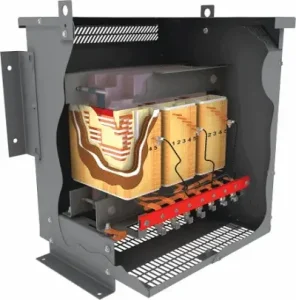
Rex Power Magnetics Encapsulated Transformers are designed to provide reliable voltage transformation and electrical isolation in environments exposed to moisture, dust, and other airborne contaminants. Each unit’s core and coil assembly is fully encapsulated in a high-quality epoxy resin, forming a solid, moisture-resistant mass that protects internal components from harsh operating conditions and mechanical stress.
These transformers are ideal for indoor and outdoor installations where environmental protection and long-term reliability are critical. The encapsulation process enhances dielectric strength, prevents corrosion, and dampens vibration, ensuring consistent performance over years of service.
Rex encapsulated transformers are available in both single-phase and three-phase configurations, covering a broad range of kVA ratings and voltage combinations. Built to meet or exceed CSA and UL standards, they provide excellent voltage regulation, low losses, and quiet operation.
With proven design experience and precision manufacturing, Rex Power Magnetics delivers encapsulated transformers that combine durability, safety, and efficiency — ensuring dependable performance in demanding industrial, commercial, and institutional applications.
| Capacity |
|
| Voltage Class | 600V |
| Cooling | Self Cooled (ANC) |
| Frequency | 60Hz (50/60Hz Optional) |
| Conductors | Copper (Cu) or Aluminum (Al) Windings |
| Temperature Rise | 130°C rise (115°C & 80°C Optional) |
| Insulation System | 200°C |
| Impregnation | Core & Coil Are Encapsulated In a Block of Polyurethane and Silica Sand |
| Primary Taps | Typically +/-2 x 2.5% taps (Refer To Dry Type Distribution Transformer Catalog) |
| Sound Level | Meets NEMA ST-20 |
| Enclosure Type | Type 3R Indoor/Outdoor (Type 4 or 4X Optional) |
| Enclosure Finish | ANSI/ASA 61 Grey |
| Warranty | 12 Months (See Warranty and Limitations) |
| Quality System | ISO 9001:2015 Quality Management System |
| Certifications |
|
| Reference Standards |
|
| Optional Features & Accessories |
|
Distribution Transformer Catalog (English)
Distribution Transformer Catalog (French)
Maintenance, Operating & Installation Manual (English)
Maintenance, Operating & Installation Manual (French)
Configure an encapsulated transformer to build its Rex catalog part number. Codes follow the Rex catalog numbering system.
Encapsulated transformers are exempt from DOE and NRCan efficiency requirements.
This tool assembles a catalog part number from the options you select, following the Rex Power Magnetics catalog numbering system. Not every combination of options is necessarily a standard or available product, and some configurations may require review or a custom quote. For a voltage not listed, the code ‘X’ is used and the value specified separately. Rex Power Magnetics makes no representations as to the accuracy of the information generated by this tool; part numbers should be confirmed with Rex before ordering. Contact Rex Power Magnetics to verify availability, pricing, and specifications.
An encapsulated transformer is a dry-type transformer in which the core and coils are completely enclosed in a protective epoxy or resin compound. This encapsulation seals the electrical components from moisture, dust, and other environmental contaminants. The result is a durable, low-maintenance transformer that provides reliable performance in harsh or corrosive environments. Rex Power Magnetics encapsulated transformers are ideal for outdoor installations, marine applications, and industrial sites where airborne contaminants or high humidity could affect standard dry-type designs.
In resin-dipped transformers, the core and coils are coated with a protective film, but air remains within the winding spaces. In an encapsulated transformer, the coils are completely embedded in epoxy or resin, eliminating air pockets and forming a solid, sealed mass. This provides superior protection against moisture ingress, mechanical vibration, and corrosive atmospheres. Encapsulation also increases dielectric strength and reduces noise. Rex Power Magnetics employs high-quality encapsulating materials designed for excellent thermal conductivity and long service life.
Encapsulated transformers offer exceptional protection from environmental conditions that can cause electrical or mechanical degradation. The resin enclosure prevents dust, oil, and corrosive vapors from reaching the coils, allowing installation in wash-down areas, chemical plants, and outdoor enclosures. They are quieter than open-type designs, require minimal maintenance, and resist damage from vibration and shock. Because of their sealed construction, they can be installed close to the load without requiring additional environmental protection or ventilation systems.
A Rex Encapsulated Transformer uses a polyurethane and silica sand compound to seal the core and windings into a solid block. This construction protects the electrical insulation against moisture, salt mist, dust, and other contaminants while securing the conductors against vibration and electromagnetic forces.
The silica sand improves the compound’s thermal conductivity and helps control expansion and contraction during temperature changes. Because the transformer is self-cooled and non-ventilated (ANC), heat generated in the windings must pass through the encapsulated block to the enclosure and surrounding air.
This construction makes encapsulated transformers suitable for outdoor, washdown, and contaminated industrial environments where exposed windings would require additional protection. See How Transformers Are Constructed for more information.
Yes. Rex encapsulated transformers are a two-winding design with a physically separate primary and secondary, providing full galvanic isolation and its secondary can be grounded as a separately derived system exactly as a general purpose isolation transformer would be. The difference between the two products is construction and cooling, not circuit topology. The encapsulated unit uses a 200°C insulation system at 130°C rise inside a cast block, while the general purpose unit uses a 220°C system at 150°C rise with a ventilated, resin-dipped coil.
For instrumentation and communications loads in outdoor or wet locations, the same electrostatic shield options (single, double or triple, codes S1, S2 and S3 in the Part Number Builder) are available on the encapsulated design, and the sealed construction adds a benefit the ventilated unit does not have: the interwinding insulation cannot absorb moisture over time, so the leakage path between primary and secondary stays stable through humidity cycles.
No. Encapsulation protects the coil from the environment; it does not make the transformer a certified piece of hazardous location equipment. A Rex encapsulated transformer has exposed terminals and, depending on options, thermostats and shield leads, all of which are potential ignition sources under the CEC Section 18 and NEC Article 500 rules, and the product is certified to CSA C22.2 No. 47 and the corresponding UL requirements for general-purpose dry-type transformers, not to a hazardous location standard.
Where a classified area is involved, Rex builds a dedicated hazardous location transformer in the Specialty range, and the application should be reviewed with Rex engineering before a part number is chosen. What the encapsulated transformer is well suited to is the unclassified but hostile zone beside a classified one: a wastewater headworks building, the outdoor side of a refinery utility wall, or a mining surface plant with conductive dust. In those spaces the sealed coil, Type 4 or 4X enclosure and optional 304 or 316L stainless housing address corrosion and contamination without the cost of a hazardous location certification that the location does not require. If a spec calls for both, the correct route is the hazardous location product, not an encapsulated unit with a special enclosure.
Both transformers use epoxy encapsulation but have different electrical functions. The Rex EP autotransformer uses a single tapped winding for voltage matching without electrical isolation. The encapsulated transformer uses separate windings to provide isolation, a separately derived neutral, and optional shielding.
Choose an EP autotransformer for voltage conversion without isolation, or an encapsulated transformer when isolation, a new neutral, or shielding is required.
Each transformer is built with high-grade silicon steel cores and precision-wound copper or aluminum conductors. The coils are fully encapsulated in epoxy resin, forming a solid, sealed block that prevents the ingress of moisture or contaminants. The encapsulation compound also enhances mechanical rigidity and heat dissipation. The core and coil assembly is mounted within a corrosion-resistant NEMA-rated enclosure to protect against mechanical damage. This construction provides a compact, durable, and long-lasting transformer suitable for demanding applications.
The tap leads are cast into the block and terminate on pads protruding out of the surface of the cast resin inside the enclosure, so changing a tap on a Rex encapsulated transformer is done with the unit de-energized by moving a jumper or lead between marked terminals in the same way as on a ventilated unit. Because the leads pass through the compound, the tap arrangement is fixed at manufacture and cannot be added later.
The standard arrangement is two 2.5% taps above and two below nominal. On a 600 V primary that gives connection points at 630 V, 615 V, 600 V, 585 V and 570 V; on a 480 V primary, 504 V, 492 V, 480 V, 468 V and 456 V. The W1 option in the Part Number Builder provides six taps, two 2.5% above and four 2.5% below nominal, extending the low side to 540 V on a 600 V unit for sites at the end of long feeders. A unit connected on a below-nominal tap at nominal supply voltage runs at higher flux density; do not select a low tap to “boost” output on a system that is actually at nominal. The Transformer Tap Changers article explains the flux consequences, and the Single Phase and Three Phase schematic PDFs on the product page show the terminal designations.
The enclosure protects the terminals, tap board, accessory wiring and the block’s outer surface, and it determines what the whole assembly is rated for. The standard Rex encapsulated enclosure is Type 3R for indoor or outdoor use, which sheds rain and snow and excludes falling dirt but is not sealed against hose-down or dust. The E4 option is a Type 4 non-ventilated enclosure, gasketed against hose-directed water and windblown dust; E4X adds corrosion resistance and is the choice for chemical plants, coastal and marine sites, and food processing washdown. Rex also offers 304 or 316L stainless steel construction and custom finishes for locations where the standard ANSI/ASA 61 grey painted steel would corrode.
Two things do not change with the enclosure. First, the coil’s own protection is the same in all three, so a Type 3R encapsulated unit already tolerates humidity and condensation that would damage a ventilated coil in the same housing. Second, cooling is by conduction and natural convection off the enclosure surface in every case; moving from Type 3R to Type 4 does not remove louvres because there are none to remove, so the rating is not derated the way a ventilated unit is when placed in a sealed housing. Confirm the enclosure dimensions and conduit entry locations for the selected option on the Enclosure Drawings page before laying out the pad or wall.
Yes. The encapsulated product can be ordered K4, K9, K13 or K20; the standard build is K1, non-K-rated. A K-rating means the transformer is designed to carry a non-sinusoidal load current with the corresponding K-factor without exceeding its 130°C rise, which in practice means larger conductor cross-section or stranding to cut eddy losses, lower core flux density, and an oversized neutral where triplen harmonics flow.
Harmonic losses are concentrated in the conductors nearest the leakage field, at the ends and outer layers of the coil. In a ventilated unit those regions are also the best cooled, so the extra loss is partially self-correcting. In a cast block the heat has to conduct out regardless of where it is generated, so the design must hold the hot-spot gradient with margin rather than rely on local air flow. That is why a K-rated encapsulated transformer is generally larger and heavier than a K1 unit of the same kVA, and why Rex applies the K-rating to the design rather than simply derating a standard unit. Typical cases are an outdoor EV charging pedestal group, a pump station with several small VFDs, or a remote telecom shelter with switch-mode rectifiers. For heavy drive loads above 150 kVA, the K-Factor Rated Transformer or Drive Isolation Transformer is the right product. The Knowledge Hub’s K-Factor Transformer Explained covers how to compute the K-factor of a load.
The shield is a grounded conductive foil or winding placed between the primary and secondary coils before casting, with its lead brought out through the block to a terminal marked for connection to the enclosure ground. The Part Number Builder offers S1 (single shield between primary and secondary), S2 (double, one on each winding) and S3 (triple). Once cast, the shield’s position and the capacitance it controls are fixed, which is an advantage: the shield in a ventilated unit can shift slightly with thermal cycling and vibration, while the encapsulated shield does not.
A single shield diverts common-mode noise and line-to-ground transients coupled through interwinding capacitance to ground rather than to the load. It is the usual choice for encapsulated units feeding instrumentation, PLC panels, flow meters or SCADA equipment at outdoor sites, where lightning-induced transients on the primary are common. Double and triple shields reduce the residual coupling further and are specified where the secondary feeds sensitive analog measurement or where the primary is on a long exposed overhead feed with frequent switching transients. Shielding does not attenuate normal-mode (line-to-line) disturbances and is not a substitute for a surge protection device; Rex offers both, and they are often specified together on outdoor encapsulated units. The Knowledge Hub’s How Electrostatic Shields Reduce Transformer Noise explains the coupling mechanism.
Encapsulated transformers are commonly used in commercial and industrial facilities where exposure to moisture or airborne contaminants is expected. Typical applications include wastewater treatment plants, pulp and paper mills, food processing plants, marine vessels, and outdoor equipment enclosures. They are also used in mining, refineries, and agricultural operations. Rex Power Magnetics designs encapsulated transformers to provide dependable voltage transformation and isolation in both indoor and outdoor installations that demand robust environmental performance.
Yes. When supplied with NEMA 3R or higher-rated enclosures, these transformers are suitable for outdoor or damp environments. The polyester resin coating protects the core and windings from moisture, dust, and corrosion, while the weatherproof housing shields electrical connections. For more severe environments, encapsulated construction or stainless-steel enclosures are available. Proper mounting, grounding, and ventilation practices must be followed to maintain performance and meet CSA and local electrical code requirements for outdoor installations.
Treat the enclosure as a radiator. All of the losses of a Rex encapsulated transformer leave through the enclosure surface by natural convection and radiation, so anything that heats that surface or blocks air movement across it reduces the effective kVA. Practical rules:
• Keep the 150 mm (6 in) clearance Rex recommends to adjacent enclosures and walls on all sides other than the mounting surface, and the 6 mm (0.25 in) standoff to a non-combustible mounting wall, so air can circulate behind and beside the unit.
• Do not mount directly above a boiler, compressor discharge or other heat source, and do not enclose the unit in a tight recess or cabinet without ventilation.
• Outdoors, avoid a south- or west-facing wall in full sun where possible; a simple sun shade is inexpensive compared with derating.
• Where the site ambient will exceed 30°C average or 40°C peak, order T115 or T80 rise so the hot spot stays within the 200°C limit.
• Rex’s standard service conditions apply: −30°C to +30°C ambient (40°C peak), relative humidity below 70 percent, altitude up to 1,000 m; above that altitude, reduced convection calls for a derating review.
Clearances required by the CEC or NEC and the local inspector take precedence. The Knowledge Hub’s Transformer Clearance Requirements article and the installation manual give the details.
A delta-wye or single-phase encapsulated transformer creates a separately derived system, and both the CEC and NEC require that its neutral be bonded to ground at one point only. With the transformer on an outdoor pad or wall and the panel indoors, the designer must decide where that point is. The common arrangement is to make the system bonding jumper at the transformer: connect the secondary neutral (X0) to the enclosure and to a grounding electrode conductor run to the nearest effectively grounded structure or electrode at the transformer location, then carry an insulated neutral and a separate bonding conductor in the secondary conduit to the panel, where the neutral and ground bars are kept isolated.
Bonding at the first indoor disconnect instead is permitted where the neutral runs unbroken and unbonded from the transformer, but leaves the outdoor enclosure relying on the bonding conductor alone. Whichever point is chosen, the transformer’s stainless or painted enclosure, any Type 4X gland plate, and the metallic conduit must all be bonded, and the electrostatic shield lead, if ordered, connected to the enclosure ground terminal. Do not bond the neutral at both ends; the resulting parallel path carries neutral current on the enclosure and conduit and will confuse ground-fault protection on the primary feeder. The Transformer Grounding and Bonding Explained and Wye vs. Delta articles cover the connection choices behind this.
Canadian parking-lot chargers are typically 208 V or 240 V single- or three-phase loads fed from a 600 V service through a step-down transformer that sits outdoors at or near the pedestals. The encapsulated transformer suits that position: it is delivered in a Type 3R indoor/outdoor enclosure as standard, its coil is immune to the road salt spray and condensation that a ventilated unit in the same spot would breathe, and it stays quiet next to parked cars.
For a group of chargers, size on the sum of charger nameplate currents at the secondary voltage, apply the diversity the charger management system actually enforces, and add margin for future pedestals; a bank of six 7.2 kW chargers at 208 V with no load management is about 43 kVA and would be served by a 45 kVA three-phase unit, confirmed against the catalog sizes. Chargers are rectifier loads, so consider K4 where the site has no power-factor-corrected front ends, and specify a surge protection device and S1 shield because the pedestals are exposed to lightning-induced transients. A 316L stainless or Type 4X enclosure is worthwhile in coastal or heavily salted locations. Rex’s EV Charging industry page and the Knowledge Hub’s Transformer Considerations for EV Charging Infrastructure address load profiles and future expansion; above 150 kVA, move to a general purpose unit in a Type 3R or 4X housing.
Transport and relocation are hard on ventilated transformers: coil ties loosen, dust enters during moves, and a unit stored unheated on a laydown yard arrives with condensation in the winding. The cast block in a Rex encapsulated transformer fixes the conductors rigidly, so road and rail vibration, crane lifts and the shock of a skid being set down do not shift turns or crack lead insulation. With no air in the winding, the unit can go from a heated shop to a −30°C site and into service without the drying-out procedure a ventilated unit would need.
For temporary power rental fleets and mining surface equipment, order the Y1 external anti-vibration pads to isolate the enclosure from a steel skid or conveyor structure, Y2 special lugs if the skid uses cam-lock or compression terminations, and a Type 4 or 4X enclosure if the skid will be washed down between deployments.
Rex’s cold-start procedure for ventilated transformers exists mainly because of two risks: condensation on a cold coil, and brittle insulation cracking when a cold conductor expands under load. On an encapsulated transformer the first risk is largely removed, since there is no exposed winding surface for moisture to condense on and the block prevents water reaching the conductors. The second risk is different rather than absent: the compound, not the turn insulation, is the element that contracts in the cold, and a rapid load step on a block that has soaked at very low temperature stresses the bond between conductor and compound.
The practical procedure is therefore simpler but not nil. If the unit has been stored or de-energized at low ambient within its −30°C service range, energize it at no load first and let the no-load losses warm the block for a period before applying full load, particularly for the larger sizes where the block is thickest. Check the terminals and tap board for frost or ice before energizing, because condensation can still form on exposed metal inside the enclosure. If the unit has been stored below the −20°C storage limit, warm it above that temperature before energizing and inspect the block for cracks. A megger test before energization confirms the terminal insulation and leads are dry. The Knowledge Hub’s Low-Ambient Temperature Considerations explains the underlying behaviour.
Yes, with care about where the heat goes. Because the unit is already non-ventilated, it can be mounted inside a sealed machine base, a Type 12 control cabinet or a marine console without concern for dust reaching the coil, which is why panel builders choose it over a ventilated unit for wash-down machinery and outdoor kiosks. What must be provided is a way for the transformer’s full-load losses to leave the cabinet. If the cabinet is sealed, the transformer’s losses add to the electronics’ losses and raise the internal ambient, and once that ambient exceeds 40°C at the transformer surface the 200°C hot-spot budget is consumed.
The design steps are to obtain the no-load and load losses for the selected kVA from Rex, add them to the cabinet heat load, and size the cabinet’s cooling (surface area, fan, heat exchanger or air conditioner) accordingly; mount the transformer low and away from temperature-sensitive drives and PLCs; keep the recommended clearance around the enclosure or, for a core-and-coil block supplied without enclosure, consult Rex on mounting the block directly to a heat-conducting panel. Ordering T115 or T80 lowers the surface temperature and the cabinet heat load per kVA. Rex’s Custom vs. Standard Transformers article describes how OEM mounting requests are handled, and the Get a Quote form is the place to attach a cabinet drawing.
It can be connected in reverse, but a few points specific to small transformers need attention. Rex designs distribution transformers below 3 kVA with a compensated secondary, which means the encapsulated range, starting at 3 kVA, is generally uncompensated; still, confirm the ratio with Rex before reverse-feeding a unit at the bottom of the range so that the output voltage is what the interconnection expects. Second, the inrush drawn when energizing from the low-voltage winding is a much larger multiple of rated current than from the high-voltage winding, so the inverter-side breaker or the inverter’s own inrush limiting must be checked. Third, the taps are on the winding that is now the output, so line-voltage compensation is lost unless the taps are set once at commissioning.
Grounding is the point that most often goes wrong. If the 208Y/120 V winding of a delta-wye unit is fed from an inverter and the 600 V delta side is the output, the wye neutral is no longer a separately derived neutral and must not be bonded to the enclosure or the building ground. For energy storage and small solar interconnections, a purpose-designed step-up is often better; Rex covers that in Step-Up Dry-Type Transformers. Review any reverse-fed installation with the authority having jurisdiction.
Rex encapsulated transformers have greater thermal mass, allowing them to absorb short overloads with slower temperature increases. However, sustained overloads can cause excessive heat buildup and shorten insulation life due to limited cooling.
For applications with frequent overloads, consider lower temperature-rise options such as T115 or T80. Contact Rex for application-specific loading guidance.
Transformer noise has two sources: magnetostriction in the core laminations at twice line frequency, and mechanical vibration of the coils and clamping structure under the alternating forces of load current. In a ventilated unit both escape through air ducts and louvres. Casting the core and coil of a Rex encapsulated transformer in a dense block damps the coil vibration almost entirely and muffles the core, and the closed enclosure has no louvres to pass sound. Rex rates the product to NEMA ST-20 sound levels, and in practice it is noticeably quieter than a ventilated unit of the same rating, which is why it is chosen for hospital corridors,
Usually, yes. On a conduction-cooled unit the enclosure surface is the heat exchanger, and at full load in a warm room it is intended to run well above ambient; a surface that is uncomfortable to keep a hand on can still be within design. The test is not touch but a measurement compared with the design. Record the phase currents, the ambient at the enclosure and the surface temperature at the hottest point, and compare with the commissioning readings at a known load. If the unit was ordered with a thermometer or thermal sensor, that reading, not the surface, is the reference.
Investigate if any of the following are true: the surface temperature has climbed at the same load and ambient since commissioning; one phase current is well above the others; the ambient at the enclosure is above 40°C because a heat source was added nearby or a sun shade was removed; something was placed against the enclosure or the clearance was reduced; or the load has become non-linear with drives or rectifiers that were not in the original design, in which case a K-rated unit may be needed. A thermostat alarm contact tripping is a definitive signal to reduce load and investigate. The Transformer Maintenance checklist lists the readings to log.
On the ventilated families a lower rise is one of several ways to extend life; on the encapsulated product it is the principal one, because the sealed block removes the cleaning and re-varnishing that keep a ventilated coil healthy. Ordering T115 or T80 keeps the 200°C insulation system but designs the winding for a 115°C or 80°C average rise at full load, which lowers the hot-spot temperature by the same amount. Under the IEEE C57.96 ageing model, every reduction in hot-spot temperature slows insulation ageing; Rex states that its reduced-rise designs extend design life from at least 30 years to over 50 years under standard service conditions.
The same margin can be spent in other ways. A T80 unit at 40°C ambient has roughly the thermal headroom that a standard unit has at 30°C average, which is how an encapsulated transformer is applied in a hot process area or a sealed cabinet. Alternatively, the margin becomes overload capacity, allowing a unit to run above nameplate for extended periods on a station where the future load is uncertain. The cost is a larger, heavier block and enclosure, and the 150 kVA three-phase ceiling still applies. For a long-life asset in a difficult location, T115 is a reasonable default; T80 where ambient or overload drives it. The Power Transformer Design and Key Specifications article discusses the rise trade-off.
Encapsulated transformers are virtually maintenance-free. Periodic inspection should include checking terminal tightness, ensuring ventilation openings (if applicable) are clear, and verifying there are no signs of corrosion or mechanical damage. The encapsulated design eliminates the need for revarnishing or reconditioning of coils. In demanding environments, visual inspection of enclosures and connections should be performed at regular intervals. With proper installation, Rex Power Magnetics encapsulated transformers deliver years of trouble-free operation.
Yes. Rex Power Magnetics offers fully customized encapsulated transformers to meet specific electrical, mechanical, and environmental requirements. Options include special voltage ratios, kVA ratings, frequency ratings, enclosure materials, and mounting configurations. Custom encapsulation compounds and temperature-rise classes can be specified for unique applications such as marine or corrosive atmospheres. Every custom unit is built and tested to the same standards as catalog models, ensuring consistent performance and reliability in specialized environments.
The encapsulated product is CSA Certified and UL Listed, and its reference standards are CSA C22.2 No. 47 (air-cooled transformers, dry-type), CSA C9 (dry-type transformers, performance and testing), IEEE C57.12.01 (general requirements for dry-type distribution and power transformers), IEEE C57.12.91 (test code for dry-type transformers) and NEMA ST-20 (dry-type transformers for general applications, including sound levels). Rex manufactures under an ISO 9001:2015 quality system, and the certification records are on the Certifications page.
An insulation resistance test before first energization confirms that the leads, tap board, terminals and any accessory wiring are dry and that nothing was damaged in transit. It is applied primary to ground, secondary to ground and primary to secondary at a voltage appropriate for a 600 V class unit, with any shield lead grounded. On an encapsulated unit the readings are typically high and stable, because the compound rather than air and varnish forms the insulation, and they do not show the temperature and humidity sensitivity that a ventilated coil’s readings do. The test cannot see a fault inside the block; a low reading points to contamination or moisture at the terminals, to be cleaned, dried and retested, while a persistently low reading indicates a damaged unit that should not be energized.
The commissioning record should also include ratio and polarity checks, tap position, terminal torque to the manual value, the neutral bond location and enclosure ground, and baseline readings: primary and secondary voltages, phase currents, ambient and enclosure surface temperature at a known load. Each later visit, annually or more often in washdown or corrosive service, repeats the readings, retorques terminals, inspects gaskets, drains, finish and any visible block surface for cracks, and verifies alarm contacts. The Knowledge Hub’s Transformer Commissioning article sets out the full pre-energization sequence.
Friday, 20 February 2026
Dry-type transformers are frequently installed in regions where ambient temperatures may fall to ...