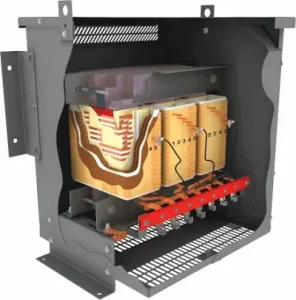
Low Voltage Distribution Transformers
Autotransformers

Low Voltage Distribution Transformers
Rex Power Magnetics Autotransformers provide efficient and cost-effective voltage transformation for a wide range of industrial, commercial, and utility applications. By sharing common windings between the primary and secondary circuits, these transformers offer a compact and lightweight solution for applications where electrical isolation is not required but precise voltage adjustment and reliable performance are essential.
Engineered for high efficiency and excellent voltage regulation, Rex Autotransformers are ideal for motor starting, voltage correction, equipment interconnection, and system balancing applications. Each unit is designed with premium core materials, precision-wound conductors, and high-quality insulation systems to ensure dependable operation and long service life under continuous or intermittent load conditions.
Available in a wide range of kVA ratings, voltage configurations, and enclosure types, Rex Autotransformers are manufactured and tested to meet or exceed CSA and UL standards. Standard and custom designs are available to suit specific electrical and mechanical requirements — delivering reliable, efficient performance backed by Rex Power Magnetics’ proven engineering expertise.
| Capacity |
|
| Voltage Class | 1.2kV |
| Cooling | Air Cooled (ANN / AN) |
| Frequency | 60Hz (50/60Hz Optional) |
| Conductors | Copper (Cu) or Aluminum (Al) Windings |
| Temperature Rise | 150°C Rise (115°C or 80°C Optional) |
| Insulation System | 220°C |
| Impregnation | Polyester Resin Dipped and Baked |
| Sound Level | Meets NEMA ST-20 |
| Enclosure Type | Type 1 or 3R Indoor (Refer To Catalog) |
| Enclosure Finish | ANSI/ASA 61 Grey |
| Warranty | 12 Months (See Warranty and Limitations) |
| Quality System | ISO 9001:2015 Quality Management System |
| Certifications |
|
| Reference Standards |
|
| Optional Features & Accessories |
|
Distribution Transformer Catalog (English)
Distribution Transformer Catalog (French)
Maintenance, Operating & Installation Manual (English)
Maintenance, Operating & Installation Manual (French)
Configure an autotransformer to build its Rex catalog part number. Codes follow the Rex catalog numbering system.
Single-phase autotransformers are copper only.
Encapsulated units use 130 °C standard rise.
Autotransformers are exempt from North American efficiency regulation.
Encapsulated units are Type 3R (or Type 4 / 4X); other enclosures don’t apply.
This tool assembles a catalog part number from the options you select, following the Rex Power Magnetics catalog numbering system. Not every combination of options is necessarily a standard or available product, and some configurations may require review or a custom quote. For a voltage not listed, the code ‘X’ is used and the value specified separately. Rex Power Magnetics makes no representations as to the accuracy of the information generated by this tool; part numbers should be confirmed with Rex before ordering. Contact Rex Power Magnetics to verify availability, pricing, and specifications.

An autotransformer is a single-winding transformer that provides voltage transformation through tapped sections of a common winding. Unlike a two-winding isolation transformer, it does not provide electrical isolation between the primary and secondary circuits. Instead, it offers a compact, efficient solution for applications requiring voltage step-up or step-down within the same system. Rex Power Magnetics autotransformers are used in motor starting, voltage conversion, and equipment designed to operate on non-standard supply voltages where isolation is not required.
Autotransformers are used for adjusting supply voltages in power distribution systems, controlling motor starting currents, and converting equipment for use on alternate voltage systems. They are also applied in test benches, variable voltage supplies, and energy management systems. In industrial settings, autotransformers are often used to match equipment designed for 480 V operation to 600 V supply systems. Their compact design and high efficiency make them ideal for both fixed and adjustable voltage control applications.
Autotransformers provide significant savings in material, size, and cost compared to isolation transformers of equivalent capacity. They offer higher efficiency due to reduced winding losses and better voltage regulation under load. Their compact construction simplifies installation, especially in retrofit applications. Because only part of the winding handles full load current, autotransformers deliver more kVA per pound of material, making them an efficient choice when electrical isolation is not a requirement.
The primary difference is in winding configuration. An isolation transformer has separate primary and secondary windings, ensuring full electrical isolation, while an autotransformer uses a single shared winding with multiple taps. This design reduces size, weight, and losses, offering greater efficiency and lower cost. However, because the circuits are not isolated, autotransformers are typically used where system grounding and safety measures are well-controlled. Rex Power Magnetics engineers design each autotransformer to meet specific application and voltage ratio requirements while maintaining electrical reliability.
Any transformer which is not installed and energized immediately should be stored in a dry, clean space having a uniform temperature to prevent condensation on the windings. Dry type transformers with resin dipped or epoxy vacuum impregnated coils can be stored at ambient temperatures as low as -50C. Transformers with encapsulated or epoxy cast coils should not be stored at ambient temperatures below -20C to prevent cracking of the epoxy. Preferably, transformers should be stored in a heated building having adequate air circulation and protected from cement, plaster, paint, dirt, and water or other gases, powders, and dust. The floor on which the transformer is being stored should be resistant to the upward migration of water vapor. Precautions should be taken to prevent storage in an area that water could be present, such as roof leaks, windows, etc. Condensation or absorption of moisture can be greatly reduced by keeping the transformer enclosure 5⁰C-10⁰C above ambient temperature. This can be easily achieved by the installation and energization of space heaters (optional). If the transformer is not furnished with internal space heaters, then external, portable heaters can be used. Note: Lamps or heaters should never come in direct contact with the transformer coil insulation.
It is not advisable to store a dry type transformer outdoors, but in the case that it is unavoidable, protective measures should be taken to prevent moisture and foreign debris from entering the transformer enclosure. The plastic wrapping supplied during shipment should be left in place, and a suitable drying agent such as silica gel packs should be used. The unit should also be checked periodically for indications of condensation on the windings, coil support blocks, core, core clamping system and bus/cables.
Yes. Because they use a single winding, autotransformers are inherently more efficient than isolation transformers. Efficiency often exceeds 97%, resulting in lower operating costs and reduced heat generation. The reduced copper and core material requirements contribute to compact size and improved performance. Rex Power Magnetics designs its autotransformers to deliver stable voltage regulation and minimal losses, making them an environmentally and economically advantageous choice where isolation is not required.
Each autotransformer is built using high-grade silicon steel cores and precision-wound copper or aluminum conductors. The core and coil assembly is dipped in polyester resin, which provides mechanical rigidity, improved insulation, and protection against moisture and contaminants. This process enhances durability and minimizes vibration and noise. Units are available as open core-and-coil assemblies or enclosed in NEMA-rated housings. Every transformer undergoes thorough electrical testing for performance, ratio accuracy, and dielectric strength before shipment.
Rex Power Magnetics provides extensive customization capabilities for autotransformers. Options include specific voltage ratios, kVA ratings, taps, and enclosure types to match customer requirements. Custom-engineered units can be designed for harmonic conditions, continuous or intermittent duty, or specialized environmental protection. Engineering support is available to assist OEMs and system integrators in designing transformers that meet precise technical and mechanical specifications. All custom units are built and tested to the same rigorous standards as catalog models.
Unless designed for special service conditions / environments, below are the standard service conditions for dry type distribution transformers:
To ensure proper operation, avoid installing transformers in environments with excessive moisture, extreme temperatures, or direct sunlight. Maintain recommended clearances and keep all ventilation panels unobstructed.
In dry-type transformers, the surrounding air plays a critical role in their operation. Generally, low ambient temperatures do not negatively impact an energized transformer, as the no-load losses typically generate enough heat to maintain proper conditions, even in environments as cold as -30°C. However, transformers stored at low temperatures present two primary concerns:
Rex Power Magnetics recommends testing transformers (megger testing), warming them to above 0°C, or following a drying-out procedure if moisture is suspected. Refer to Rex Power Magnetics’ cold start procedures to ensure safe energization in cold conditions. Energizing a transformer with compromised insulation due to moisture can cause damage and potential safety hazards.
The minimum required clearances of a dry type transformer to walls, floors or other equipment must adhere to the local electrical code requirements.
In the absence of such requirements, Rex Power Magnetics recommends that dry type transformers be mounted so that there is an air space of no less than 150mm (6”) between the enclosures, and between the enclosure and any adjacent surface except floors. When the adjacent surface is a combustible material, the minimum permissible separation between the transformer enclosure and the adjacent surface should be 300mm (12”). Where the adjacent surface is the wall on which the transformer is mounted, the minimum permissible separation between the enclosure and the mounting wall should be 6mm (0.25”) so long as the surface is of a non-combustible material.
Temperature rise refers to average increase of temperature of the transformer windings at full load above the ambient temperature. when operating at full load. In addition to the average temperature rise of the windings, transformers also experience a “hot spot” temperature, which refers to the highest temperature point in the windings.
For example, a transformer with a 220°C insulation system may be designed with a 150°C average temperature rise and a 30°C hot spot allowance. This means that Above a 40C ambient, the total absolute temperature will not exceed 220°C. Transformers with lower temperature insulation systems (180°C or 200°C) will be designed with lower temperature rises (115° or 130°C) and hot spots so they can be installed in the same ambient temperature and still not exceed the temperature rating of the insulation system.
The table below shows the maximum average winding temperature rise, maximum hot spot temperature rise and maximum winding temperature for the most common insulation classes. Note that these are based on a max average ambient of 30°C during any 24-hour period and a maximum ambient of 40°C at any time.
| Insulation Class | Insulation Class | Average Winding Temperature Rise |
Hot Spot Temperature Rise |
Maximum Winding Temperature |
| Class 180 | F | 115°C | 145°C | 180°C |
| Class 200 | N | 130°C | 160°C | 200°C |
| Class 220 | H | 150°C | 180°C | 220°C |
Customers occasionally specify a transformer of a particular insulation class to be designed with an average temperature rise below the average temperature rise values shown in the table above. The benefits of doing so include:
The life expectancy of a dry-type transformer is primarily determined by the insulation system and the operating temperature. According to IEEE Std. C57.96, the deterioration of insulation is directly related to the time and temperature the transformer experiences during operation. Insulation materials degrade faster at higher temperatures, so the transformer’s life expectancy is closely tied to how well it is kept within its design temperature limits.
In most transformers, the highest temperature occurs at a specific point in the windings, known as the hot spot. This area undergoes the most significant wear over time, making it the primary factor in determining the transformer’s ageing process.
All of Rex Power Magnetics’ dry-type transformers are designed using UL-listed insulation systems with a maximum hot spot temperature that ensures a design life of at least 30 years under standard operating conditions (continuous rated load, typical ambient temperatures, and no sustained overloads). Transformers designed with reduced temperature rise can extend this design life expectancy to over 50 years, as operating at lower temperatures slows the insulation’s ageing process.
Factors That Affect Life Expectancy:
By following proper installation and maintenance practices, such as avoiding overloading and ensuring the transformer operates within its designed ambient temperature, you can significantly extend its lifespan. Rex Power Magnetics’ high-quality transformers are built for durability, ensuring reliable performance for decades under standard conditions.
It`s normal for new transformers to release some harmless odors from the varnish impregnation used in the coils for a week or two after energization. Older Transformers can also release some odor if loaded to a higher level than they have experienced previously in their history.
Rex Power Magnetics’ ventilated distribution transformer terminals are rated 90°C. Conductors with at least a 90°C insulation rating at or below their 90°C ampacity rating should be utilized.
Rex Power Magnetics Autotransformers provide efficient and cost-effective voltage transformation for a wide range of industrial, commercial, and utility applications. By sharing common windings between the primary and secondary circuits, these transformers offer a compact and lightweight solution for applications where electrical isolation is not required but precise voltage adjustment and reliable performance are essential.
Engineered for high efficiency and excellent voltage regulation, Rex Autotransformers are ideal for motor starting, voltage correction, equipment interconnection, and system balancing applications. Each unit is designed with premium core materials, precision-wound conductors, and high-quality insulation systems to ensure dependable operation and long service life under continuous or intermittent load conditions.
Available in a wide range of kVA ratings, voltage configurations, and enclosure types, Rex Autotransformers are manufactured and tested to meet or exceed CSA and UL standards. Standard and custom designs are available to suit specific electrical and mechanical requirements — delivering reliable, efficient performance backed by Rex Power Magnetics’ proven engineering expertise.
| Capacity |
|
| Voltage Class | 1.2kV |
| Cooling | Air Cooled (ANN / AN) |
| Frequency | 60Hz (50/60Hz Optional) |
| Conductors | Copper (Cu) or Aluminum (Al) Windings |
| Temperature Rise | 150°C Rise (115°C or 80°C Optional) |
| Insulation System | 220°C |
| Impregnation | Polyester Resin Dipped and Baked |
| Sound Level | Meets NEMA ST-20 |
| Enclosure Type | Type 1 or 3R Indoor (Refer To Catalog) |
| Enclosure Finish | ANSI/ASA 61 Grey |
| Warranty | 12 Months (See Warranty and Limitations) |
| Quality System | ISO 9001:2015 Quality Management System |
| Certifications |
|
| Reference Standards |
|
| Optional Features & Accessories |
|
Distribution Transformer Catalog (English)
Distribution Transformer Catalog (French)
Maintenance, Operating & Installation Manual (English)
Maintenance, Operating & Installation Manual (French)
Configure an autotransformer to build its Rex catalog part number. Codes follow the Rex catalog numbering system.
Single-phase autotransformers are copper only.
Encapsulated units use 130 °C standard rise.
Autotransformers are exempt from North American efficiency regulation.
Encapsulated units are Type 3R (or Type 4 / 4X); other enclosures don’t apply.
This tool assembles a catalog part number from the options you select, following the Rex Power Magnetics catalog numbering system. Not every combination of options is necessarily a standard or available product, and some configurations may require review or a custom quote. For a voltage not listed, the code ‘X’ is used and the value specified separately. Rex Power Magnetics makes no representations as to the accuracy of the information generated by this tool; part numbers should be confirmed with Rex before ordering. Contact Rex Power Magnetics to verify availability, pricing, and specifications.
An autotransformer is a single-winding transformer that provides voltage transformation through tapped sections of a common winding. Unlike a two-winding isolation transformer, it does not provide electrical isolation between the primary and secondary circuits. Instead, it offers a compact, efficient solution for applications requiring voltage step-up or step-down within the same system. Rex Power Magnetics autotransformers are used in motor starting, voltage conversion, and equipment designed to operate on non-standard supply voltages where isolation is not required.
Autotransformers are used for adjusting supply voltages in power distribution systems, controlling motor starting currents, and converting equipment for use on alternate voltage systems. They are also applied in test benches, variable voltage supplies, and energy management systems. In industrial settings, autotransformers are often used to match equipment designed for 480 V operation to 600 V supply systems. Their compact design and high efficiency make them ideal for both fixed and adjustable voltage control applications.
Autotransformers provide significant savings in material, size, and cost compared to isolation transformers of equivalent capacity. They offer higher efficiency due to reduced winding losses and better voltage regulation under load. Their compact construction simplifies installation, especially in retrofit applications. Because only part of the winding handles full load current, autotransformers deliver more kVA per pound of material, making them an efficient choice when electrical isolation is not a requirement.
The primary difference is in winding configuration. An isolation transformer has separate primary and secondary windings, ensuring full electrical isolation, while an autotransformer uses a single shared winding with multiple taps. This design reduces size, weight, and losses, offering greater efficiency and lower cost. However, because the circuits are not isolated, autotransformers are typically used where system grounding and safety measures are well-controlled. Rex Power Magnetics engineers design each autotransformer to meet specific application and voltage ratio requirements while maintaining electrical reliability.
Any transformer which is not installed and energized immediately should be stored in a dry, clean space having a uniform temperature to prevent condensation on the windings. Dry type transformers with resin dipped or epoxy vacuum impregnated coils can be stored at ambient temperatures as low as -50C. Transformers with encapsulated or epoxy cast coils should not be stored at ambient temperatures below -20C to prevent cracking of the epoxy. Preferably, transformers should be stored in a heated building having adequate air circulation and protected from cement, plaster, paint, dirt, and water or other gases, powders, and dust. The floor on which the transformer is being stored should be resistant to the upward migration of water vapor. Precautions should be taken to prevent storage in an area that water could be present, such as roof leaks, windows, etc. Condensation or absorption of moisture can be greatly reduced by keeping the transformer enclosure 5⁰C-10⁰C above ambient temperature. This can be easily achieved by the installation and energization of space heaters (optional). If the transformer is not furnished with internal space heaters, then external, portable heaters can be used. Note: Lamps or heaters should never come in direct contact with the transformer coil insulation.
It is not advisable to store a dry type transformer outdoors, but in the case that it is unavoidable, protective measures should be taken to prevent moisture and foreign debris from entering the transformer enclosure. The plastic wrapping supplied during shipment should be left in place, and a suitable drying agent such as silica gel packs should be used. The unit should also be checked periodically for indications of condensation on the windings, coil support blocks, core, core clamping system and bus/cables.
Yes. Because they use a single winding, autotransformers are inherently more efficient than isolation transformers. Efficiency often exceeds 97%, resulting in lower operating costs and reduced heat generation. The reduced copper and core material requirements contribute to compact size and improved performance. Rex Power Magnetics designs its autotransformers to deliver stable voltage regulation and minimal losses, making them an environmentally and economically advantageous choice where isolation is not required.
Each autotransformer is built using high-grade silicon steel cores and precision-wound copper or aluminum conductors. The core and coil assembly is dipped in polyester resin, which provides mechanical rigidity, improved insulation, and protection against moisture and contaminants. This process enhances durability and minimizes vibration and noise. Units are available as open core-and-coil assemblies or enclosed in NEMA-rated housings. Every transformer undergoes thorough electrical testing for performance, ratio accuracy, and dielectric strength before shipment.
Rex Power Magnetics provides extensive customization capabilities for autotransformers. Options include specific voltage ratios, kVA ratings, taps, and enclosure types to match customer requirements. Custom-engineered units can be designed for harmonic conditions, continuous or intermittent duty, or specialized environmental protection. Engineering support is available to assist OEMs and system integrators in designing transformers that meet precise technical and mechanical specifications. All custom units are built and tested to the same rigorous standards as catalog models.
Unless designed for special service conditions / environments, below are the standard service conditions for dry type distribution transformers:
To ensure proper operation, avoid installing transformers in environments with excessive moisture, extreme temperatures, or direct sunlight. Maintain recommended clearances and keep all ventilation panels unobstructed.
In dry-type transformers, the surrounding air plays a critical role in their operation. Generally, low ambient temperatures do not negatively impact an energized transformer, as the no-load losses typically generate enough heat to maintain proper conditions, even in environments as cold as -30°C. However, transformers stored at low temperatures present two primary concerns:
Rex Power Magnetics recommends testing transformers (megger testing), warming them to above 0°C, or following a drying-out procedure if moisture is suspected. Refer to Rex Power Magnetics’ cold start procedures to ensure safe energization in cold conditions. Energizing a transformer with compromised insulation due to moisture can cause damage and potential safety hazards.
The minimum required clearances of a dry type transformer to walls, floors or other equipment must adhere to the local electrical code requirements.
In the absence of such requirements, Rex Power Magnetics recommends that dry type transformers be mounted so that there is an air space of no less than 150mm (6”) between the enclosures, and between the enclosure and any adjacent surface except floors. When the adjacent surface is a combustible material, the minimum permissible separation between the transformer enclosure and the adjacent surface should be 300mm (12”). Where the adjacent surface is the wall on which the transformer is mounted, the minimum permissible separation between the enclosure and the mounting wall should be 6mm (0.25”) so long as the surface is of a non-combustible material.
Temperature rise refers to average increase of temperature of the transformer windings at full load above the ambient temperature. when operating at full load. In addition to the average temperature rise of the windings, transformers also experience a “hot spot” temperature, which refers to the highest temperature point in the windings.
For example, a transformer with a 220°C insulation system may be designed with a 150°C average temperature rise and a 30°C hot spot allowance. This means that Above a 40C ambient, the total absolute temperature will not exceed 220°C. Transformers with lower temperature insulation systems (180°C or 200°C) will be designed with lower temperature rises (115° or 130°C) and hot spots so they can be installed in the same ambient temperature and still not exceed the temperature rating of the insulation system.
The table below shows the maximum average winding temperature rise, maximum hot spot temperature rise and maximum winding temperature for the most common insulation classes. Note that these are based on a max average ambient of 30°C during any 24-hour period and a maximum ambient of 40°C at any time.
| Insulation Class | Insulation Class | Average Winding Temperature Rise |
Hot Spot Temperature Rise |
Maximum Winding Temperature |
| Class 180 | F | 115°C | 145°C | 180°C |
| Class 200 | N | 130°C | 160°C | 200°C |
| Class 220 | H | 150°C | 180°C | 220°C |
Customers occasionally specify a transformer of a particular insulation class to be designed with an average temperature rise below the average temperature rise values shown in the table above. The benefits of doing so include:
The life expectancy of a dry-type transformer is primarily determined by the insulation system and the operating temperature. According to IEEE Std. C57.96, the deterioration of insulation is directly related to the time and temperature the transformer experiences during operation. Insulation materials degrade faster at higher temperatures, so the transformer’s life expectancy is closely tied to how well it is kept within its design temperature limits.
In most transformers, the highest temperature occurs at a specific point in the windings, known as the hot spot. This area undergoes the most significant wear over time, making it the primary factor in determining the transformer’s ageing process.
All of Rex Power Magnetics’ dry-type transformers are designed using UL-listed insulation systems with a maximum hot spot temperature that ensures a design life of at least 30 years under standard operating conditions (continuous rated load, typical ambient temperatures, and no sustained overloads). Transformers designed with reduced temperature rise can extend this design life expectancy to over 50 years, as operating at lower temperatures slows the insulation’s ageing process.
Factors That Affect Life Expectancy:
By following proper installation and maintenance practices, such as avoiding overloading and ensuring the transformer operates within its designed ambient temperature, you can significantly extend its lifespan. Rex Power Magnetics’ high-quality transformers are built for durability, ensuring reliable performance for decades under standard conditions.
It`s normal for new transformers to release some harmless odors from the varnish impregnation used in the coils for a week or two after energization. Older Transformers can also release some odor if loaded to a higher level than they have experienced previously in their history.
Rex Power Magnetics’ ventilated distribution transformer terminals are rated 90°C. Conductors with at least a 90°C insulation rating at or below their 90°C ampacity rating should be utilized.