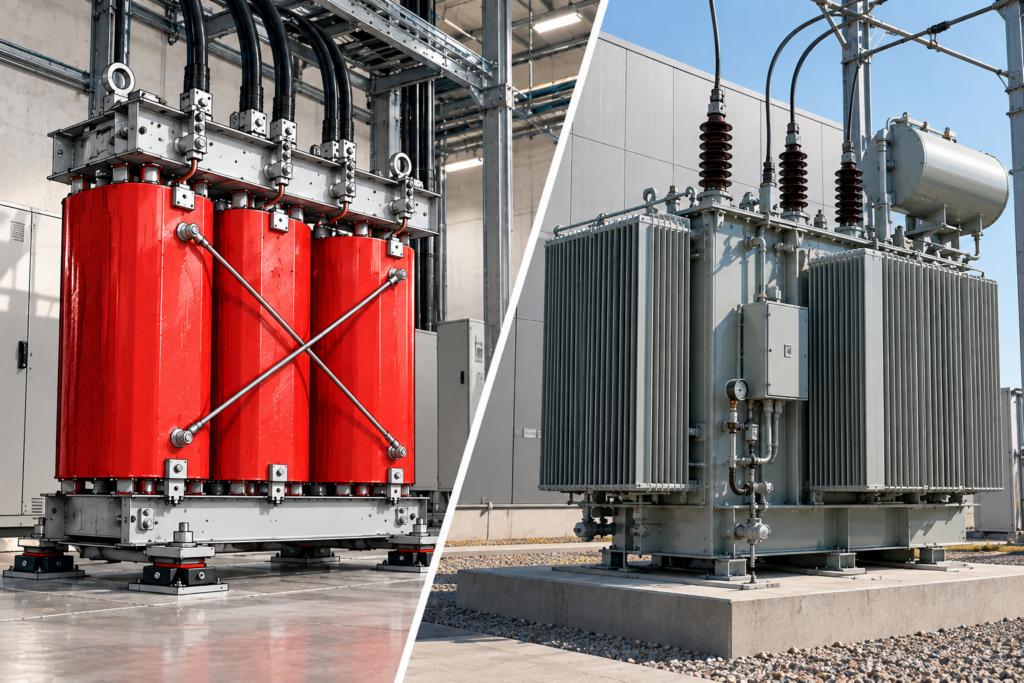
Transformers are central to electrical power systems, enabling voltage to be stepped up for transmission and stepped down for utilization. While the operating principle is consistent across designs, the method of insulation and cooling introduces meaningful differences in performance, installation, and lifecycle behavior.
The two dominant categories — dry-type and liquid-filled transformers — are not interchangeable. Each is optimized for specific environments, load profiles, and risk considerations. Selecting between them requires understanding how construction affects thermal performance, safety, maintenance, and long-term reliability.
Fundamental Difference: Insulation and Cooling Medium
The primary distinction lies in how insulation and cooling are achieved.
Dry-type transformers use solid insulation systems such as cast resin or VPI/VPE, with heat dissipated through air. Liquid-filled transformers use a dielectric fluid — mineral oil, natural ester, or synthetic ester — which provides both electrical insulation and effective heat transfer. This difference drives most of the practical trade-offs between the two designs.
Dry-Type Transformers
Dry-type transformers are constructed without liquid dielectric. Windings are insulated using solid materials, and cooling is achieved through natural convection or forced air. The absence of liquid eliminates spill risk and reduces fire propagation concerns, which makes them well suited to indoor installations and occupied spaces.
Air is a less effective cooling medium than liquids, which results in lower power density and greater sensitivity to ambient conditions. In practice, dry-type transformers are often larger for the same kVA rating and require careful attention to ventilation and enclosure design. They are commonly applied in commercial buildings, healthcare facilities, data centers, and indoor industrial environments where safety and accessibility are primary considerations.
Liquid-Filled Transformers
Liquid-filled transformers use a dielectric fluid to insulate internal components and remove heat. The fluid circulates through the transformer, transferring heat to radiators or tank surfaces where it is dissipated. At higher capacity ratings, this delivers higher power density, better overload capability, and more uniform winding temperatures — making them well suited to utility systems, renewable energy applications, and large outdoor industrial loads.
Fluid type matters significantly. Mineral oil is traditional and widely used but carries higher fire risk and environmental impact. Natural esters (such as FR3 from Cargill or BIOTEMP from ABB) are biodegradable with higher fire points. Synthetic esters are engineered for enhanced fire resistance in demanding environments. The increased use of ester-based fluids has expanded the range of applications where liquid-filled units can be installed, including some that were previously limited to dry-type designs.
Thermal, Efficiency, and Noise Performance
Liquid-filled transformers benefit from the higher heat capacity of dielectric fluids, allowing them to operate at higher loads while maintaining lower internal temperatures. Dry-type units, relying on air cooling, are more sensitive to ambient temperature and airflow — though properly engineered ventilation, enclosure design, and forced-air cooling can substantially close the gap.
At equivalent ratings, liquid-filled transformers typically have slightly lower no-load and load losses. Over a 25- to 30-year service life, this can translate to a measurable difference in energy cost, particularly for units operating near full load continuously. Dry-type designs using high-grade silicon steel or amorphous metal cores narrow this gap considerably.
Dry-type transformers can also produce slightly higher audible noise, since the surrounding liquid in a filled unit dampens core vibration. This is managed through enclosure design, mounting isolation, and lower flux density designs. For noise-sensitive installations, sound levels should be specified explicitly and verified against test reports per NEMA TR1 and IEEE C57.12.91.
Installation and Site Considerations
Installation requirements often influence transformer selection as much as electrical performance.
Dry-type transformers can typically be installed indoors and close to the load without fluid containment systems. They are also lighter than liquid-filled units of equivalent rating, which makes them the practical choice for upper-floor or rooftop installations where structural loading is constrained. NEC Article 450 governs transformer installation requirements in North America and specifies different clearance, ventilation, and fire separation rules for the two technologies.
Liquid-filled transformers have traditionally been installed outdoors or in dedicated enclosures due to fluid containment and fire protection requirements. High fire point ester fluids have expanded indoor installation options, but fluid management and containment remain important design considerations that add infrastructure cost and complexity not present in dry-type installations.
Maintenance and Lifecycle
Dry-type transformers generally require minimal routine maintenance — visual inspection, cleaning, ensuring adequate airflow, and periodic insulation resistance testing. There is no fluid to test, sample, or replace.
Liquid-filled transformers require periodic dielectric strength testing, moisture content analysis, and dissolved gas analysis (DGA). These diagnostics support predictive maintenance strategies, but they also add complexity, sampling requirements, and the need for trained personnel or third-party labs.
End-of-life considerations differ as well. Liquid-filled transformers require fluid disposal at decommissioning, with mineral oil units requiring particular care due to potential historical PCB contamination in pre-1980s equipment. Dry-type transformers have no fluid disposal requirement, simplifying end-of-life handling.
Safety and Environmental Considerations
Dry-type transformers eliminate liquid-related risks such as spills and leaks, and they generally present a lower fire load. This makes them well suited to occupied or sensitive environments — schools, hospitals, residential buildings, and indoor commercial spaces.
Modern ester-based fluids offer higher fire points (above 300°C for natural esters, compared to about 160°C for mineral oil), reduced flammability, and biodegradability — narrowing the safety gap with dry-type designs in many applications. For installations where any fluid presence is unacceptable — clean rooms, food processing, water treatment, occupied indoor environments — dry-type remains the only viable choice.
Cost: Initial vs. Lifecycle
At higher capacity ratings, typically above about 1,500 kVA, liquid-filled transformers often have a lower cost per kVA than dry-type units. At smaller ratings, the cost difference narrows or reverses, with dry-type sometimes being the more economical option upfront.
Beyond purchase price, lifecycle cost depends on installation infrastructure (containment, fire protection, ventilation), maintenance and diagnostic requirements, energy losses over the service life, and end-of-life handling. Dry-type transformers typically have lower maintenance and infrastructure costs across all ratings, and over a 25- to 30-year service life these savings frequently offset higher initial cost in indoor and occupied applications.
Application-Based Selection
Selection is driven by application constraints rather than preference for a specific technology.
Dry-type transformers are typically selected for indoor installations and occupied spaces, locations with strict fire safety requirements, upper-floor or weight-constrained installations, and any environment where fluid presence is unacceptable.
Liquid-filled transformers are generally preferred for higher-capacity systems above 1,500 kVA, outdoor installations with available containment infrastructure, applications requiring sustained overload capability, and installations where DGA-based predictive maintenance is part of the asset management strategy.
Why Customers Choose Dry-Type
For the applications dry-type transformers serve, several characteristics consistently drive selection:
- Safety in occupied spaces — no fluid means no spill risk, no leak containment, and lower fire load.
- Installation flexibility — indoor placement without containment systems, lighter weight, and simpler code compliance.
- Minimal maintenance — no fluid sampling, no DGA program, no end-of-life fluid disposal.
- Predictable long-term cost — lower infrastructure and ongoing maintenance combine to make dry-type the economical choice over the full lifecycle in most indoor applications.
- Custom engineering — dry-type designs lend themselves well to custom voltage configurations, special enclosures, and application-specific modifications.
Common Misconceptions
Several oversimplifications can lead to suboptimal decisions:
- Treating all liquid-filled transformers as equivalent despite significant differences in fluid type and fire performance.
- Assuming dry-type is always safer regardless of installation context.
- Assuming liquid-filled is always more efficient — efficiency depends on design quality and loading profile as much as insulation medium.
- Comparing initial cost without considering installation infrastructure, maintenance, and end-of-life requirements.
Conclusion
Dry-type and liquid-filled transformers represent two distinct approaches to insulation and cooling, each with clear advantages depending on the application. Dry-type offers simplicity, reduced environmental risk, and suitability for indoor and occupied installations. Liquid-filled provides superior thermal performance and higher power density at large ratings.
The right choice matches the operating environment, safety requirements, lifecycle expectations, and capacity rating of the specific application. For indoor installations, occupied spaces, and applications where low maintenance and installation simplicity matter, dry-type designs remain the leading choice.
Rex Power Magnetics designs and manufactures CSA-certified, UL-listed dry-type transformers from 50 VA to 15 MVA at our facility in Concord, Ontario. Whether your application calls for a standard distribution unit or a custom medium-voltage cast coil design, contact our engineering team to discuss whether dry-type is the right fit for your project.