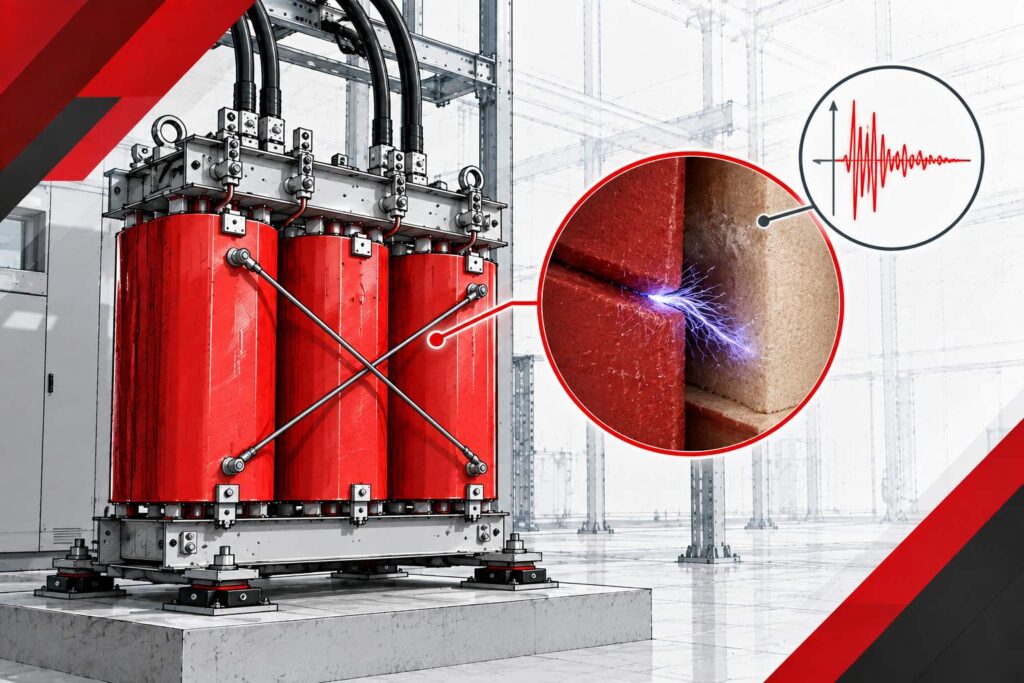
Partial discharge (PD) is one of the most important indicators of insulation condition in dry type transformers. While it is often associated with factory testing, its real significance lies in what it reveals about long-term reliability.
Unlike catastrophic failures, partial discharge is a progressive phenomenon. It develops in localized regions of insulation and gradually degrades material over time. Left unaddressed, it leads to insulation breakdown, reduced service life, and eventual failure.
In dry type transformers, the absence of liquid insulation means that defects in solid insulation — voids, contamination, or surface irregularities — are directly exposed to electrical stress. Understanding and managing PD is therefore central to reliable operation.
This article looks at where PD originates, how it is detected, and how its impact can be mitigated.
What Is Partial Discharge?
Partial discharge is a localized dielectric breakdown that occurs within a portion of an insulation system without fully bridging the gap between conductors.
It develops where the local electric field exceeds the dielectric strength of the material at that point — typically at imperfections such as air voids, contamination, or material interfaces. PD appears in three main forms: internal discharge within insulation, surface discharge along insulation boundaries, and corona in high-field regions in air.
Individual discharge events are small, often measured in picocoulombs (pC). But they are repetitive, and their cumulative effect drives erosion, carbonization, and the formation of conductive paths through otherwise sound insulation.
Why Partial Discharge Matters
Each discharge event introduces localized thermal and chemical stress that gradually weakens the dielectric. Over time this produces erosion, tracking, and electrical treeing — branching conductive channels that eat into the insulation until breakdown occurs.
In the early stages, a transformer with active PD operates normally. Nothing in the load data or thermal readings suggests a problem. What is actually happening is that the insulation margin is quietly shrinking. For this reason, PD is best understood as an early indicator of insulation degradation rather than a fault condition in itself. By the time the symptoms become obvious, the margin is largely gone.
Dry Type vs Liquid-Filled Transformers
The impact of PD differs significantly between the two designs.
In liquid-filled transformers, discharge typically occurs within the insulating liquid or at liquid-solid interfaces. The liquid dissipates discharge energy and, when degraded, can be partially restored through filtration or degassing. The insulation system is, in a limited sense, serviceable.
Dry type transformers have no such buffer. Air may be present in the design, but the solid insulation absorbs the effects of any discharge. The air itself is not permanently damaged; the surrounding insulation is. The result is localized erosion, carbonization, and a progressive reduction in dielectric strength that cannot be reversed in service.
This is especially critical in cast coil transformers, where windings are encapsulated in epoxy. A void a few millimetres across inside the resin — often left behind from imperfect casting — can host recurring discharges for years, slowly carbonizing the cavity walls until a tracking path forms. The damage stays localized but never stops developing. This is why PD testing is a standard factory requirement for cast coil transformers: it is the only practical way to verify that those voids are either absent or small enough to remain inactive under service voltage.
Common Causes
Partial discharge is rarely random. It is associated with identifiable conditions that can be categorized into four groups.
Manufacturing defects are the primary cause. Voids in winding insulation, incomplete resin impregnation in vacuum pressure impregnated (VPI) or vacuum pressure encapsulated (VPE) designs, and imperfections in cast resin systems all create localized weak points where PD can initiate.
Installation and handling introduce their own risks. Mechanical damage during transport, dust and moisture contamination during a prolonged storage period, and poorly executed terminations can all create stress points that did not exist when the unit left the factory.
Environmental conditions influence PD behavior throughout service life. Moisture and airborne pollution promote surface discharge. High altitude reduces the dielectric strength of air and increases corona susceptibility — a consideration for installations above roughly 1000 m, where derating is typically required.
Electrical stress is the fourth contributor. Overvoltages, switching transients, and high dv/dt waveforms (rapid voltage rise rates) from variable frequency drives and other power electronics intensify local electric fields. A transformer specified for sinusoidal service can see materially higher PD activity when fed from a rectifier or inverter, even within nameplate limits.
Where PD Occurs
In dry type transformers, PD tends to develop in predictable locations. Internal voids within winding insulation are the classic site, as are interfaces between conductors and insulation, and boundaries where solid insulation meets air. Surface contamination can create conductive paths that support discharge along otherwise sound insulation surfaces.
Geometry matters as much as materials. Sharp edges and abrupt geometry changes concentrate electric fields and are disproportionately represented in PD activity. Reduced clearances, whether by original design or imposed by field conditions, have the same effect.
Detection Methods
PD detection falls into two broad categories: offline testing and online monitoring. Choosing between them — and between the specific techniques within each — depends on what question is being asked.
Offline testing is performed during factory acceptance and commissioning. The unit is energized under controlled conditions, typically at 1.8 times rated voltage per IEEE for cast resin designs, and PD levels are measured in picocoulombs. Acceptance limits vary by standard and by customer specification, but values below 10 pC at rated voltage are common targets for cast coil units. Offline testing establishes a baseline and verifies that the transformer meets specification before energization.
Online monitoring measures PD under actual operating conditions, including the switching transients and harmonic content the transformer actually sees. It can be continuous (permanent sensors feeding a monitoring system) or periodic (portable instruments used during scheduled inspections). Online data is noisier than offline data but more representative of real service stress.
Three detection techniques are in common use, and they are complementary rather than interchangeable:
- Electrical measurement is the most quantitative. It is the method specified in IEEE standards and is the right choice when a numerical result in pC is required.
- Acoustic detection uses sensors to pick up the pressure waves generated by discharge events. It is useful for locating the source of PD within a transformer enclosure and for monitoring in electrically noisy environments.
- Ultrasonic sensing detects discharge activity on external surfaces, bushings, and cable terminations, and is typically deployed during field inspections.
For a facility setting up a PD program, the practical starting point is a baseline measurement at commissioning using the method specified in the transformer’s factory test report, followed by periodic ultrasonic surveys during routine inspections. Continuous online monitoring is usually reserved for critical units where unplanned outage cost justifies the investment.
Interpreting Results
Absolute PD values are less useful than trends. A stable 10 pC reading consistent with factory results is generally unremarkable. A reading that has climbed from 10 pC to 25 pC over two inspection intervals is a clear signal of developing insulation issues, even if the absolute number is still low.
Environmental and operating conditions — temperature, humidity, voltage waveform, load — all influence measurements. Comparing readings taken under different conditions without normalizing for them will produce misleading conclusions.
The practical implication is that the first PD measurement on any given transformer is an investment in the baseline. Its value compounds over the life of the unit.
Mitigation
Managing PD addresses both its initiation and its progression.
At the design and manufacturing stage, the levers are well understood: high-quality insulation materials, controlled impregnation and casting processes, and attention to electric field control at edges, corners, and terminations. This is the stage at which most PD is either designed out or designed in.
During installation, the single most common field-induced PD source is cable routing. Cables installed too close to energized windings or buswork create local field intensification that was not present in the factory test configuration. The transformer can pass factory PD testing at 10 pC and show 50 pC in service purely because of how the cables were run. Maintaining the clearances specified in the installation drawings is not a suggestion; it is a precondition for the factory PD result to be meaningful in the field.
Terminations deserve the same discipline. A cable termination assembled in a clean, dust-free environment with properly seated stress relief components will behave very differently from one assembled on a dusty construction site at the end of a long shift.
In operation, environmental control and routine maintenance preserve the insulation. Cleaning to remove dust and contamination, inspection for moisture ingress, and periodic PD measurement collectively make the difference between a transformer that reaches its design life and one that does not.
Standards and Testing
PD testing for dry type transformers is defined in IEEE C57.12.91. These standards specify test procedures, test voltages, and acceptable PD levels for factory acceptance.
What they do not do is represent field conditions. A transformer that passes factory PD testing has demonstrated that its insulation system meets a controlled specification under controlled conditions. It has not demonstrated that it will see the same PD levels once installed in a specific building, fed from specific switchgear, terminated by a specific contractor, and operated in a specific environment.
Factory compliance is a baseline. Long-term performance is earned in installation and operation.
Conclusion
Partial discharge is not a fault. It is a signal — an early, quantifiable indicator of insulation degradation that begins long before any other symptom appears. In dry type transformers the signal is particularly important because the damage it reveals is cumulative and cannot be reversed.
Managing PD is not a test that gets passed once at the factory. It is a lifecycle discipline that starts with design, continues through installation, and persists through the service life of the transformer. Done well, it is one of the most reliable ways to protect insulation life and ensure the transformer delivers the service its nameplate promises.