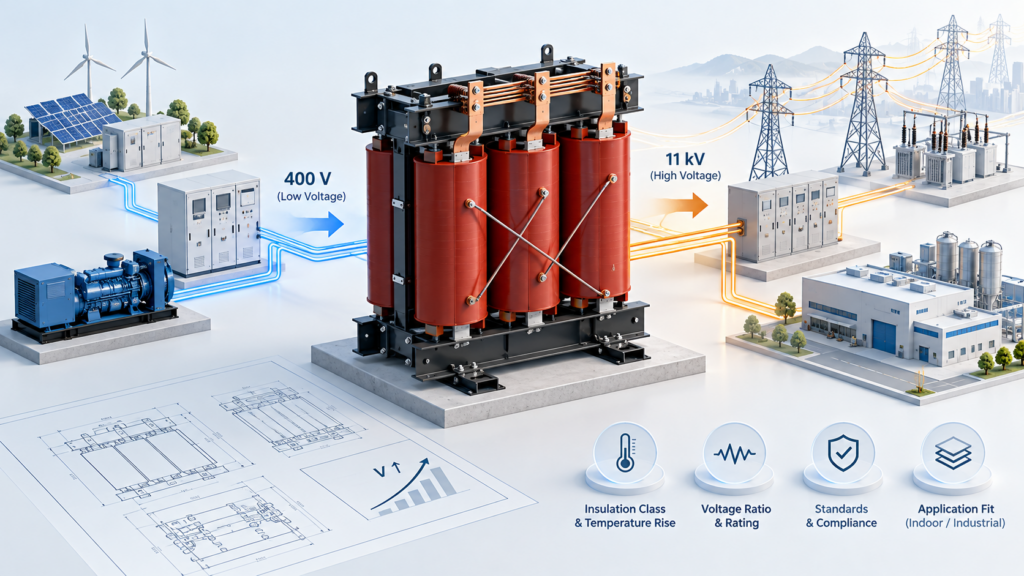
For decades, transformer specification in commercial and industrial facilities has been a step-down problem. Take medium voltage from the utility, drop it to 480 V or 600 V, distribute it to loads. Step-up applications were the utility’s concern, not the facility’s.
That’s changing. The growth of solar PV, battery energy storage, on-site generation, and microgrids has pushed step-up transformers out of the substation and into the building — directly at the interface between low-voltage power electronics and medium-voltage distribution. Most of these applications fall well below transmission scale, in the 600 V to 34.5 kV range, and most are well-suited to dry-type construction.
The transformers themselves are not exotic. What’s different is how they’re applied. Step-up dry-type transformers sit at an active boundary in the system, and most field problems don’t come from the transformer — they come from how it was specified. Energization side, tap placement, and voltage control logic all behave differently than in a conventional step-down installation, and getting them wrong creates issues that look like transformer problems but aren’t.
What “Step-Up” Means in This Context
A step-up transformer raises voltage from primary to secondary by way of more turns on the secondary winding. As voltage increases, current decreases proportionally. None of that is unique to dry-type construction.
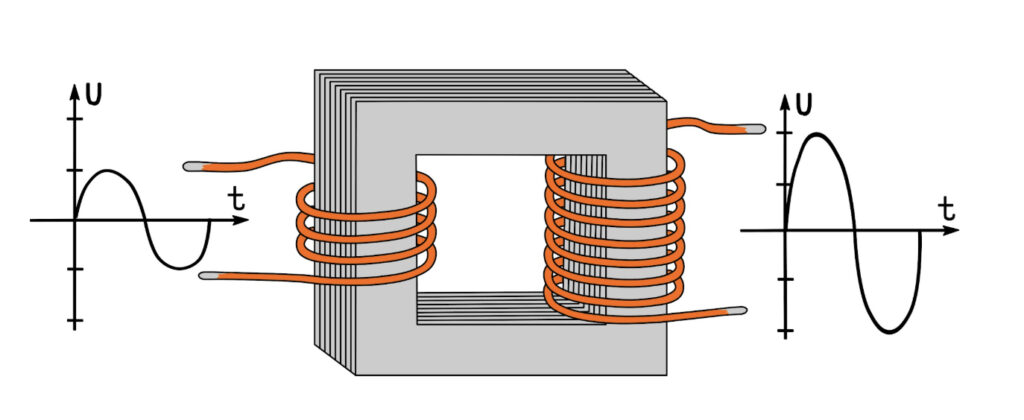
What’s worth distinguishing is scale. In utility contexts, “step-up transformer” usually means a generator step-up (GSU) unit feeding a transmission system. Dry-type step-up transformers operate well below that, in ranges such as:
- 480 V or 600 V → 4.16 kV
- 600 V → 13.8 kV
- 5 kV class → 15 kV, 25 kV, or 34.5 kV class
These are facility-level and equipment-level transformers, not transmission assets, and the application logic is different.
Where They’re Used
Distributed energy systems. The most common modern application is solar PV and battery energy storage. Inverters produce low-voltage output that has to be stepped up to medium voltage for facility or grid interconnection. The transformer sits directly between the power electronics and the electrical system, often inside a space-constrained enclosure. Harmonic loading from the inverter is non-trivial in these installations and typically drives a K-factor rating or equivalent derating in the specification.
Industrial systems with medium-voltage loads. When a facility has medium-voltage equipment — large motors, specialized process equipment — but is fed from a low-voltage system, stepping up locally near the load is often more practical than distributing medium voltage throughout the building. The transformer becomes part of a localized solution, usually installed in or near an electrical room.
On-site generation and microgrids. Generators, fuel cells, and microturbines typically produce power at low voltage. Connecting them to medium-voltage distribution requires a step-up transformer, and microgrids often involve several of these stepping up to a common bus. Voltage coordination across sources is the central design problem, and the transformer’s impedance and ratio are part of that picture.
Testing. OEM test cells are a clear example — facilities where medium-voltage equipment such as MV drives, motors, switchgear, and breakers must be tested in a lab environment that only has a low-voltage supply available. A step-up dry-type transformer feeds the test bus at the required MV level, often at non-standard ratios driven by the equipment under test rather than by distribution conventions.
What Actually Drives the Specification
The transformer is not fundamentally different in a step-up role. Its position in the system is. The table below summarizes how the specification logic shifts:
| Specification Factor | Conventional Step-Down | Step-Up Dry-Type |
|---|---|---|
| Typical voltage range | 15 kV / 25 kV / 34.5 kV class → 480 V or 600 V | 480 V / 600 V → 4.16 kV / 13.8 kV / up to 34.5 kV |
| Source of power | Utility (medium voltage) | Inverter, generator, fuel cell, or LV bus |
| Energized from | Primary (MV) side | Usually MV side, even though power flows from LV |
| Tap changer location | MV winding (standard) | MV winding — but taps may be reduced or omitted entirely |
| Voltage regulation source | Utility + transformer taps | Often handled upstream by the inverter or source |
| Harmonic loading | Typically modest | Significant in PV/BESS applications; K-factor often required |
| Role in the system | Passive distribution element | Active interface between generation and distribution |
| Protection coordination | Standard radial schemes | Bidirectional considerations, interconnection requirements |
| Voltage ratio drivers | Standard distribution levels | Inverter output, interconnection spec, facility bus |
Three decisions get missed most often.
Energization side vs. power flow direction
Power in a step-up application flows from low voltage to medium voltage. The transformer is not necessarily energized from that same side. In most installations tied to medium-voltage distribution, the transformer remains energized from the MV winding even though the source is on the LV side.
This matters because:
- The energized winding is treated as the primary for insulation and design purposes.
- BIL (Basic Impulse Level) and insulation requirements follow the energized winding.
- Tap changers are typically located on the energized side, where current is lower and the mechanical design is easier.
Confusing power flow with energization is one of the most common sources of specification error in step-up applications.
Tap location and whether taps are needed at all
Tap placement follows the energized side, not the higher voltage by default. If the transformer is energized from the medium-voltage side, taps go there.
The more interesting question is whether taps are needed in the first place. Many modern step-up applications are fed from regulated low-voltage sources — inverters, in particular — that hold their output voltage tightly. When the source already controls voltage, transformer taps add cost and complexity without solving a real problem. In these cases, a fixed-ratio transformer is often the right answer, with voltage adjustment handled upstream.
The decision comes down to a single question: where in the system does voltage variability actually live? Adjustment capability belongs there, not by default at the transformer.
Interaction with regulated sources
Inverters and similar power-electronic sources behave differently than utility feeds. They hold voltage stable at their own terminals across a range of operating conditions, but the transformer still influences what shows up at the medium-voltage bus through its impedance and turns ratio.
A typical example: during a sudden load step on the MV side, the inverter holds its LV output steady, but the voltage drop across the transformer impedance produces a transient sag at the MV bus that the inverter doesn’t see and can’t directly correct. Partial loading and harmonic-rich loads create similar effects in steady state. Coordination between the source and the transformer — not just sizing — is what determines whether the system runs cleanly.
System Position and Interface Effects
Step-up dry-type transformers usually sit at a boundary: between generation and distribution, or between LV equipment and an MV bus. That position has consequences beyond the transformer itself.
Protection coordination has to account for bidirectional considerations and, in grid-tied systems, utility interconnection requirements. Grounding configuration — Wye-Delta, Delta-Wye, or otherwise — is a real specification decision driven by the source characteristics and the downstream system, not a default. Energization sequences and switching procedures often differ from a standard step-down installation.
Voltage ratios, finally, tend to be driven by interface requirements rather than standard distribution levels. Matching an inverter’s output window, aligning with a facility bus, or meeting an interconnection spec can all push toward less conventional ratios and tighter tolerances than a typical step-down unit would carry.
Conclusion
The equipment is well understood. The application is where things go wrong. Specifying a step-up transformer the same way as a step-down unit — defaulting the energization side, placing taps by habit, ignoring how a regulated source changes the voltage control problem — produces issues that surface after commissioning, when they’re most expensive to fix.
Three questions, answered clearly up front, prevent most of them. Where is the transformer energized from? Where in the system does voltage variability actually live? What is the transformer being asked to do at the interface? When those are clear, the rest of the specification follows.