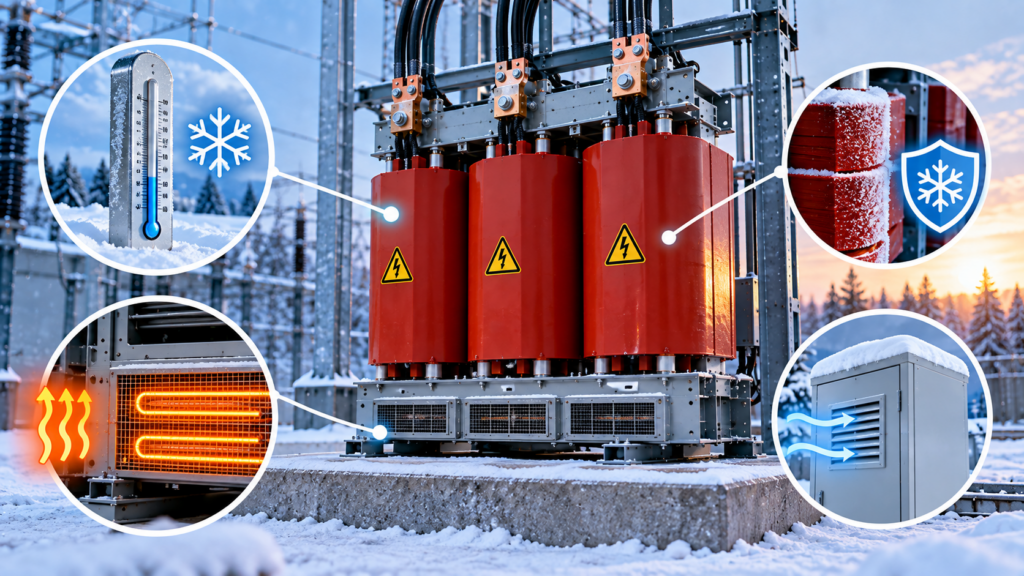
Dry-type transformers are frequently installed in regions where ambient temperatures may fall to –40 °C or lower. In such environments, reliable performance depends not only on the transformer’s rated operating ambient, but on proper handling during storage and disciplined energization practices during cold start.
Three distinct conditions must be clearly differentiated:
- Storage (de-energized condition)
- Cold-start energization below 0 °C
- Continuous operation at low ambient once energized
Each condition introduces different mechanical, thermal, and dielectric stresses. Improper storage or uncontrolled energization at sub-freezing temperatures can lead to insulation damage that may not be immediately apparent, but can significantly reduce long-term transformer reliability.
This paper consolidates Rex guidance from product manuals and technical references to provide a unified engineering framework for low-ambient applications.
Storage Conditions and Environmental Control
Any transformer not installed and energized immediately should be stored in a dry, clean environment with uniform temperature conditions to prevent condensation on windings and internal components. A heated building with adequate air circulation is preferred. The storage area should be protected from cement dust, plaster, paint, dirt, water intrusion, corrosive gases, and airborne contaminants. The floor should resist upward migration of water vapor, and the location must be free from roof leaks or moisture intrusion pathways.
The primary objective during storage is moisture control. Temperature alone does not typically damage a de-energized transformer; however, temperature cycling around the freezing point can promote condensation within the enclosure. Moisture accumulation on windings, core laminations, clamping systems, or bus connections introduces significant dielectric risk at energization.
When transformers are stored at or near freezing, condensation can be greatly reduced by maintaining the enclosure temperature approximately 5 °C to 10 °C above ambient. This may be achieved through installation and energization of space heaters. However, anti-condensation heaters supplied with the transformer are generally intended to reduce moisture accumulation and may not be sufficient to maintain the enclosure above minimum recommended storage temperature limits. Where necessary, additional internal or external heaters may be required.
When heaters are used during storage, ventilation openings may be temporarily blocked or covered to retain heat within the enclosure. A minimum clearance must remain to allow moist air to escape, and all coverings must be removed prior to energization to restore normal ventilation. Heating devices must never come into direct contact with transformer coil insulation.
Outdoor storage is not recommended. If unavoidable, the unit must remain protected with its original plastic wrapping, supplemented by suitable desiccant materials such as silica gel packs. The transformer should be periodically inspected for signs of condensation on windings, support blocks, core assemblies, and bus structures.
Before placing any stored transformer into operation, insulation resistance testing shall be performed. If readings are below recommended values, or if visible condensation is present, a controlled drying procedure is required prior to energization.
Transformers stored at sub-freezing temperatures must be allowed to thermally stabilize above freezing before energization.
Storage Temperature Limits by Transformer Design
Storage temperature limits apply only when the transformer is not energized.
For VPI and VPE dry-type transformers, the recommended minimum storage temperature is down to –50 °C, provided the unit remains dry, protected from moisture ingress, and not subjected to mechanical shock while cold.
These insulation systems do not experience electrical or magnetic stress during storage. The primary risks are moisture ingress, condensation during temperature cycling, and mechanical damage when insulation materials are less flexible at low temperature.
For cast coil transformers, the recommended minimum storage temperature is –20 °C . Below this temperature, epoxy resin systems become increasingly brittle. While dielectric strength may remain intact, impact resistance decreases, increasing the risk of micro-cracking or long-term dielectric degradation, particularly if mechanical shock occurs.
Accordingly, storage of cast coil transformers below –20 °C is not recommended unless specifically approved and accompanied by controlled protective measures.
The distinction between VPI/VPE and cast coil during storage is primarily mechanical rather than electrical.
Continuous Operation at Low Ambient
Operating ambient temperature refers to continuous service while the transformer is energized and supplying load.
For both VPI/VPE and cast coil transformers, the typical minimum operating ambient is –30 °C however for special applications, VPI/VPE transformer can be designed with a minimum operating ambient as low as –40 °C
Low ambient temperatures do not inherently impair electrical performance once the transformer is energized. No-load losses generate sufficient heat to maintain appropriate internal conditions, even in ambient temperatures as low as –30 °C. Insulation systems remain electrically stable provided mechanical integrity is intact and moisture is controlled.
In steady state, internal winding temperature is governed primarily by load current and transformer temperature rise design. The principal limitation at low temperature is not continuous operation, but the energization of a cold transformer.

Cold-Start Energization Below 0 °C
Cold-start energization presents the highest risk condition for dry-type transformers in cold climates.
Two primary mechanisms must be addressed:
First, coil insulation systems become mechanically stiff at low temperatures. During energization and subsequent loading, copper conductors expand as temperature rises. If expansion occurs more rapidly than insulation can accommodate, cracking between turns or layers may occur, potentially leading to internal faults.
Second, low ambient temperatures promote condensation formation inside the enclosure and on coil surfaces. Energizing a transformer with moisture present on windings can result in dielectric breakdown and insulation damage.
To mitigate these risks, energizing a transformer below 0 °C requires a controlled cold-start procedure.
Cold-Start Procedure Requirements
If coil temperature is below –20 °C, the transformer must first be warmed to –20 °C or higher using external heat. Ventilation openings may be partially blocked to accelerate warming, provided sufficient clearance remains to allow moist air to escape. Direct heat contact with coil insulation is strictly prohibited.
Once above –20 °C, recommended pre-service tests, including insulation resistance (megger) testing, must be performed. If insulation resistance readings fall below acceptable values, additional heating shall be applied for a minimum of 12 hours, followed by re-testing. This cycle shall be repeated until readings meet specification.
After acceptable insulation resistance values are confirmed, the transformer may be energized at no load and allowed to warm for approximately 24 hours, or until winding temperature reaches at least 0 °C. External heat and partial ventilation blockage may remain in place during this warm-up period.
Once winding temperature exceeds 0 °C, temporary heating and ventilation restrictions may be removed, and the transformer may be loaded as appropriate.
This staged energization process ensures that conductors do not expand more rapidly than insulation systems can accommodate and that all internal moisture has been removed prior to loading.
Engineering Implications for Specification
In cold-climate projects, specifications often reference only the minimum operating ambient, such as –40 °C. While technically correct for energized operation, this does not address storage exposure or cold-start requirements.
Proper project documentation should define:
- Minimum storage temperature by transformer design
- Environmental storage requirements and moisture control provisions
- Mandatory insulation resistance testing prior to energization
- Controlled cold-start procedure below 0 °C
- Heater requirements for outdoor or intermittently energized installations
Reliability in cold climates is not achieved solely by selecting a –40 °C rated transformer. It depends equally on storage discipline, moisture control, staged energization, and commissioning planning.
Conclusion
Dry-type transformers operate reliably in ambient temperatures as low as –30°C once energized and thermally stabilized. VPI/VPE designs tolerate storage down to –50 °C when properly protected, while cast coil designs should not be stored below –20 °C without special approval.
The most critical condition is energization below 0 °C. Controlled heating, insulation resistance verification, staged no-load warm-up, and careful ventilation management are essential to prevent insulation cracking and moisture-related failures.
In low-ambient applications, long-term reliability is determined less by steady-state temperature rating and more by disciplined storage and commissioning practices. Proper environmental control and adherence to cold-start procedures ensure insulation integrity and sustained transformer performance throughout its service life.