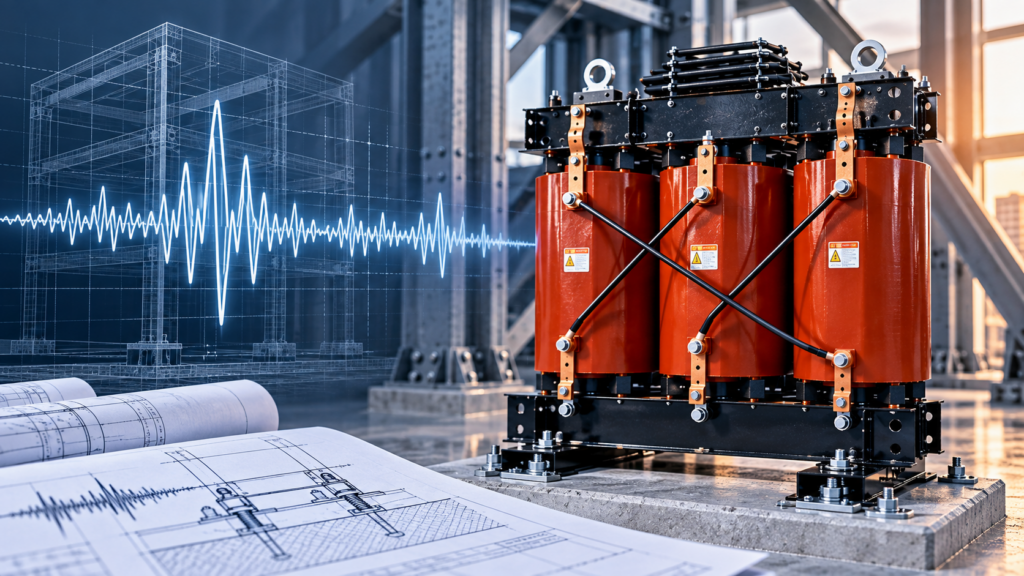
Seismic requirements show up on transformer specifications constantly, and they’re among the most misunderstood lines in the document. A typical spec says something like “the transformer shall be designed for the seismic parameters of the installation location” — and stops there. The intent is clear. What’s missing is any recognition of how seismic certification actually works: how a transformer gets qualified, what the certification covers, and — most importantly — what installation decisions can quietly void it.
This article walks through the code framework in both the United States and Canada, the difference between designing for seismic loads and certifying seismic performance, why certification is tied to the exact tested construction, and the installation detail that undoes more seismic certifications than any other: mounting the transformer on vibration isolation.
Why Transformers Have Seismic Requirements
Building codes treat a dry-type transformer as a nonstructural component — equipment attached to the building rather than part of its structure. The seismic requirements exist at two levels.
The first is life safety: during an earthquake, the transformer must not break loose, topple, or slide into an egress path. This is fundamentally an anchorage problem — the unit must stay attached to the structure through the design seismic event.
The second is functionality: for essential facilities — hospitals, emergency operations centers, fire stations, post-disaster buildings — the transformer must not merely stay put, it must still work afterward. Power distribution is exactly the kind of system these facilities need functioning after an earthquake, and a transformer whose core-and-coil assembly has shifted, whose connections have pulled loose, or whose internal supports have buckled fails that test even if the enclosure never moved.
These two levels drive very different qualification requirements, and conflating them is where much of the specification confusion starts.
The Code Framework
In the United States, the International Building Code points to ASCE 7, Chapter 13 (nonstructural components). The seismic demand on a component is built from a few parameters: the site’s short-period design spectral acceleration (SDS), the component importance factor (Ip — 1.0 for ordinary equipment, 1.5 for life-safety and essential-facility equipment), and the component’s attachment height in the building (the z/h ratio — a rooftop unit sees roughly triple the acceleration of one at grade). ASCE 7 Section 13.2 then defines how compliance is demonstrated: by analysis, by testing, or by experience data. The critical distinction is in Section 13.2.2 — active equipment with Ip = 1.5 that must remain functional after the design earthquake requires certification by shake-table testing or experience data. Analysis alone can qualify anchorage; it cannot certify that energized equipment will still function.
In Canada, the National Building Code addresses the same territory in Sentence 4.1.8.18 — elements and components of buildings — with seismic design forces built from the site’s spectral acceleration, component factors, and height in the building, conceptually parallel to the ASCE 7 approach. CSA S832 (Seismic Risk Reduction of Operational and Functional Components of Buildings) provides the companion guidance, and post-disaster buildings carry functionality expectations equivalent to the U.S. essential-facility category. The engineering logic is the same in both countries: ordinary installations need restraint; critical installations need demonstrated performance.
How Certification Is Actually Done
The recognized method for certifying that a transformer will survive and function is shake-table testing to ICC-ES AC156 — the acceptance criteria developed specifically for seismic certification of nonstructural components, aligned with ASCE 7’s component certification provisions and referenced across North America and internationally.
In an AC156 program, the transformer is mounted on a shake table the same way it would be anchored in service, instrumented, and subjected to a synthesized 30-second multi-frequency input motion whose response spectrum envelopes the code demand for the target SDS and installation height. The unit is functionally verified before and after the test sequence. Passing means the transformer stayed anchored, nothing failed structurally, and it still operates — at the tested seismic level.
The output is a certification tied to specific test parameters: a maximum SDS, an Ip, a z/h assumption, and — this is the part specifications routinely miss — a specific tested configuration.
The Certification Covers the Tested Construction. Exactly.
A shake-table certificate is not a blanket property of a product line. It applies to units built the way the tested units were built: the same core-and-coil mounting arrangement, the same internal bracing, the same enclosure construction, the same base structure and anchorage provisions, the same approximate weight and center of gravity.
Rex Power Magnetics has shake-table tested its dry-type transformers per ICC-ES AC156 against the combined requirements of the IBC, CBC, and NBC, and holds Special Seismic Certifications on that basis: TRU Compliance certifications covering IBC 2021/CBC 2022 at SDS = 2.05g with Ip = 1.5, and NBC 2020 at Sa(0.2) = 2.28g with IE = 1.5 — both for ground-level and rooftop (z/h = 1.0) installations — along with an HCAI Special Seismic Certification Preapproval (OSP-0332), the California healthcare-facility preapproval widely regarded as the most demanding seismic qualification benchmark in North America. Rex can supply seismically rated units on that basis — but only when the unit is manufactured to match the tested construction, and the certification documents say so directly: the limits apply to solid base-mounted transformers. That’s not manufacturer caution; it’s what the certification legally and technically means. Change the core mounting, substitute a different enclosure, add significant accessories that shift the mass distribution, or modify the base, and the tested dynamic behavior no longer describes the unit being shipped. A transformer is a heavy mass on a flexible internal support structure; its seismic response is governed by exactly the construction details that customization changes.
The practical consequence for specifiers: a seismic requirement and a heavily customized construction can be in direct conflict. If the project needs certified seismic performance, the transformer needs to be ordered in a certified configuration — and that conversation should happen at specification time, not at submittal review.

The Springs-and-Snubbers Problem
The most common way a valid seismic certification gets voided in the field is well-intentioned: the design calls for the transformer to be installed on vibration isolation — spring isolators, often with seismic snubbers — to keep transformer hum out of the building structure.
Here’s the problem. The shake-table certification was performed with the transformer rigidly anchored, because that’s the mounting configuration the certificate covers — certification documents state the qualified mounting explicitly (Rex’s certifications, for example, apply to solid base-mounted transformers). Setting the same transformer on springs fundamentally changes the dynamic system. The isolators introduce a new, low natural frequency; the transformer can now displace and rock on its mounts; seismic input that the rigid-mounted unit shrugged off can be amplified through the isolation system; and the snubbers — which limit displacement by impact — introduce shock loads into a structure that was never tested for them.
None of that behavior is covered by the rigid-mount test. Installing a certified transformer on spring isolators and snubbers voids the seismic certification — not as a paperwork technicality, but because the tested configuration and the installed configuration are now two different dynamic systems.
If a project genuinely needs both vibration isolation and seismic qualification, that combination has to be engineered and qualified as a system — the isolated assembly is what needs seismic substantiation, which is a different scope involving the isolation supplier and the project’s structural engineer. What cannot be done is specifying a certified transformer, placing it on springs, and pointing to the transformer’s certificate. The certificate no longer applies to the installation.
Whose Scope Is What
One more point of recurring confusion is worth settling directly: the design of the seismic anchorage is not part of the transformer manufacturer’s scope.
The manufacturer’s scope is the equipment itself — supplying a transformer in a certified configuration, with documented anchorage provisions: the mounting hole locations and sizes, the base construction, and the unit’s weight and center of gravity. These are the inputs the project engineer needs to calculate the anchor demands and design the attachment. That information comes with the certified product.
The site-specific anchorage design — selecting the anchors, verifying embedment and slab capacity, designing any restraint hardware, and stamping the installation for the actual building — belongs to the project’s structural or professional engineer. It depends on things the manufacturer cannot know: the slab construction, the concrete strength, the attachment substrate, the local code adoption, and the rest of the load path down to the structure. Certification documents state this division explicitly — Rex’s certification notes that seismic requirements of anchors and anchoring are to be addressed by the building and site engineers. Specifications frequently assign “design, supply and installation of seismic protection measures” to the equipment supplier, and many jurisdictions additionally require that the seismic restraint design be performed by a locally licensed engineer. Both of those requirements point at the installation side of the line, not the manufacturing side — and bids and submittals go smoother when everyone recognizes that the transformer certificate and the anchorage design are two different deliverables produced by two different parties.
What Specifiers Should Actually Do
A seismic specification that works looks like this: state the site parameters (SDS or the NBC spectral values, the seismic design category, and Ip), state the installation height if it’s not grade level, and require certification to ICC-ES AC156 with a certificate of compliance covering the supplied configuration. Then coordinate three things before release: confirm the transformer will be supplied in the manufacturer’s tested construction; confirm the anchorage design (which is the installing engineer’s scope, using the manufacturer’s anchorage provisions); and confirm the mounting is rigid — or, if vibration isolation is unavoidable, raise it with the manufacturer and the structural engineer at the start, because it changes the entire qualification path.
“Designed for the seismic parameters of the location” is where the specification should begin, not end. The parameters define the demand. The certification — tested construction, rigid mounting, documented certificate — is what demonstrates the transformer can meet it.
Conclusion
Seismic certification of dry-type transformers is well-established engineering with a clear framework: ASCE 7 and the NBC define the demand, AC156 shake-table testing demonstrates the performance, and the certificate covers a specific tested construction, rigidly mounted. The recurring failures aren’t technical — they’re coordination failures. A spec that names parameters but not the certification method; a custom construction ordered against a certificate that doesn’t cover it; a certified unit set on spring isolators that void the whole exercise.
Handled at specification time, none of these are difficult. The site parameters are known, tested configurations exist, and the mounting question has a clear answer. Handled at commissioning — or after the earthquake — they are considerably more expensive.
References
- Rex Power Magnetics — Seismic Qualification and Certification
- Rex Power Magnetics — Certifications
- HCAI Special Seismic Certification Preapproval OSP-0332 (Rex Power Magnetics dry-type transformers)
- ICC-ES AC156 — Acceptance Criteria for Seismic Certification by Shake-Table Testing of Nonstructural Components
- ASCE 7 component certification provisions — commentary and background