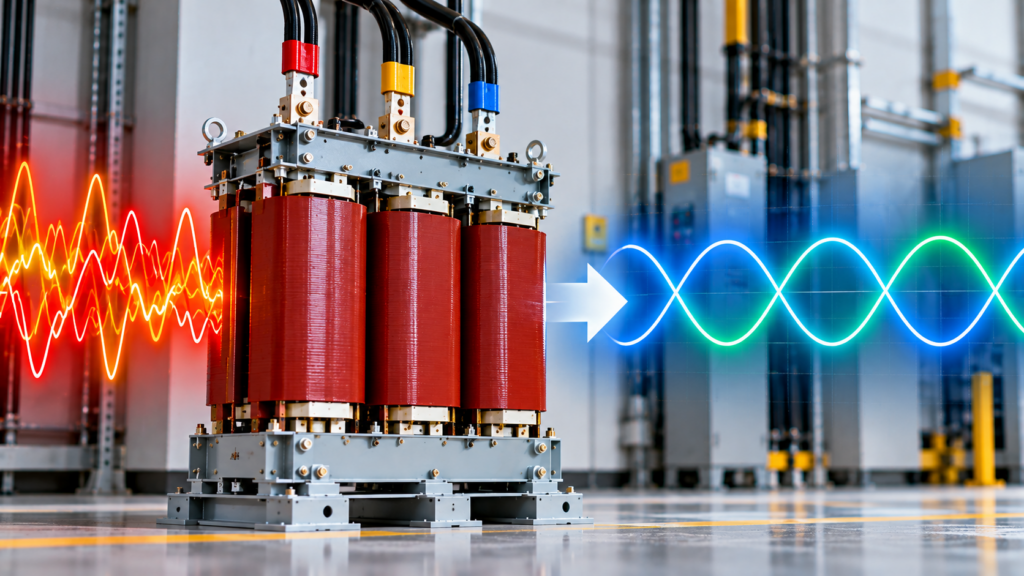
Modern electrical systems contain a growing concentration of non-linear loads — servers, UPS systems, LED lighting, computers, and variable-frequency drives. These devices draw current in pulses rather than smooth sine waves, creating harmonic distortion that travels through distribution systems and increases transformer heating, reduces efficiency, and stresses upstream equipment.
While K-rated transformers are designed to withstand the heating effects of harmonic currents, they do not reduce the distortion itself. Harmonic Mitigating Transformers (HMTs), by contrast, use engineered winding configurations and phase-shift techniques to actively reduce specific harmonic orders, improving upstream power quality and reducing stress across the system.
This article explains how HMTs work, where they are most effective, and how they differ from other harmonic solutions.
Harmonic Distortion in Modern Electrical Systems
Non-linear loads distort current waveforms, producing frequencies that are integer multiples of the fundamental (60 Hz). These harmonic currents adversely affect transformer operation.
Common characteristics include:
- Triplen harmonics (3rd, 9th, 15th) add in the neutral and lead to elevated neutral current.
- 5th and 7th harmonics increase stray flux and cause supplementary eddy-current heating.
- Total Harmonic Distortion (THDi) makes upstream voltage distortion worse under heavy non-linear loading.
- Typical sources include: VFDs, UPS systems, server racks, LED lighting, EV chargers, and switch-mode power supplies.
Without proper mitigation, these harmonics can produce excess transformer heating, nuisance tripping, reduced system capacity, and abnormal neutral conductor loading.

What Is a Harmonic Mitigating Transformer?
A Harmonic Mitigating Transformer is a dry-type transformer engineered to cancel or redirect harmonic currents using specially designed winding configurations, phase shifts, and zero-sequence impedance control.
A Key distinction with K-rated transformers is that HMTs reduce harmonic distortion while K-rated transformers only survive it.
HMTs do not absorb harmonics like a passive filter; instead, they use vector and phase relationships within the transformer windings to prevent additive harmonic currents from flowing into the upstream system.
How Harmonic Mitigating Transformers Work
The effectiveness of an HMT depends on winding geometry, core design, and engineered phase displacement. While the details vary by manufacturer, most HMTs employ three primary mechanisms:
Triplen Harmonic Reduction
Triplen harmonics (3rd, 9th, 15th) are zero-sequence components and naturally accumulate in the neutral. HMT winding schemes such as zig-zag, delta-zig-zag, or special dual-secondary configurations redirect or cancel these triplen currents, reducing neutral overloading.
Cancellation of 5th and 7th Harmonics
When two secondary outputs are phase-shifted (e.g., 0° and 30°), the 5th and 7th harmonic currents produced by separate load banks become 180° out of phase and cancel.
Reduced Stray Losses Through Magnetic Design
HMTs incorporate:
- Optimized core geometry
- Reduced zero-sequence impedance
- Special winding placement
- Controlled flux paths
These features limit leakage flux and minimize higher-frequency eddy-current heating.
The result is a transformer that runs cooler and produces lower upstream current distortion — without filters, reactors, or active electronics.
Types of Harmonic Mitigating Transformers
HMTs are available in several configurations depending on the harmonic profile of the installation.
Triplen-Canceling HMTs
Designed for environments dominated by single-phase electronic loads (offices, IT rooms). They target triplene harmonic reduction (3rd, 9th, 15th) and are used where high neutral current is a concern.
Phase-Shifted / Multi-Pulse HMTs
Provide a deliberate displacement between secondary outputs (e.g., 30° or 15°). When loads are divided appropriately, the 5th and 7th harmonics cancel naturally.
Ideal for:
- VFD-intensive facilities
- UPS plants
- Data centers with distributed non-linear loads
- Dual-Output HMTs
Provide two harmonically complementary outputs, each feeding separate panels. Triplen and non-triplen harmonics partially cancel upstream. Useful where no single load dominates but overall THDi needs reduction.
Benefits of Harmonic Mitigating Transformers
HMTs provide several system-wide advantages, described below in narrative form to maintain flow.
Lower Neutral Currents
By preventing triplen harmonics from accumulating in the neutral, HMTs significantly reduce neutral conductor heating and the risk of overload in 4-wire systems.
Reduced Transformer Heating
Harmonics increase stray and eddy-current losses. With an HMT, these losses are minimized by design, allowing the unit to operate cooler and more efficiently.
Improved Power Quality Upstream
Lower harmonic current flow results in reduced voltage distortion, benefiting sensitive equipment and supporting better PCC (Point of Common Coupling) compliance.
Higher Usable System Capacity
When harmonics are reduced, protective devices and conductors experience lower RMS current, freeing capacity for additional loads.
Extended Equipment Life
Lower temperatures and reduced harmonic stress improve the longevity of both the transformer and connected equipment.
Support for IEEE 519 Compliance
While HMTs do not guarantee compliance, they significantly improve harmonic performance at service entrances and distribution points.
HMTs vs. K-Rated Transformers
This distinction is critical for specifiers:
- K-Rated Transformers
- Harmonic Mitigating Transformers
- Designed to withstand harmonic heating
- Designed to reduce harmonic currents
- Do not change THDi or neutral loading
- Actively reduce harmonic distortion
- Increase reliability under distorted loads
- Improve upstream power quality
A K-rated transformer is appropriate where harmonic content is unavoidable but mitigation is not required. An HMT is appropriate where neutral currents, voltage distortion, or system losses must be reduced.
Application Considerations
Harmonic mitigating transformers should be selected based on a measured or well-characterized harmonic profile. They are most effective in environments where:
- Single-phase electronic loads dominate (triplen issues)
- Multiple VFDs or UPS systems create 5th and 7th harmonic clusters
- Facilities must meet power-quality standards
- Neutral conductors or feeders are running hot
- Upstream voltage distortion limits are being approached
Designers must consider load distribution, phase balance, grounding method, transformer connections, and the presence of other harmonic mitigation equipment (filters, reactors, active solutions). Proper system analysis ensures the HMT performs as intended.
Rex Power Magnetics Perspective
Rex Power Magnetics engineers and manufactures a full range of Harmonic Mitigating Transformers, including:
- Zig-zag and delta-zig-zag configurations for triplen mitigation
- Dual-secondary and phase-shifted outputs for 5th and 7th harmonic cancellation
- Reduced zero-sequence impedance designs for lower neutral current
- Optimized magnetic and winding construction to minimize stray losses
Each HMT is sized and configured based on the specific harmonic spectrum of the application. Rex engineers support consultants and end users with harmonic assessment, load evaluation, and transformer selection to ensure measurable power-quality improvement.
Conclusion
Harmonic mitigating transformers are an effective, passive solution for reducing harmonic currents and improving overall power quality. They provide benefits such as lower transformer heating, reduced neutral loading, improved upstream voltage quality, and better utilization of electrical system capacity.
By combining engineered winding configurations with deliberate phase displacement, HMTs offer a robust way to handle the growing harmonic challenges of modern electrical installations. When selected and applied correctly, they outperform traditional approaches such as K-rated transformers in both performance and long-term system reliability.