Updated: August 17th, 2026
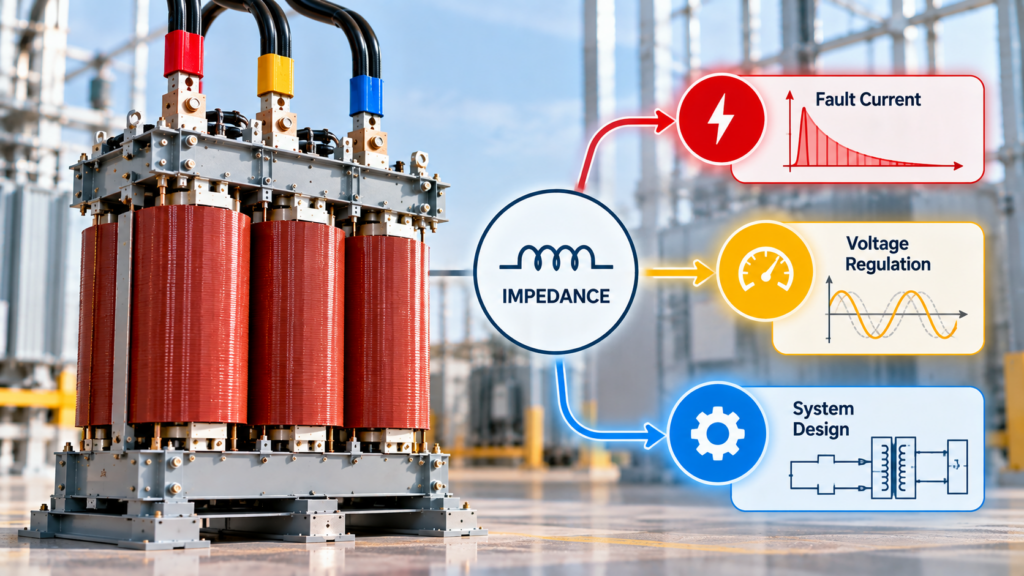
A transformer with lower impedance may provide better voltage regulation. It may also deliver substantially more current into a downstream fault. Increasing the impedance can reduce that fault duty, but the same change may produce more voltage variation during motor starting or other high-current conditions.
This is why impedance should be considered during transformer sizing and selection, not treated as a nameplate value to review after the transformer has already been selected. It is part of the transformer’s electromagnetic design, and it affects the switchgear, conductors, protective devices, and connected loads around it.
Percent impedance, normally shown as %Z, describes the voltage required to circulate rated current through the transformer when one winding is short-circuited. That definition is straightforward. Its consequences for fault-current calculations, protection coordination, parallel operation, and transformer construction require a closer look.
What Percent Impedance Actually Represents
During a transformer short-circuit test, one winding is shorted, and a reduced voltage is applied to the other. The applied voltage is gradually increased until rated current flows through the windings.
If rated current is reached with 5.75% of rated voltage applied, the transformer has an impedance of 5.75%.
Under normal operation, the transformer transfers power magnetically from one winding to the other. During the short-circuit test, the low applied voltage produces only a small portion of normal core flux. The test is therefore dominated by the voltage required to overcome the winding resistance and leakage reactance at rated current.
Percent impedance expresses the combined internal impedance on the transformer’s own voltage and kVA base. This makes it useful in per-unit calculations and allows transformers with different ratings to be compared on a common basis. It does not mean that transformers of different sizes have the same impedance. The specified value still depends on the transformer’s rating, voltage class, construction, winding arrangement, and application.
The tested percent impedance is normally included with the other electrical ratings on the transformer nameplate. Rex’s transformer nameplate guide explains how to interpret these ratings and connection details.
Impedance Comes from Resistance and Leakage Reactance
Transformer impedance has two components: resistance and reactance.
Winding resistance is the electrical resistance of the conductors. It produces load loss and heat as current passes through the windings. The resistive component varies with conductor material, conductor cross-section, mean turn length, temperature, and connection arrangement.
Leakage reactance comes from magnetic flux that links one winding without fully linking the other. Unlike mutual flux in the core, this leakage field occupies the space within and around the windings. Its magnitude is strongly affected by winding height, radial build, spacing between windings, conductor arrangement, and the geometry of the leakage channel.
In many power and distribution transformers, leakage reactance accounts for most of the total impedance. This is an important distinction because it explains why a higher %Z does not automatically mean that the transformer has higher losses or lower efficiency. Two transformers can have similar impedance magnitudes but different resistance-to-reactance ratios and therefore different voltage-regulation, loss, and parallel-operation characteristics.
The relationship between these components is:

The total impedance shown on the nameplate gives the magnitude, but studies involving detailed voltage regulation, protection behaviour, or parallel operation may also require the resistance, reactance, or X/R ratio.
How Winding Design Controls Impedance
Leakage impedance is not a separate component installed inside the transformer. It is created by the winding arrangement itself.
Bringing the primary and secondary windings into closer electromagnetic coupling generally reduces leakage reactance. Increasing the distance between them generally increases it. The actual design is more involved because the engineer must also maintain dielectric clearances, provide cooling ducts, control mechanical forces, accommodate taps, and fit the winding assembly within the available core window.
These requirements often work against one another. A winding arrangement selected only for low impedance may not provide the required insulation distance or short-circuit strength. A design intended to increase impedance cannot simply add uncontrolled spacing without considering thermal performance, mechanical support, and the resulting dimensions.
This is also why impedance cannot normally be changed after manufacturing. Moving taps changes the effective turns ratio and operating voltage; it does not provide an adjustable impedance setting. If a system requires additional impedance after installation, it must generally be introduced through external equipment such as a current-limiting reactor or through a different transformer design.
The Direct Relationship Between Impedance and Fault Current
At the transformer secondary terminals, percent impedance provides a quick estimate of the symmetrical fault current the transformer can supply. If the available source is assumed to be infinitely strong and all external impedance is ignored, the approximate current is:
I_SC = I_rated × (100 ÷ Z%)
Where:
I_SC = short-circuit current
I_rated = transformer rated full-load current
Z% = transformer percent impedance
The same relationship can be written using per-unit impedance:
I_SC = I_rated ÷ Z_pu
The notation matters. A transformer with 5.75% impedance can be entered either as 5.75 in the first equation or as 0.0575 in the second. Mixing percentage and per-unit notation produces a result that is wrong by a factor of 100.
Consider a 500 kVA, three-phase transformer with a 480 V secondary and 5.75% impedance. Its rated secondary current is:
I_rated = (500 × 1,000) ÷ (√3 × 480) ≈ 601 A
The estimated symmetrical fault current at its secondary terminals is therefore:
I_SC = 601 × (100 ÷ 5.75) ≈ 10,450 A
The result is approximately 10.5 kA, assuming the transformer is the only impedance limiting the current.
If the same transformer had 4% impedance, the corresponding estimate would be approximately 15.0 kA. At 7% impedance, it would be approximately 8.6 kA. A change of only a few percentage points on the nameplate can therefore have a significant effect on the short-circuit duty imposed on downstream equipment.
This simplified calculation is useful for an initial check, but it is not a complete short-circuit study. The installed result also depends on utility or generator source impedance, upstream transformers, cables, busways, connections, and contributions from motors or other connected sources. Transformer impedance tolerances must also be considered when determining maximum possible fault current.
Lower Fault Current Is Not the Only Design Objective
It may appear desirable to specify higher impedance whenever available fault current is a concern. That decision has consequences elsewhere in the system.
As load current passes through the transformer impedance, an internal voltage drop develops. The magnitude and phase of that drop depend on the resistive and reactive components of the impedance and on the load power factor.
For a lagging power-factor load, approximate voltage regulation can be expressed as:
Voltage regulation ≈ R% cos φ + X% sin φ
where φ is the load power-factor angle; the reactive component becomes particularly important when the transformer supplies motors, welders, or other loads that draw substantial reactive current.
A higher-impedance transformer may therefore produce a deeper temporary voltage dip during motor starting or other sudden load changes. This can affect contactors, control circuits, variable-frequency drives, lighting, and sensitive electronic loads connected to the same bus.
The design decision is not simply “high impedance versus low impedance.” It is a balance among available fault current, voltage regulation, motor-starting performance, protective-device capability, physical construction, and the requirements of the connected load.
Impedance Sets the Starting Point for Protection Coordination
Protective devices can only clear faults correctly if the expected current lies within their operating and interrupting capabilities.
A low-impedance transformer may deliver enough current to operate an upstream or downstream device quickly, but it can also raise the fault duty beyond the interrupting rating of a breaker, fuse, switchboard, or panelboard. Higher transformer impedance reduces the available current, but sufficiently low fault current at a remote point may increase clearing time.
This is why protection coordination cannot be based on transformer full-load current alone. The study must consider maximum fault current for equipment-duty verification and minimum fault current for reliable protective-device operation. Conductor impedance, transformer tolerances, grounding arrangement, and the type and location of the fault can all change the result.
Specifying a different transformer impedance can sometimes help resolve a system fault-current limitation. It should not be used as a substitute for a complete coordination and equipment-rating review.
Why Impedance Matching Matters in Parallel Operation
Two transformers with the same voltage ratio do not necessarily share load equally when connected in parallel.
With compatible ratios, phase relationships, polarity, connections, and tap positions, the division of load is governed largely by their internal impedances. The transformer with the lower per-unit impedance tends to carry a greater share of the current. It can become overloaded before the combined bank reaches its apparent total kVA capacity.
Matching the magnitude of percent impedance is only part of the requirement. A significant difference in X/R ratio can cause the transformers to share real and reactive current differently, even when the impedance magnitudes appear close. Circulating current may also result from unequal secondary no-load voltages or incompatible tap positions.
Parallel operation should therefore be evaluated using the complete transformer data rather than a simple comparison of the two %Z nameplate values.
There Is No Universally Correct Impedance Value
Typical impedance varies with kVA rating, voltage class, winding construction, insulation requirements, and applicable product standards. Smaller low-voltage transformers may have relatively low impedance, while larger dry-type power transformers commonly require higher values. Special impedance levels may also be designed where an application has unusual fault-current, voltage-drop, or paralleling requirements.
These ranges should not be used as quality rankings. A transformer is not better because its impedance is lower, nor is it inherently safer because its impedance is higher. The relevant question is whether its impedance fits the electrical system in which it will operate.
The nameplate value or certified test report should always be used when calculating an existing unit. During specification, the required impedance should be established early enough for the transformer manufacturer to incorporate it into the winding design. Rex Power Magnetics can provide general-purpose isolation transformers with special impedance levels where the system requirements justify a non-standard design.
Conclusion
Transformer impedance connects the internal winding design to the behaviour of the entire electrical system. It determines how much fault current the transformer can supply, contributes to voltage variation under load, influences protective-device coordination, and controls how transformers divide load in parallel.
The lowest available impedance is not automatically the best choice. Neither is specifying a higher value simply to reduce fault current. Each change affects another part of the system.
The correct impedance is the value that satisfies the required balance among fault-current duty, voltage regulation, load behaviour, protection, and transformer construction. Establishing that balance before the transformer is manufactured is considerably easier than correcting it after the equipment and switchgear have been installed.