Most low-voltage distribution gets built up from discrete components. A transformer here, a primary disconnect there, a panelboard somewhere downstream, conduit and conductors tying them together, all sized and specified and installed separately. For the majority of commercial and industrial applications, that’s the right approach — flexible, well-understood, and built around the standard equipment electricians work with every day.
There’s a class of installations where the discrete approach starts to lose its advantages. Tight spaces, remote locations, repeated identical drops to the same kind of load, or budgets and schedules that can’t absorb the labor of assembling and coordinating multiple components on site. For those cases, the mini power center (MPC) packages the same functions into a single factory-assembled unit. This article covers what an MPC actually is, where it fits, and how to think about the choice between integrated and discrete distribution.
What a Mini Power Center Actually Is
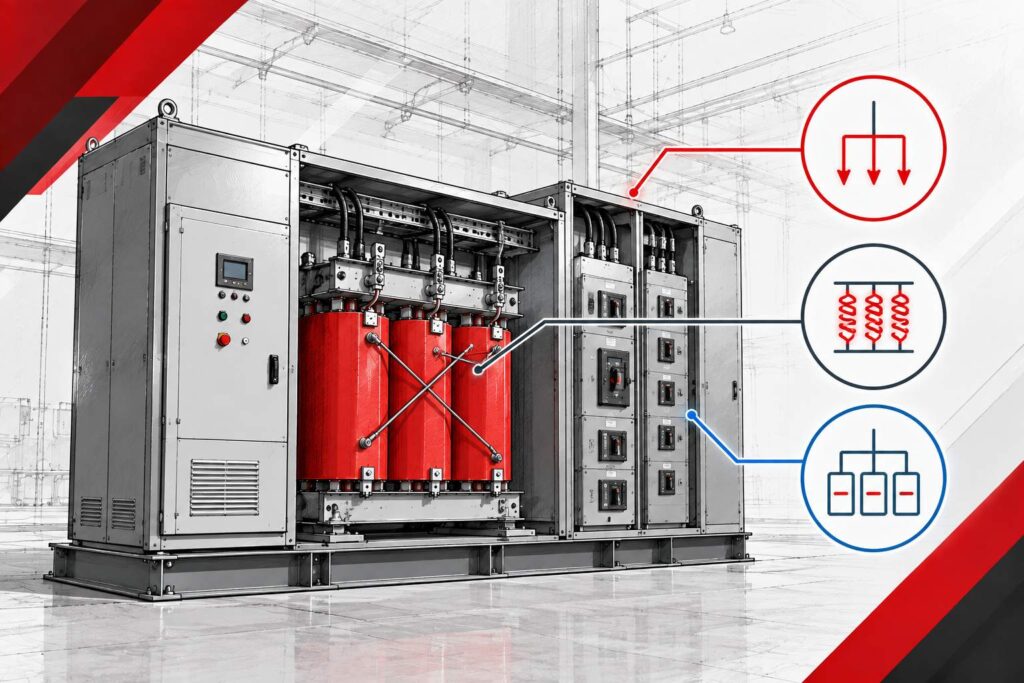
A mini power center is a single enclosure that integrates the three main components of a small distribution drop:
- Primary disconnect — a fused switch or circuit breaker on the input side
- Step-down transformer — typically 480 V or 600 V primary to 120/240 V or 208/120 V secondary encapsulated transformer
- Secondary panelboard — with branch circuit breakers and a neutral/ground bus
Everything is factory-wired, tested, and labeled. The installation reduces to mounting the enclosure, landing the primary feed, and landing the branch circuits. The transformer is usually a dry-type encapsulated or ventilated design, sized in the range of 5 to 75 kVA for most product lines.
What sets MPCs apart from a “small substation” or “unit substation” is the scale and the application focus. Unit substations handle hundreds to thousands of kVA at medium voltage. Mini power centers handle the tail end of low-voltage distribution — the last step from a facility bus down to receptacle or lighting voltage at a specific load location.
Where MPCs Earn Their Place
A few application patterns repeat in the field.
Remote or distributed equipment. Pumping stations, telecom huts, EV charging sites, outdoor process equipment, modular buildings, and similar installations often need a small panel of 120 V circuits, fed from a 480 V or 600 V supply that’s already on site. Running an entire transformer-plus-panelboard assembly to each location adds labor, coordination, and on-site rework. An MPC arrives ready to wire.
Repeated identical drops. When a facility has a dozen identical workstations, machine tools, or equipment skids, each requiring the same modest amount of utilization voltage, an MPC at each location is faster to specify, easier to standardize, and simpler to maintain than a dozen custom assemblies.
Space-constrained installations. A factory-integrated unit takes less floor space than discrete components with conduit between them, and the layout is fixed in advance. In mechanical rooms, electrical closets, and modular installations where every inch matters, an MPC can fit where a discrete assembly doesn’t.
OEM and skid-mounted equipment. Equipment manufacturers building skids for delivery to end users frequently spec MPCs as the supply for onboard controls and auxiliaries. The skid arrives at the customer site with one primary connection and a fully integrated secondary distribution.
Temporary and rental power. Construction sites, events, and temporary installations benefit from the rapid deployment that integrated equipment allows. Plug-and-play primary connection, immediate availability of branch circuits.
MPC vs. Discrete Distribution: The Real Trade-Offs
The decision between an MPC and a discrete transformer-plus-panelboard setup comes down to a small number of factors. Both approaches deliver the same end result — isolated, properly fused branch circuits at the required voltage — but the cost and complexity profile differs.
Installation labor. MPCs win, often by a lot. A discrete assembly involves mounting the transformer, mounting the primary disconnect, mounting the panelboard, sizing and pulling conduit between them, terminating the inter-component wiring, and labeling everything. An MPC arrives with all of that done. For a small installation with one feed and one panel, the labor savings frequently exceed the equipment cost difference.
Equipment cost. Discrete components are usually cheaper to buy in isolation. Buy a transformer, a disconnect, and a panelboard separately and the bill of materials is typically lower than the equivalent MPC. The MPC’s premium pays for the factory integration, the testing, and the single-source warranty. Whether that premium is worth it depends on the labor and coordination savings on the other side.
Flexibility. Discrete wins. A standard MPC comes with a fixed transformer kVA, a fixed number of branch circuit poles, and a fixed enclosure configuration. If the application later needs more capacity, more circuits, or different protection, modifying an MPC is harder than swapping a component in a discrete assembly. Discrete construction also accommodates non-standard requirements — unusual voltages, special transformer types (K-factor, drive isolation, harmonic-mitigating), or unusual breaker arrangements — that an off-the-shelf MPC may not.
Footprint. MPCs win. Factory integration removes the conduit between components and packs the assembly tighter than discrete construction usually achieves.
Maintenance. Roughly even, with different failure modes. An MPC consolidates several components in one enclosure, so a transformer fault that takes the unit out of service may require pulling the entire MPC. A discrete assembly lets you replace a panelboard without touching the transformer. On the other hand, MPCs come with a single source of warranty and support, which can simplify troubleshooting on critical installations.
Standardization. MPCs win for repeated installations. Specifying one part number twelve times is much easier than coordinating twelve discrete assemblies. The downside is that the standardization only helps if the application actually fits the standard product.
Sizing and Specification
MPC sizing follows the same logic as any other transformer-and-panel combination. The kVA must cover the connected load with appropriate diversity, plus margin for inrush, harmonics, future growth, and ambient conditions. A standard rule of thumb — size the transformer to 80% loading at expected peak, then verify against the actual harmonic and inrush profile — works reasonably well for typical commercial and light industrial loads. For loads with significant power-electronic content (LED drivers, VFDs, electronic ballasts, switching power supplies), a K-factor rated transformer or explicit harmonic margin is appropriate.
Voltage selection is usually constrained by what’s available on site. A 480 V three-phase primary feeding a 208Y/120 V secondary is the most common configuration in North American commercial work. 600 V primaries are common in Canadian installations. 240 V primaries serve light commercial or residential adjacent applications.
Panelboard sizing — number of poles, main breaker rating, branch breaker provisions — should be matched to both immediate needs and reasonable future expansion. Specifying too tightly is a common error; the cost difference between a 12-circuit and an 18-circuit MPC is usually small compared to the cost of replacing the entire unit when the building load grows.
Other selection considerations include enclosure rating (NEMA 1 indoor, NEMA 3R outdoor, NEMA 4X for washdown or corrosive environments), grounding configuration, fusing or breaker preference on the primary, and any specific listings or certifications required for the installation (CSA, UL, NEMA, or industry-specific).
When to Skip the MPC
A few application patterns push back toward discrete components.
Large installations. Above a few hundred amperes on the secondary, the integrated form factor stops making sense and a unit substation or discrete construction is more appropriate.
Unusual voltages or special transformers. If the application needs an isolation transformer with electrostatic shielding, a K-13 or K-20 harmonic-rated unit, a drive isolation transformer, or any non-standard voltage ratio, an off-the-shelf MPC may not cover it. Custom MPC construction is possible but starts to erode the cost advantage.
Frequent reconfiguration. Installations where the panel layout, circuit count, or transformer size is likely to change significantly over time are better served by discrete components that can be modified piece by piece.
Highly critical loads with specific maintenance requirements. Applications where individual components need to be serviced or replaced without affecting the others may justify the labor cost of discrete construction.
Conclusion
Mini power centers solve a specific problem: getting from a facility bus to usable utilization voltage at a load location, with minimum installation labor, predictable footprint, and standardized specifications. They’re not a replacement for discrete distribution in general — they’re the right tool for the applications where their advantages line up with the actual requirements.
The choice between integrated and discrete distribution isn’t a value judgment about either approach. It’s a question of which one fits the constraints of the specific installation. Remote, repeated, space-constrained, or skid-mounted applications usually point toward an MPC. Large, custom, evolving, or specialty applications usually point toward discrete components. Most facilities end up with both, used where each makes the most sense.