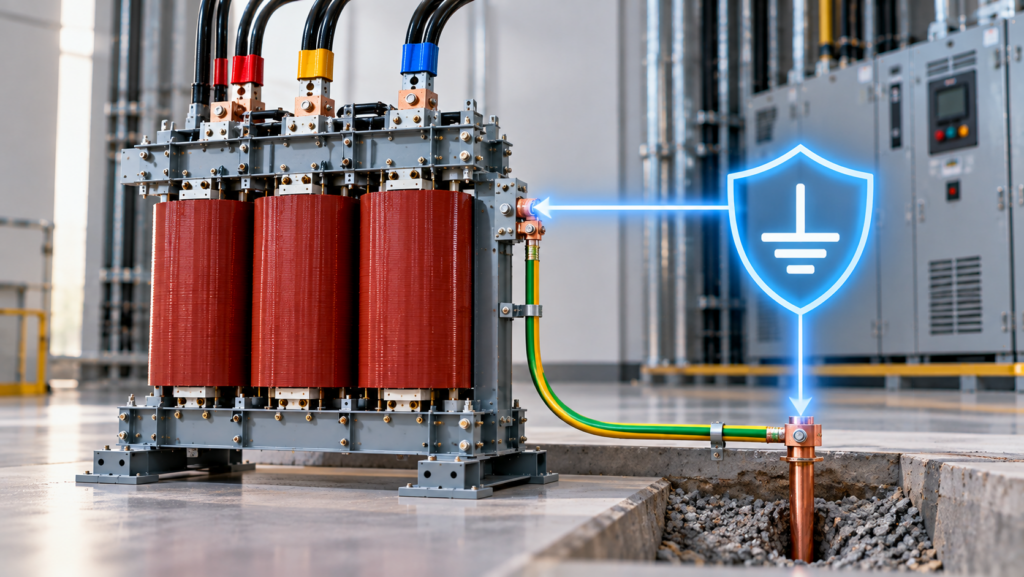
Transformer grounding is one of the most critical aspects of electrical system design. It establishes a reference point for phase voltages, ensures predictable system behavior during ground faults, and enables safe operation of protection systems. Whether applied in commercial, industrial, or utility environments, proper transformer neutral grounding is fundamental to electrical safety, equipment performance, and compliance with local electrical codes.
Grounding practices vary depending on transformer configuration, system voltage, and the nature of the loads being supplied. In all cases, however, grounding must follow the requirements of the Canadian Electrical Code (CEC) or the National Electrical Code (NEC), along with manufacturer recommendations. Improper grounding can lead to unstable voltages, nuisance tripping, dangerous overvoltages, or even catastrophic equipment failures.
This article explains what transformer neutral grounding is, why it is essential, and how different grounding methods affect system performance.
What Is Transformer Neutral Grounding?
Transformer neutral grounding refers to the intentional connection of a transformer’s neutral point—typically on the secondary winding—to ground. This connection establishes a stable reference for the electrical system and defines how the system responds to ground faults.
A transformer secondary is considered a separately derived system (SDS) when it is electrically isolated from all other grounded systems. When a transformer creates an SDS, the system neutral must be grounded according to code-defined rules. This grounding point also dictates where the system’s neutral-to-ground bond is permitted.
Neutral grounding is more than a simple bond. It determines:
How ground faults flow
- What voltage stresses the insulation experiences
- How protective relays and circuit breakers operate
- Whether touch voltages remain safe under fault conditions
Proper grounding is therefore not optional; it is a critical engineering decision.
Why Proper Grounding Is Essential
Grounding directly affects four key aspects of electrical system performance.
Safety
Grounding prevents phase-to-ground voltages from drifting upward, thereby reducing shock hazards. It also ensures that ground-fault currents return through a controlled path rather than through unintended structures or personnel.
Protection System Performance
Protective devices rely on ground-fault current magnitude and direction. Proper grounding ensures that:
- Fault currents are high enough for relays to detect
- Protection settings coordinate correctly
- Ground faults clear rapidly and selectively
Without grounding, fault currents may be too low for protective devices to respond.
Voltage Stabilization
Grounding helps maintain stable phase-to-ground voltage relationships. Systems without proper grounding may experience floating neutral conditions, transient overvoltages, or ferroresonance—each of which can impose severe stress on insulation systems.
Equipment Longevity
Ungrounded or improperly grounded systems can subject equipment to unpredictable voltage stress, increasing the risk of premature insulation failure or transformer damage.
Types of Transformer Grounding Configurations
Different grounding methods define how the system behaves during a ground fault.
1. Solidly Grounded Systems
The neutral is directly bonded to ground.
- Fast operation of protection systems
- High ground-fault currents
- Common for low-voltage distribution (e.g., 208Y/120 V, 480Y/277 V systems)
2. Resistance Grounded Systems
The neutral is connected to ground through a resistor.
- Limits fault current to safer levels
- Reduces mechanical and thermal stress
- Widely used in medium-voltage industrial systems
3. Reactance Grounded Systems
The neutral is grounded through a reactor (air-core).
- Limits fault current using inductive reactance
- Used in MV/HV networks and generator applications
- Provides controlled fault levels while preventing transient overvoltages
4. Ungrounded Systems
No intentional connection to ground.
- Allows continued operation during the first ground fault
- Higher risk of transient overvoltages
- Rarely used in modern design except in specialized industrial applications
- Transformer Winding Configurations and Grounding Implications
- Transformer winding configuration determines whether a natural neutral point is available.
Wye (Star) Secondary
A wye-connected secondary provides a natural neutral point.
- Ideal for 4-wire distribution systems
- Simple, reliable grounding
- Used for 208Y/120 V, 600Y/347 V, and similar systems
- Delta Secondary
Delta windings have no neutral point.
- Cannot supply line-to-neutral loads
- Provide isolation from upstream grounding
- Often used for motor loads or to block triplen harmonics
If grounding is required, it must be achieved using a grounding transformer.
Zig-Zag and Grounding Transformers
These special-purpose transformers create a neutral point for grounding when none exists on the system. They are commonly used:
- On delta-fed systems requiring a neutral for grounding
- In grounding resistor/reactor applications
- In systems requiring harmonic reduction from zero-sequence currents
- Grounding Transformers: When the Neutral Is Not Available
A grounding transformer is used to supply a neutral reference when the main transformer’s secondary does not provide one. This is necessary for:
- Delta-only systems needing ground-fault protection
- Distributed generation installations requiring defined grounding
- Systems where ground-fault currents must be limited
Zig-zag grounding transformers and wye-broken-delta connections are the most common configurations. They provide an effective neutral point while controlling the magnitude and path of ground-fault current.
Consequences of Improper or Missing Neutral Grounding
Improper grounding can create severe operational and safety issues, including:
- Unstable phase voltages due to floating neutral conditions
- Nuisance tripping or failure of ground-fault protection
- Elevated insulation stress, leading to premature equipment failure
- Transient overvoltages that exceed transformer BIL ratings
- Difficult fault location, prolonging unsafe conditions
- Circulating currents, if multiple neutral-ground bonds exist
- Shock hazards, due to unregulated touch/step voltages
In extreme cases, improper grounding can lead to catastrophic equipment failure.
Code Requirements (CEC and NEC)
Both the CEC and NEC define when and how transformer secondaries must be grounded. While specific clauses differ, both codes require:
- Grounding of secondary neutrals in most SDS configurations
- A single neutral-to-ground bond per SDS
- Proper sizing of grounding electrodes, bonding jumpers, and grounding conductors
- Clear identification of grounding conductors
- Ground-fault protection where required
Adhering to code requirements is not only mandatory for inspection approval but also essential for safe operation.
Best Practices for Transformer Neutral Grounding
Good engineering practice strengthens both safety and system reliability.
- Confirm whether the transformer secondary forms a separately derived system (SDS).
- Ground the neutral at the location specified by code—usually the first disconnecting means.
- Ensure only one neutral-to-ground bond exists within the SDS.
- Size grounding and bonding conductors according to the available fault current.
- Coordinate grounding method with protective device settings.
- For harmonic-heavy installations, evaluate neutral conductor loading and consider oversized neutrals or grounding transformers.
- When using resistance or reactance grounding, verify thermal and short-time ratings for the grounding equipment.
Rex Power Magnetics Perspective
Rex Power Magnetics provides transformers designed with grounding in mind. Our capabilities include:
- Wye, delta, zig-zag, and grounding transformer designs
- Compatibility with resistance and reactance grounding systems
- Engineering guidance for grounding, bonding, and SDS configuration
- Application support for harmonic mitigation and neutral loading
- Clear documentation and diagrams for correct grounding and installation
By combining engineering expertise with high-quality manufacturing, Rex ensures that customers receive safe, reliable, and code-compliant grounding solutions.
Conclusion
Proper transformer neutral grounding is essential for ensuring electrical safety, stable phase voltages, predictable protection behavior, and long equipment life. Grounding choices directly affect system performance during faults and must be selected carefully based on transformer configuration, system requirements, and code rules.
By understanding the grounding implications of transformer winding arrangements and applying appropriate grounding methods—whether solid, resistive, or reactive—engineers can create electrical systems that operate safely, efficiently, and reliably.