Transformers are designed to operate with remarkable efficiency, often exceeding 98%. Yet even the best designs experience small but unavoidable energy losses whenever voltage and current flow through their magnetic and electrical paths. These losses manifest as heat, which affects performance, reliability, and lifecycle cost.
Understanding the types, causes, and magnitude of transformer losses is essential for optimizing performance and specifying units that balance energy efficiency with durability. Industry standards such as IEEE C57.12.01, CSA C802.2, and NRCan 2019 define acceptable loss levels and testing methods to ensure consistent, measurable performance across manufacturers.
This article explores the primary loss components—core, conductor, and stray—and explains how they influence transformer efficiency and long-term operating cost.
Core (No-Load) Losses
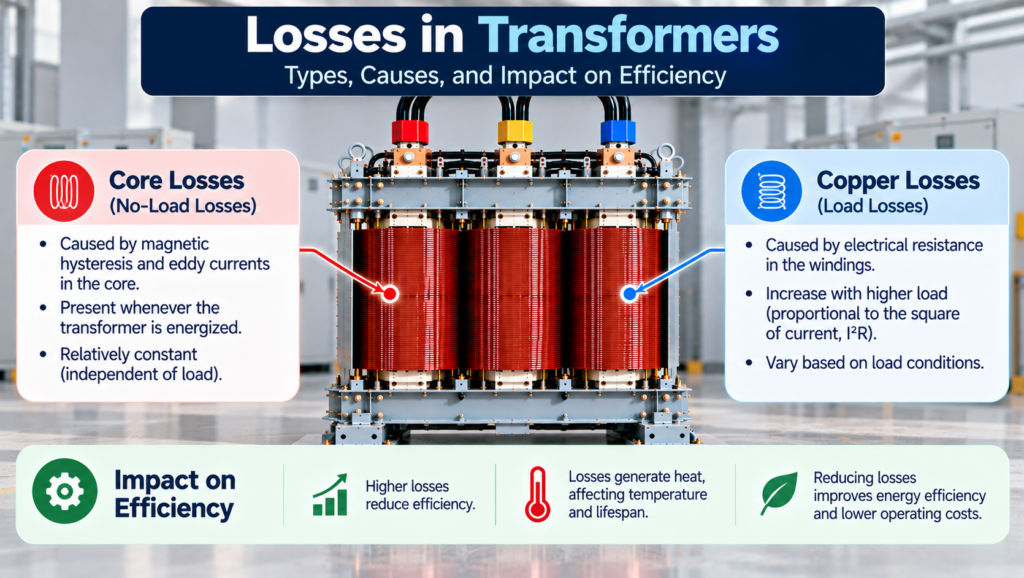
Core losses, also called no-load losses, occur whenever a transformer is energized, regardless of the load. They arise from the magnetization and demagnetization of the steel core with each alternating current cycle.
Two physical phenomena cause these losses:
Hysteresis Loss: As the magnetic field in the core reverses direction 60 times per second, the steel’s magnetic domains realign. The molecular friction created during this process consumes energy and produces heat.
Eddy Current Loss: Alternating magnetic flux induces circulating currents within the steel laminations. These currents generate localized heating that further contributes to no-load loss.
Core losses depend primarily on the magnetic properties of the steel and the flux density in the core. Using grain-oriented silicon steel, thin laminations, and optimized joint design (such as step-lap construction) significantly reduces hysteresis and eddy current effects.
Because no-load losses occur continuously whenever the transformer is energized, they represent a major portion of energy consumption in lightly loaded or continuously energized equipment.
Load (Conductor) Losses
Load, or conductor losses, occur when current flows through the transformer windings. They are proportional to the square of the load current and arise from the electrical resistance of the winding material—whether copper or aluminum. The fundamental principle is the same: current squared times resistance (I²R).
As current increases, conductor heating rises sharply. Winding material, cross-sectional area, temperature, and operating conditions all influence these losses. Transformers designed with larger conductor cross-sections or higher conductivity material exhibit lower resistive losses but at higher material cost and weight.
Conductor losses also vary with temperature. As winding temperature rises, resistance increases, resulting in slightly higher losses at full load. For this reason, test results are standardized to a 75°C reference temperature for comparison across manufacturers and materials.
Stray and Additional Losses
In addition to I²R losses, transformers experience stray losses caused by leakage magnetic flux that does not follow the intended path through the core. This flux induces eddy currents in nearby metallic parts—such as core clamps, tank walls, and structural supports—creating additional localized heating.
Other factors can add to stray losses:
Leakage Flux Coupling: Non-uniform magnetic fields around conductors induce circulating currents in adjacent metalwork.
Proximity and Skin Effects: At higher frequencies or in harmonic-rich systems, current tends to concentrate near conductor surfaces, increasing effective resistance.
Harmonic Currents: Non-linear loads such as VFDs and UPS systems generate harmonics that elevate both conductor and stray losses beyond standard design expectations.
Stray losses are usually small but can become significant in systems with high harmonic distortion or non-sinusoidal loading. IEEE C57.110 provides detailed guidance for evaluating these effects and applying appropriate derating factors.
Total Losses and Efficiency
A transformer’s total loss at any load point is the sum of its core, conductor, and stray losses. These losses convert directly into heat, reducing efficiency and increasing cooling demand.
Efficiency is defined as the ratio of output power to input power, expressed as a percentage. Because no-load losses are constant while load losses vary with current, transformer efficiency changes with load.
Most transformers reach their maximum (peak) efficiency at approximately 40% to 70% of rated load—where the variable and constant losses are balanced. Operating consistently above or below that range can result in increased losses and reduced overall efficiency.
Factors Affecting Transformer Efficiency
Transformer efficiency depends on both design and operational factors.
Material Quality and Design
- High-grade, grain-oriented core steel minimizes hysteresis and eddy current losses.
- Larger conductors or high-conductivity materials reduce resistive losses but increase cost and mass.
- Precision coil geometry and balanced magnetic design limit stray flux.
Operating Conditions
- Elevated ambient temperatures reduce cooling effectiveness and increase winding resistance.
- Unbalanced loading between phases can cause localized heating.
- Harmonic distortion raises apparent load and loss levels, even when RMS current remains within limits.
System Sizing and Loading
- Selecting a transformer appropriately sized for its expected loading profile is critical. Oversized transformers operate with higher no-load losses relative to useful load, while undersized units run hotter and age faster.
- Matching transformer capacity to the real load curve ensures both energy and cost efficiency.
Efficiency Standards and Regulatory Requirements
National efficiency regulations ensure that modern transformers contribute to energy conservation and environmental responsibility.
In Canada, Natural Resources Canada (NRCan) 2019 efficiency regulations establish minimum performance levels for dry-type distribution transformers under the Energy Efficiency Act. These requirements are harmonized with CSA C802.2, which defines test methods, reference conditions, and reporting procedures.
In the United States, the DOE 2016 Energy Conservation Standards define comparable limits. Both standards specify minimum efficiencies at rated voltage, frequency, and load conditions, ensuring consistency across the North American market.
Rex Power Magnetics designs and tests transformers to meet or exceed NRCan 2019 and DOE 2016 efficiency requirements, verifying compliance through certified performance testing at rated conditions.

Improving Efficiency Through Design and Application
While losses cannot be eliminated entirely, they can be minimized through engineering, materials, and proper system application.
Design Optimizations
- Use of high-permeability, low-loss core steel.
- Precision-engineered step-lap cores to reduce flux leakage and noise.
- Optimized winding geometry to minimize leakage flux paths.
- Selection of conductor material and size to balance cost and efficiency.
Application Best Practices
- Select transformers sized for typical (not peak) load conditions.
- Maintain clean ventilation and monitor operating temperature.
- Address harmonic distortion through filters or harmonic-mitigating transformers.
- Implement regular maintenance to prevent connection losses and overheating.
- An efficient transformer not only saves energy but also operates cooler, extending insulation life and improving overall system reliability.
Conclusion
Every transformer experiences energy losses—but understanding their sources is the first step toward minimizing them. Core losses occur continuously, conductor losses rise with load, and stray losses emerge from leakage flux and harmonics. Together, these factors determine total efficiency, operational temperature, and long-term cost of ownership.
Modern efficiency standards such as NRCan 2019, CSA C802.2, and DOE 2016 ensure that transformers deliver maximum energy performance while maintaining safety and reliability.
At Rex Power Magnetics, our transformers are engineered for optimized efficiency through advanced materials, precision magnetic design, and controlled manufacturing processes. Each unit is tested and verified to meet or exceed applicable efficiency standards—providing dependable, cost-effective operation throughout its service life.