Updated: August 17th, 2026
A K-rating is often selected from the connected equipment list: office loads receive one rating, data centres another, and variable-frequency drives another. That approach is convenient, but it can miss the actual transformer problem. Two facilities with similar equipment can produce very different harmonic spectra because of drive topology, loading, system impedance, uninterruptible power supply operating mode and the mix of single-phase loads.
The transformer does not respond to the equipment label. It responds to the current waveform. Correct selection therefore begins with the harmonic current spectrum, the transformer’s loss distribution and the neutral-current path. This article explains how harmonic currents create additional transformer heating, what a K-rating represents and when a K-rated transformer is not the complete solution.
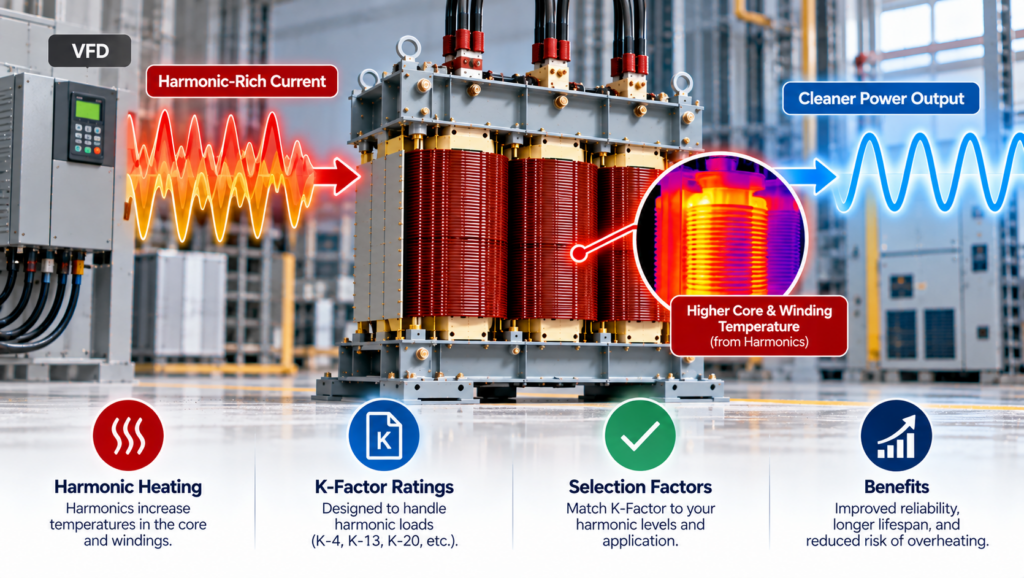
How Harmonic Currents Create Transformer Heating
A linear load draws current approximately in proportion to the applied voltage. A non-linear load draws current in pulses. Switch-mode power supplies, uninterruptible power supplies, rectifiers, electronic lighting and variable-frequency drives all use power electronics that reshape the current waveform.
A distorted waveform can be resolved into the 60-hertz fundamental and harmonic components at integer multiples of that frequency. The 3rd harmonic is 180 hertz, the 5th is 300 hertz, and the 7th is 420 hertz. Six-pulse drives commonly produce strong 5th- and 7th-order currents, while single-phase electronic loads can produce significant triplen harmonics.
The additional heating is not explained by kilovolt-amperes alone. Harmonic current increases total root mean square current and therefore increases conductor I²R loss. Higher-frequency components also increase skin effect, proximity effect and winding eddy-current loss. Eddy-current heating rises more rapidly with harmonic order than the harmonic current magnitude by itself suggests, which can create local hot spots even when the transformer is not above nameplate kVA.
This is why a conventional transformer can run hotter on a non-linear load than on a sinusoidal load with the same measured root mean square current. The practical consequences are higher temperature rise, reduced efficiency and faster thermal ageing of the insulation system.
Harmonic forces may also add higher-frequency sound and vibration. A change in transformer noise should not automatically be attributed to harmonics, however. Loose hardware, excessive voltage, unusual loading and installation conditions must also be checked.
Why Triplen Harmonics Create a Separate Neutral Problem
In a balanced three-phase, four-wire system, the 60-hertz phase currents cancel in the neutral. Triplen harmonics, the 3rd, 9th, 15th and other odd multiples of three, are zero-sequence components. They are in phase on all three phases and add in the neutral instead of cancelling.
A transformer supplying a large concentration of line-to-neutral electronic loads can therefore have a neutral current approaching or exceeding the phase current. The heating is not limited to the windings. It can appear in the transformer neutral bus, cable, panelboard, busway and terminations.
K-factor transformer constructions address this condition with increased neutral capacity. Underwriters Laboratories (UL) 1561 K-factor designs are commonly provided with a neutral bar rated at approximately 200% of full-load current. That larger transformer neutral does not automatically make the downstream distribution system suitable. The neutral conductor and every connection in the return path still need to be checked for the expected triplen current.
The K-factor is a thermal index based on the harmonic current spectrum. Each harmonic component is weighted by the square of its order:
K = Σ [Iₕ(pu)² × h²]
Where:
- Iₕ(pu) is the root mean square current at harmonic order h, expressed per unit of rated root mean square load current.
- h is the harmonic order.
- Σ means that the weighted values for the harmonic spectrum are added together.
The h² term is the important part. A relatively small 13th-harmonic current can contribute materially to the calculated K-factor because it is weighted by 13².
For the same reason, total harmonic distortion alone is not enough to select a transformer. Two loads can have similar current total harmonic distortion but different K-factors if one spectrum contains more high-order current.
K-1 represents the baseline associated with little harmonic heating. Commonly specified ratings include K-4, K-9, K-13 and K-20, with higher ratings available for engineered applications.
A higher number does not mean better power quality, and it does not mean the transformer removes harmonics. It means the transformer is designed to carry a defined non-sinusoidal current spectrum without exceeding its specified temperature-rise limit.
Overspecifying the K-rating is not always harmless. Higher ratings can change winding geometry, impedance, sound level, physical size, cost and available fault current. The rating should match the expected spectrum rather than serve as a substitute for a power-quality study. NEMA’s guidance for data-centre transformer applications similarly treats the K-rating as one part of a wider design decision.
How a K-Rated Transformer Is Designed Differently
A K-rated dry-type transformer uses several design features to manage the additional losses created by non-sinusoidal load current.
Winding Conductor Design
The winding can use smaller parallel conductors, foil or other optimized conductor geometry to reduce eddy-current concentration. Additional conductor area may also be used to control root mean square heating.
The appropriate construction depends on current density, harmonic order, winding location and stray-flux exposure. Simply increasing conductor size without considering conductor geometry may not control high-frequency losses effectively.
Winding Arrangement and Cooling
Sectioning, spacing and cooling ducts can be arranged to move heat away from areas where harmonic losses concentrate.
The objective is not simply to lower average winding temperature. The design must prevent localized hot spots from exceeding the insulation system’s thermal capability. A transformer can have an acceptable average temperature while individual winding regions operate substantially hotter.
Core and Magnetic Design
The applied voltage and frequency still establish the main core flux. Harmonic load current primarily increases winding and stray losses rather than fundamental core flux.
Manufacturers may nevertheless use controlled flux density and low-loss core steel as part of the complete thermal design, particularly where stray flux and higher-frequency loss are significant. The exact balance between core size, winding arrangement, impedance and cooling depends on the transformer rating and the manufacturer’s construction method.
Neutral Construction
A 200% neutral is a defining practical feature for many low-voltage K-rated designs serving three-phase, four-wire systems. It addresses additive triplen current at the transformer.
It does not replace the need to specify downstream neutrals, panelboards and distribution equipment correctly.
These design measures are evaluated as a system. A Class H insulation system, larger conductor or extra ventilation by itself does not establish a K-rating. The transformer must meet the applicable construction, marking and temperature-rise requirements for its stated rating.
K-Rated and Harmonic-Mitigating Transformers Solve Different Problems
A K-factor -rated transformer is designed to withstand harmonic heating. The harmonic currents remain in the system.
A harmonic-mitigating transformer uses winding configuration, phase displacement and zero-sequence impedance to reduce selected harmonic currents or prevent them from propagating upstream. Line reactors, multi-pulse arrangements and active or passive filters may also be appropriate, depending on the load and the required point of compliance.
The selection depends on the engineering objective. Where the concern is transformer temperature rise, a correctly selected K-rated unit may be sufficient.
Where the concern is neutral current, voltage distortion, generator compatibility or harmonic current at the point of common coupling, harmonic mitigation must be evaluated at the system level. More background is available in Rex Power Magnetics’ guide to harmonics in power systems.
Selecting the Correct K-Rating
Selection should begin with an inventory of the loads and how they operate. Drive pulse configuration, uninterruptible power supply topology, server utilization, electronic lighting, battery chargers and the proportion of line-to-neutral loads all affect the spectrum.
Future load additions also matter. A transformer that is suitable at commissioning may no longer be suitable after an information technology or process expansion.
Where the harmonic content is material, individual current harmonics should be measured with a power-quality analyzer over a representative operating period. A short reading during light load can miss the condition that controls transformer heating.
Measurements should include normal production, high electronic-load demand, uninterruptible power supply operation and any operating mode that changes the rectifier or drive loading.
The following ranges are useful only for preliminary screening:
Equipment type should not be used as the final selection method. A lightly loaded modern uninterruptible power supply with an active front end may produce a less severe spectrum than an older or more heavily loaded unit. Drives with different pulse configurations can also impose substantially different harmonic currents.
An existing standard transformer does not always have to be replaced immediately. IEEE C57.110 provides methods for evaluating the capability of liquid-filled and dry-type two-winding transformers supplying non-sinusoidal load current. In some applications, derating the existing transformer may be technically acceptable.
That decision must also address neutral capacity, operating temperature and the connected equipment. Reducing kVA loading does not correct an undersized neutral. IEEE C57.110 also does not cover rectifier transformers, so those applications require separate design guidance.
The final transformer specification must still address:
- Kilovolt-ampere rating
- Voltage ratio and taps
- Impedance
- Temperature rise
- Enclosure and environmental conditions
- Efficiency
- Sound requirements
- Ambient temperature and altitude
- Ventilation
- Available short-circuit current
- Expected future loading
A K-rating does not correct an undersized transformer or an unsuitable installation.
Standards and Certification to Confirm
The applicable edition and certification requirements should be stated in the project specification rather than assumed from the words “K-rated.” The principal references include:
- UL 1561, Dry-Type General Purpose and Power Transformers
- CSA C22.2 No. 47:13 (R2023), Air-Cooled Transformers (Dry Type)
- IEEE C57.110-2018, Recommended Practice for Establishing Liquid-Immersed and Dry-Type Power and Distribution Transformer Capability When Supplying Nonsinusoidal Load Currents
- NEMA ST 20-2021, Dry-Type Transformers for General Applications
UL 1561 remains active and was most recently reaffirmed in 2023. CSA C22.2 No. 47:13 is listed as active and reaffirmed in 2023. NEMA ST 20-2021 supersedes the 2014 edition previously used in many transformer specifications.
Certification markings, energy-efficiency requirements and electrical-code obligations vary with voltage class and installation jurisdiction. They should be confirmed with the manufacturer and the project’s qualified electrical engineer before release for manufacture.
Conclusion
K-factor selection is a transformer thermal-design decision, not an equipment-category shortcut. The connected load creates a harmonic spectrum; that spectrum increases root mean square, eddy-current and stray losses; those losses determine winding hot spots, neutral loading and allowable transformer capacity.
A K-rated transformer is appropriate when the objective is to carry those currents without exceeding its temperature-rise limit. It is not a harmonic filter, and its enlarged neutral does not protect the rest of the distribution system.
The correct specification brings together the measured or calculated spectrum, neutral-current path, transformer loss design, kilovolt-ampere rating, impedance, environment and future loading. Where the harmonic profile is uncertain or system-wide distortion is the real concern, the study should be completed before the K-rating is fixed.