Variable Frequency Drives (VFDs) are widely used in modern industrial and commercial power systems to control motor speed, improve process control, and reduce energy consumption. By adjusting the frequency and voltage supplied to a motor, VFDs enable precise speed regulation and improved operational efficiency.
However, VFDs also introduce electrical characteristics that can negatively affect the power system if not properly managed. These include harmonic distortion, electrical noise, and voltage stresses that can impact both equipment and system stability. For this reason, many installations incorporate drive isolation transformers to improve power quality, protect equipment, and ensure reliable operation. This article explains how VFDs work, the electrical challenges they introduce, and why drive isolation transformers are often an essential part of a well-designed system.
How Variable Frequency Drives Work
An electric motor’s speed is directly related to the frequency of the electrical power supplied to it. Traditional power systems supply motors with a fixed frequency—typically 60 Hz in North America—which means the motor operates at a constant speed.
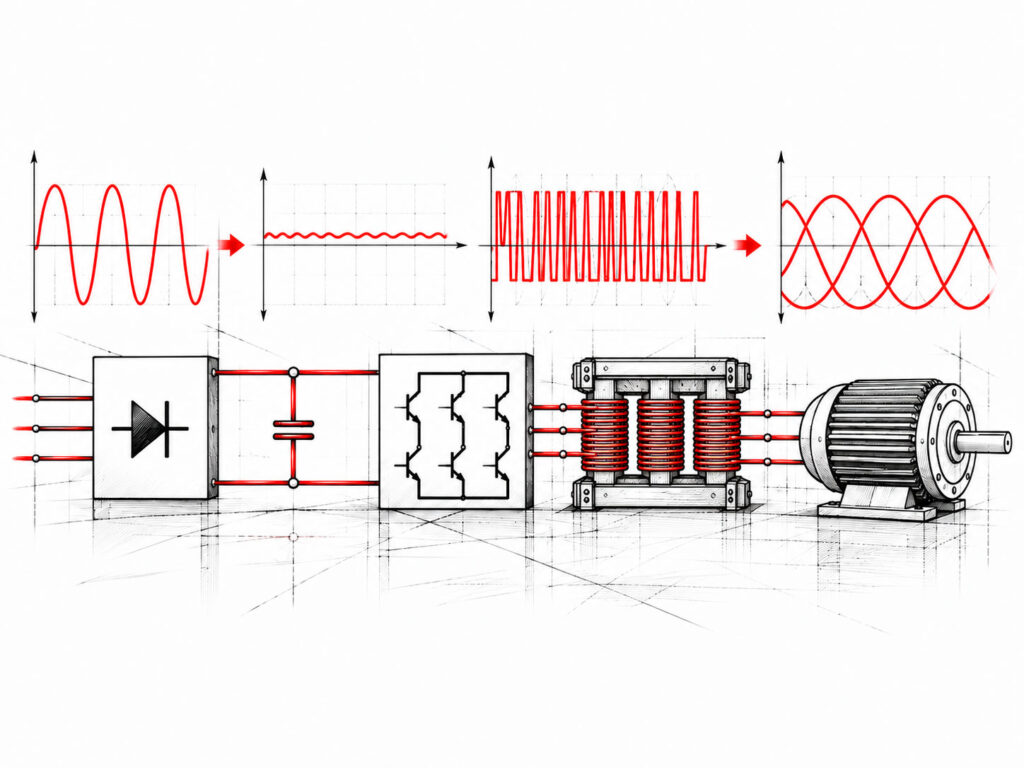
A Variable Frequency Drive controls motor speed by converting fixed-frequency power into a variable-frequency output. The process occurs in three primary stages.
First, incoming AC power is converted into DC power using a rectifier. This stage typically uses diodes or controlled semiconductor devices to create a DC voltage from the incoming supply.
Second, the DC power is smoothed using capacitors or inductors in a DC bus section. This stage stabilizes the voltage and provides energy storage.
Finally, an inverter section converts the DC voltage back into AC power with a controllable frequency and voltage. By rapidly switching semiconductor devices, the inverter generates a waveform that allows the motor speed to be adjusted precisely.
While this conversion process enables efficient motor control, it also introduces electrical effects that must be managed.
 Electrical Challenges Introduced by VFDs
 Electrical Challenges Introduced by VFDs
Because VFDs use power electronic switching devices, they do not draw current in a smooth sinusoidal pattern. Instead, current is drawn in pulses, creating harmonic distortion in the electrical system.
Harmonics can increase heating in transformers, conductors, and other electrical equipment. They may also affect sensitive electronics and interfere with protection devices.
In addition to harmonics, VFD systems can introduce high-frequency electrical noise and voltage transients. These effects can propagate through the electrical distribution system, potentially affecting nearby equipment.
Another concern involves common-mode voltage and grounding behavior, which can create circulating currents and increase stress on insulation systems.
For these reasons, VFD installations often require additional equipment to ensure the electrical system remains stable and reliable.
What Is a Drive Isolation Transformer?
A drive isolation transformer is a transformer installed between the power source and the variable frequency drive. Its purpose is to electrically isolate the drive from the upstream power system while improving power quality and system stability.
Unlike standard distribution transformers, drive isolation transformers are specifically designed to support the electrical characteristics of power electronic loads. Their design may include specialized winding configurations and impedance characteristics that help manage harmonic currents and electrical noise.
Drive isolation transformers are commonly used in industrial motor control systems, HVAC applications, water treatment facilities, and other installations where VFDs are widely deployed.
Benefits of Using Isolation Transformers with VFDs
One of the primary advantages of a drive isolation transformer is electrical isolation. By separating the input and output circuits, the transformer prevents direct electrical coupling between the VFD and the upstream system. This isolation helps protect sensitive equipment from disturbances generated by the drive.
Another important benefit is improved harmonic performance. Certain transformer configurations, such as phase-shifting designs, can help reduce harmonic currents returning to the power system. By altering the phase relationship between currents, these transformers can partially cancel specific harmonic components.
Drive isolation transformers also help reduce electrical noise and common-mode disturbances. The transformer acts as a barrier that prevents high-frequency switching noise from propagating upstream through the electrical distribution system.
In many installations, isolation transformers also improve system grounding by establishing a stable neutral reference where required.
Transformer Configurations Used for VFD Applications
Drive isolation transformers are often designed with specific winding configurations that support harmonic mitigation and system grounding.
A common configuration is delta–wye, which provides electrical isolation while allowing the secondary neutral to be grounded. This configuration also blocks certain zero-sequence currents from propagating upstream.
In larger installations, phase-shifting transformers may be used in multi-pulse drive systems. These designs can significantly reduce harmonic distortion by shifting current waveforms relative to each other.
Transformer impedance may also be selected to provide additional current limiting and harmonic control.
When Isolation Transformers Are Recommended
While not every VFD installation requires an isolation transformer, there are many situations where they provide clear benefits.
Isolation transformers are commonly used when:
- Sensitive equipment shares the same electrical distribution system
- Harmonic levels must be controlled
- Electrical isolation is required for safety or system protection
- Grounding configuration needs to be modified
- Large or critical drives are installed in industrial systems
Engineering evaluation of the power system typically determines whether a drive isolation transformer is recommended.
Practical Considerations for Transformer Selection
Selecting a transformer for a VFD application involves more than simply matching kVA ratings. The transformer must be capable of handling harmonic currents, thermal loading, and electrical stresses associated with power electronic drives.
Design considerations may include insulation system selection, conductor sizing, thermal management, and impedance characteristics. In environments with high harmonic content, specialized designs may be used to reduce additional heating caused by harmonic currents.
Proper transformer sizing and design ensure reliable operation and long service life.
Conclusion
Variable Frequency Drives play a vital role in modern motor control systems, enabling improved efficiency and operational flexibility. However, the electrical characteristics of VFDs can introduce harmonics, electrical noise, and grounding challenges that affect overall power system performance.
Drive isolation transformers provide an effective solution by electrically isolating the drive, improving power quality, and protecting upstream equipment. When properly specified and applied, they become an important component of reliable and efficient VFD installations.
Understanding the role of isolation transformers helps ensure that VFD-based systems operate safely, efficiently, and with minimal impact on the broader electrical network.