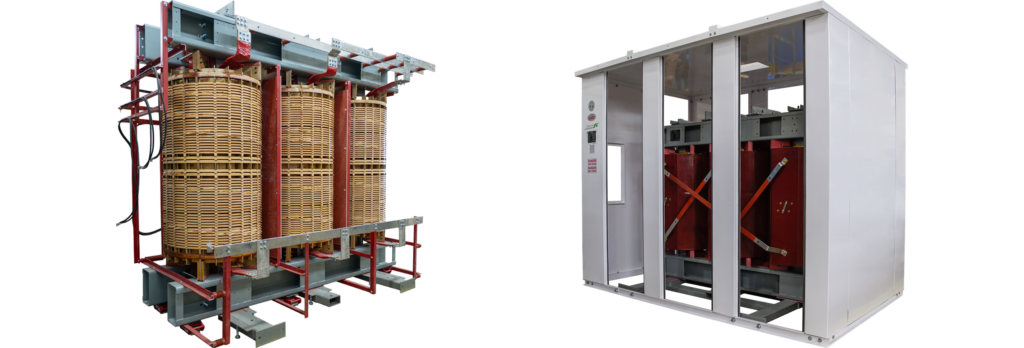
Dry-type transformers handle most of the indoor power distribution work in modern commercial and industrial facilities. They feed lighting, panelboards, motor control centers, and sensitive electronic loads, all without the fire risk and environmental exposure that come with liquid-filled units.
Within the dry-type category, two construction methods dominate: vacuum pressure impregnated (VPI) and cast coil. Both produce reliable, code-compliant transformers. They are not, however, interchangeable. The differences in how the windings are insulated translate directly into differences in environmental tolerance, mechanical durability, cost, and maintenance — and choosing the wrong one for the application is a common source of premature failure.
This article walks through how each type is built, where each one fits, and the specification logic for choosing between them.
How VPI Transformers Are Built
VPI construction starts with the windings being machine-wound to the required turns count and geometry. The completed coil assembly is then placed in a vacuum chamber and submerged in liquid polyester or epoxy resin. The vacuum draws air out of the windings; pressure then forces the resin into every void, layer interface, and conductor surface.
Once the resin is cured, the windings carry a continuous, void-free insulation layer bonded directly to the conductors. The result is a robust insulation system that handles electrical stress well, dissipates heat efficiently through the surrounding air, and resists ordinary indoor contaminants.
VPI windings are not fully encapsulated. The outer surface is sealed, but the structure remains semi-open, which is what gives VPI units their good thermal performance. They tolerate clean indoor environments comfortably and handle moderate humidity, but they are not built for direct outdoor exposure, condensing moisture, or chemically aggressive atmospheres.
Typical applications:
- Commercial buildings and office facilities
- Indoor industrial environments
- Educational, institutional, and healthcare facilities
- Standard panelboard and motor feeds
How Cast Coil Transformers Are Built
Cast coil construction takes the encapsulation further. The windings are placed in a mold and the entire coil is cast in a solid block of epoxy resin under vacuum. When the casting cures, the windings are completely encased, with no exposed conductor surfaces and no voids.
That solid epoxy shell does several things at once. It seals the windings against moisture, dust, and chemical contamination. It mechanically supports the conductors against short-circuit forces and vibration. And it allows the transformer to operate in environments that would degrade a VPI unit within a few years.
The trade-offs are real. Cast coil units cost more, weigh more, and have somewhat higher losses than equivalent VPI designs. The encapsulation that protects the windings also slows heat transfer, which influences sizing in continuous-duty applications.
Typical applications:
- Outdoor and weather-exposed installations
- Marine and offshore environments
- Mining and heavy industrial facilities
- Chemical processing and corrosive atmospheres
- High-vibration locations
- Critical installations where long service life and minimal maintenance justify the upfront cost
Side-by-Side Comparison
| Specification Factor | VPI | Cast Coil |
|---|---|---|
| Insulation method | Resin-impregnated, surface-sealed windings | Windings fully encapsulated in solid epoxy |
| Moisture resistance | Moderate; suitable for clean, dry indoor air | High; tolerates condensing humidity and direct moisture |
| Mechanical strength | Good | Excellent; resists vibration and short-circuit forces |
| Chemical and dust resistance | Limited | High; suitable for corrosive and contaminated environments |
| Outdoor suitability | Indoor only (with rare exceptions in protective enclosures) | Suitable for outdoor and exposed installations |
| Thermal performance | Better cooling, lower losses | Slightly higher losses due to encapsulation |
| Initial cost | Lower | Higher (typically 25–50% more for comparable rating) |
| Maintenance requirements | Periodic cleaning and inspection | Minimal; sealed construction reduces upkeep |
| Expected service life | 20–25 years in suitable environments | 25–30+ years, often with reduced degradation |
| Best fit | Standard indoor commercial and industrial use | Harsh, exposed, or critical environments |
Choosing Between Them
The decision usually comes down to four factors.
Environment first. This is the dominant consideration. Clean, climate-controlled indoor space → VPI is almost always the right answer. Outdoor, humid, dusty, corrosive, or vibration-prone environments → cast coil. Trying to save cost by specifying VPI for a marginal environment is the most common way these units fail early.
Total cost of ownership, not just purchase price. VPI is meaningfully less expensive upfront. In an appropriate environment, that cost difference holds — the unit lasts its full service life and the savings are real. In a harsh environment, the early replacement cost erases the savings several times over. Cast coil’s higher initial cost is justified when the environment will degrade an unsealed unit, when downtime is expensive, or when access for replacement is difficult.
Maintenance reality. VPI units benefit from periodic inspection and cleaning, particularly in environments with airborne dust or fibers. Cast coil construction is essentially closed; routine maintenance is limited to thermal checks and connection inspection. In facilities with active maintenance programs, this matters less. In remote, unmanned, or hard-to-access installations, it matters a great deal.
Load characteristics. Both types handle standard linear loads without difficulty. For loads with significant harmonic content — variable frequency drives, large UPS systems, switching power supplies — verify that the specified unit carries an appropriate K-factor rating regardless of construction type. The construction method does not eliminate the need for a harmonics-rated transformer when the load profile demands one.
Conclusion
VPI and cast coil transformers solve the same fundamental problem with different construction strategies. VPI delivers reliable, cost-effective performance in clean indoor environments — which describes the large majority of dry-type applications. Cast coil delivers sealed, durable performance in environments that would shorten the life of a VPI unit, at a higher initial cost that’s offset by longevity and reduced maintenance.
The specification logic is straightforward when the environment is honestly assessed. The most common errors come from underestimating environmental severity, treating purchase price as total cost, or assuming that any dry-type transformer will tolerate any indoor space. Match the construction to the conditions, and either type will serve well for decades.