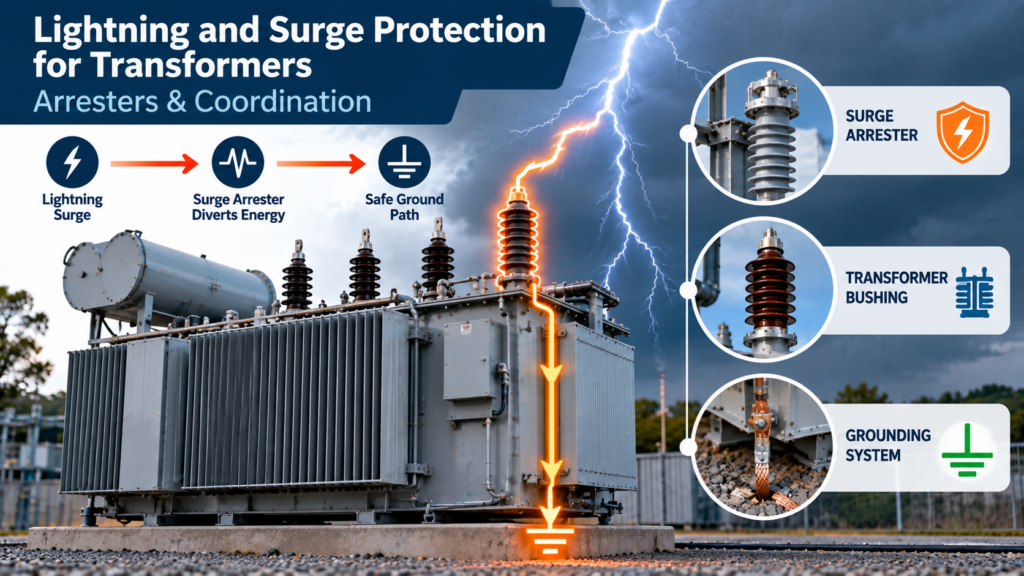
Transformers are designed to operate reliably for decades, but their insulation systems are vulnerable to short-duration overvoltages caused by lightning strikes and switching events. These transient surges, though brief, can impose stresses far above normal operating levels and progressively weaken insulation, eventually leading to failure.
Effective lightning and surge protection is therefore an essential part of transformer application design. It relies on properly selected surge arresters, correct insulation coordination, appropriate grounding practices, and careful installation. This article explains the fundamentals of transformer surge protection, with particular attention to arrester selection, grounding considerations, and the voltage ratings that define arrester performance.
Sources of Surges Affecting Transformers
Transformers are exposed to overvoltages from both external and internal system events.
Lightning-induced surges are typically the most severe. A direct strike to an overhead line, or even a nearby strike, can generate steep-front voltage waves that travel along conductors toward transformers. These surges rise extremely fast and can stress insulation unevenly, particularly at winding ends and terminals.
Switching surges are more frequent but generally lower in magnitude. They occur during breaker operations, fault clearing, capacitor switching, or system reconfiguration. Over time, repeated switching surges can contribute to cumulative insulation aging if not properly controlled.
Why Transformers Require Surge Protection
Transformer insulation is designed for a specific combination of operating voltage, temporary overvoltage, and impulse withstand. Surge waveforms challenge this design because:
- Voltage rises occur much faster than insulation can redistribute stress
- End turns, and terminal regions experience concentrated electric fields
- Internal insulation may see partial discharge even when failure does not occur
Without adequate protection, even non-catastrophic surges can shorten transformer life.
Surge Arresters and Their Role
Surge arresters are the primary devices used to protect transformers from overvoltages. Modern systems use metal-oxide varistor (MOV) arresters, which behave as non-linear resistors.
Under normal operating voltage, an arrester remains essentially non-conductive. When surge voltage exceeds its threshold, the arrester conducts heavily and diverts surge energy to ground, limiting the voltage applied to transformer insulation.
Once the surge subsides, the arrester returns to its high-resistance state.
Understanding the Two Voltage Ratings on a Surge Arrester
Two voltage values are always associated with a surge arrester, and both are critical to correct selection.
Maximum Continuous Operating Voltage (MCOV) is the highest RMS voltage that can be applied continuously without damaging the arrester. MCOV must be greater than the system’s maximum steady-state phase-to-ground voltage, including allowances for system unbalance and temporary overvoltage.
Rated voltage is higher than MCOV and reflects the arrester’s ability to withstand short-duration overvoltages. It is used for classification and coordination but is not the voltage the arrester can tolerate continuously.
In practice, MCOV is selected first, and the rated voltage follows from that selection.
How System Grounding Affects Arrester Selection
System grounding has a direct impact on arrester voltage requirements. During a ground fault, the phase-to-ground voltage on unfaulted phases depends entirely on how the system neutral is grounded.
- Solidly grounded systems limit voltage rise and allow lower MCOV values
- Low-resistance grounded systems experience moderate voltage rise
- High-impedance grounded or ungrounded systems can see phase-to-ground voltage approach line-to-line voltage
As grounding becomes less effective, the arrester must tolerate higher continuous and temporary voltages.
The table below illustrates how grounding method directly influences typical arrester nominal voltage and MCOV selection for common North American system voltages.
| System Voltage
(kV L-L) |
Solidly Grounded
Nominal / MCOV (kV) |
Low-Resistance Grounded
Nominal / MCOV (kV) |
High-Resistance Grounded
Nominal / MCOV (kV) |
|---|---|---|---|
| 2.40 | 3 / 2.55 | 3 / 2.55 | 3 / 2.55 |
| 4.16 | 3 / 2.55 | 6 / 5.10 | 6 / 5.10 |
| 4.80 | 6 / 5.10 | 6 / 5.10 | 6 / 5.10 |
| 6.90 | 6 / 5.10 | 6 / 5.10 | 9 / 7.65 |
| 8.30 | 6 / 5.10 | 9 / 7.65 | 9 / 7.65 |
| 11.30 | 9 / 7.65 | 10 / 8.40 | 15 / 12.70 |
| 12.47 | 9 / 7.65 | 10 / 8.40 | 15 / 12.70 |
| 13.20 | 10 / 8.40 | 12 / 10.20 | 15 / 12.70 |
| 13.80 | 10 / 8.40 | 12 / 10.20 | 15 / 12.70 |
| 24.95 | 18 / 15.30 | 21 / 17.00 | 27 / 22.50 |
| 34.50 | 27 / 22.00 | 30 / 24.40 | 39 / 31.50 |
| 44.00 | 36 / 29.00 | 36 / 29.00 | 48 / 36.50 |
| 46.00 | 36 / 29.00 | 39 / 31.50 | 54 / 42/00 |
Key insight: as grounding effectiveness decreases, MCOV must increase to ensure arrester survivability—often at the expense of reduced protective margin.
Insulation Coordination with Transformers
Surge protection must be coordinated with transformer insulation strength. Transformer Basic Insulation Level (BIL) defines the maximum impulse voltage the insulation can withstand.
Proper insulation coordination ensures:
- Arrester clamping voltage remains below transformer BIL
- Adequate margin exists for aging, tolerances, and lead effects
- Surge energy is diverted before insulation breakdown occurs
Incorrect arrester selection can defeat insulation coordination even when arresters are installed.
Grounding and Installation Practices
An arrester can only protect effectively if it has a low-impedance path to ground. Long or poorly routed leads increase inductive voltage rise during fast surges.
Good practice includes:
- Installing arresters as close as possible to transformer terminals
- Using short, straight line and ground leads
- Bonding transformer tanks, arresters, and grounding systems
Grounding quality often determines whether surge protection succeeds or fails.
Surge Protection for Dry-Type Transformers
Dry-type transformers are often installed indoors but may still be exposed to surges through overhead feeders, outdoor substations, or long cable runs. VPI/VPE designs and cast coil transformers both require proper arrester coordination and grounding to prevent internal insulation stress.
Conclusion
Lightning and switching surges pose a serious risk to transformer insulation, but effective protection is achievable through proper arrester selection, grounding, and insulation coordination. Understanding how grounding affects MCOV requirements—and how arrester voltages relate to transformer BIL—is essential for reliable transformer protection.
When surge arresters, grounding practices, and transformer insulation are correctly coordinated, transformers can operate safely and reliably even in surge-prone environments.