Transformer polarity is a fundamental concept that plays a critical role in how transformers interact with electrical systems. While polarity is often treated as a commissioning or installation detail, it directly affects voltage relationships, parallel operation, metering accuracy, and protection performance.
Incorrect polarity connections can result in additive voltages, circulating currents, misoperation of protection devices, or immediate equipment damage. Understanding transformer polarity what it means, how it is identified, and why it matters is essential for engineers, electricians, and technicians working with power and distribution transformers.
This article explains transformer polarity in practical terms and highlights why it must be verified before transformers are energized or interconnected.
What Is Transformer Polarity?
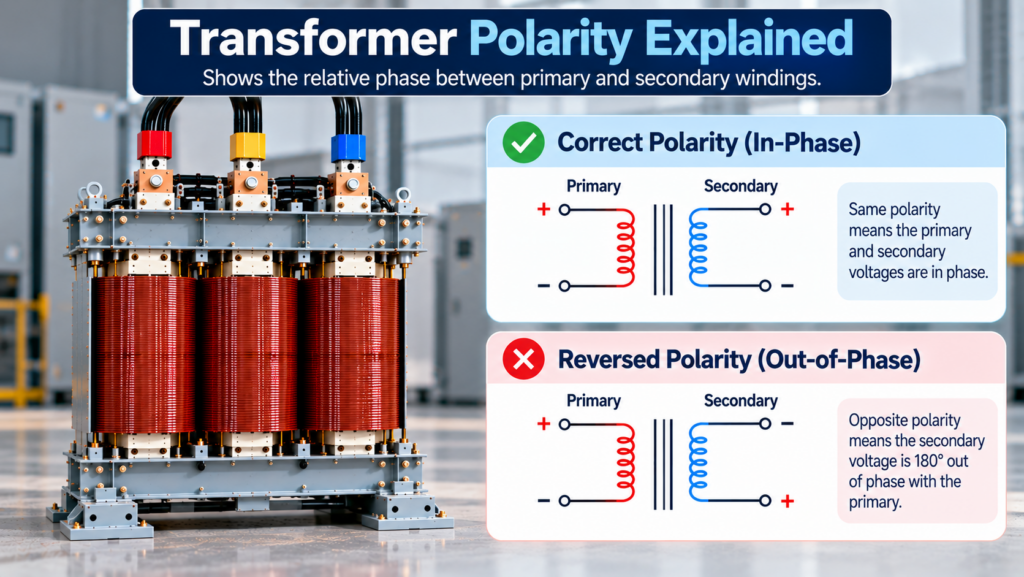
Transformer polarity describes the relative instantaneous direction of voltage between the primary and secondary windings. In other words, it indicates whether the primary and secondary voltages rise and fall in the same direction at a given moment in time.
Polarity is determined by how the windings are wound and connected around the core. It does not affect the transformer’s voltage ratio, efficiency, or kVA rating, but it has a major impact on how transformers behave when connected to other equipment or to each other.
Why Transformer Polarity Matters
Transformer polarity becomes critical whenever voltages are combined, compared, or shared.
Incorrect polarity can cause:
- Additive voltages instead of subtractive voltages
- Circulating currents between parallel transformers
- Incorrect phase relationships in three-phase systems
- Metering and protection errors
- Immediate overvoltage or short-circuit conditions
For these reasons, polarity must always be confirmed before paralleling transformers, connecting secondaries together, or energizing control circuits.

Polarity in Single-Phase Transformers
In single-phase transformers, polarity is commonly classified as either additive or subtractive.
Subtractive Polarity
Subtractive polarity means that when primary and secondary windings are connected in series, the secondary voltage subtracts from the primary voltage. This is the most common polarity for distribution and power transformers.
Subtractive polarity is typically used in:
- Medium- and high-voltage transformers
- Distribution transformers
- Industrial power applications
Most modern transformers are built with subtractive polarity unless otherwise specified.
Additive Polarity
Additive polarity means that primary and secondary voltages add together when connected in series. This configuration is more common in smaller transformers, such as control or instrument transformers.
Additive polarity may be found in:
- Small single-phase control transformers
- Low-voltage applications
- Special-purpose equipment
Because additive polarity can produce higher combined voltages, it requires careful attention during installation.
Polarity Dots and Terminal Markings
Transformer polarity is usually indicated using polarity dots or standardized terminal markings.
A polarity dot placed on each winding indicates corresponding instantaneous polarity. When the dotted ends of the primary and secondary are positive at the same time, the transformer is said to be correctly marked.
Terminal markings such as H1, H2 (primary) and X1, X2 (secondary) also convey polarity information. Connecting H1 and X1 together typically results in a subtractive polarity configuration for most power transformers.
Understanding these markings is essential when interpreting drawings and making field connections.
Polarity in Three-Phase Transformers
In three-phase transformers, polarity extends beyond simple additive or subtractive behavior. It is closely tied to phase rotation, vector group, and winding configuration.
Three-phase polarity affects:
- Phase displacement between primary and secondary
- Compatibility for parallel operation
- System grounding behavior
For three-phase transformers, polarity is often expressed as part of a vector designation, which defines how secondary voltages are phase-shifted relative to the primary.
Impact of Polarity on Parallel Operation
Transformer polarity is especially critical when transformers operate in parallel. Even if voltage ratings, impedance, and kVA match, incorrect polarity will prevent proper load sharing.
If polarity is mismatched:
- Transformers may oppose each other
- High circulating currents can flow
- Overheating and damage may occur rapidly
Correct polarity alignment is therefore a prerequisite for parallel transformer operation, along with impedance and voltage ratio matching.
Polarity and Metering / Protection
Instrument transformers such as current transformers (CTs) and potential transformers (PTs) rely heavily on correct polarity.
Incorrect polarity can cause:
- Reversed power or energy readings
- Differential protection misoperation
- Incorrect fault detection
In protection schemes, polarity errors can defeat the intended function of relays, leading to false trips or failure to trip during faults.
How Transformer Polarity Is Verified
Transformer polarity is typically verified during factory testing and again during field installation.
Common methods include:
- Voltage comparison tests using a known source
- Polarity test connections on single-phase units
- Phasing checks on three-phase transformers
Polarity testing is a standard commissioning step and should never be skipped, even when transformers appear identical.
Common Polarity-Related Mistakes
Many polarity issues arise from assumptions rather than technical errors. Common mistakes include:
- Assuming all transformers have the same polarity
- Ignoring terminal markings
- Misinterpreting schematic symbols
- Failing to test polarity before paralleling units
Because polarity errors can cause immediate problems, verification is far less costly than troubleshooting after energization.
Conclusion
Transformer polarity defines the relative voltage relationship between windings and plays a critical role in system performance, safety, and reliability. While it may seem like a small detail, incorrect polarity can lead to serious operational issues, from circulating currents to protection failures.
By understanding transformer polarity, recognizing polarity markings, and verifying polarity during installation, engineers and technicians can ensure transformers operate as intended. Polarity is not just a theoretical concept—it is a practical requirement for safe and reliable power systems.