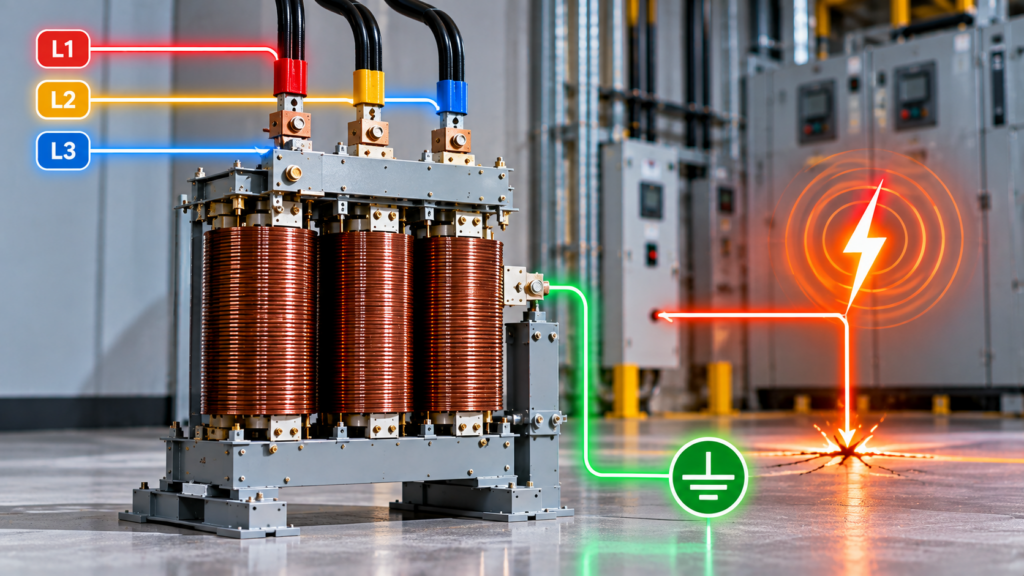
Grounding is a foundational aspect of power system design. It stabilizes phase voltages, provides a reference point for protection systems, and ensures that ground faults are managed safely and predictably. Among the available grounding methods, Neutral Grounding Reactors (NGRs) are widely used in medium and high-voltage networks to limit ground-fault current to controlled levels without the drawbacks associated with solid grounding or ungrounded systems.
A neutral grounding reactor introduces inductive reactance into the neutral-to-ground connection, ensuring that ground-fault currents remain high enough for detection but low enough to prevent equipment damage. This article explains how NGRs function, where they are applied, and why air-core construction is required for their safe and reliable performance.
Why Controlled Grounding Matters
Ground faults are the most common type of electrical fault. When a system is solidly grounded, these faults can result in extremely high fault currents, leading to:
- Thermal and mechanical stress on transformers, cables, and switchgear
- Increased arc-flash energy
- Greater likelihood of equipment failure
- Voltage depression on unfaulted phases
Conversely, ungrounded systems experience:
- Transient overvoltages
- Difficulty locating ground faults
- Insulation stress and potential resonance issues
Neutral grounding reactors offer a balanced solution. They limit ground-fault current to a safe level that still enables protective relays to operate reliably. As a result, they improve system safety, enhance coordination, and reduce damage during faults.
What Is a Neutral Grounding Reactor?
A Neutral Grounding Reactor (NGR) is an air-core inductor installed between a system’s neutral and ground. Its inductive impedance controls the magnitude of zero-sequence current that flows during a ground fault.
Why Neutral Grounding Reactors Must Be Air-Core
Neutral grounding reactors are never built with iron cores, and this is fundamental to their operation. During a ground fault, current can rise to hundreds or thousands of amperes within milliseconds. An iron-core inductor would saturate almost immediately, causing its inductance to collapse. This would eliminate its ability to limit fault current and could create unpredictable system behavior.
Air-core reactors avoid this problem entirely because:
- They cannot saturate, maintaining stable inductance even at high fault currents.
- Their behavior remains linear, which is essential for protection coordination.
- They provide predictable fault-current limitation, allowing protection settings to be designed accurately.
- They avoid the nonlinear distortion, magnetic losses, and heating associated with iron-core saturation.
For grounding applications—where performance must remain stable over a wide fault-current range—air-core construction is the only technically acceptable choice.
How Neutral Grounding Reactors Work
Normal Operation
During balanced conditions, no current flows through the reactor. It has no effect on system voltage, load capacity, or efficiency.
Ground-Fault Operation
When a ground fault occurs:
- Zero-sequence current attempts to flow to ground.
- The reactor introduces inductive impedance in this path.
- Fault current is limited to a controlled value (typically 100 A to several kA).
- Protective relays detect and isolate the fault.
Because the reactor is air-core, it maintains a predictable impedance throughout the fault, ensuring reliable operation of protection devices.
Voltage Stability
NGRs help stabilize the phase-to-ground voltages on unfaulted phases, reducing the overvoltages common in ungrounded systems and improving insulation reliability.
Applications for Neutral Grounding Reactors
Neutral grounding reactors are widely used in:
- Medium-voltage industrial systems (5 kV–35 kV)
- Generator grounding, providing controlled fault current for large rotating machines
- Utility distribution feeders
- Mining, petrochemical, pulp and paper, and heavy industrial facilities
These systems benefit from a controlled response to ground faults and improved protection selectivity.
Benefits of Neutral Grounding Reactors
Neutral grounding reactors offer several significant operational advantages:
Improved Fault Safety
By limiting fault current, NGRs lower the mechanical and thermal stress on equipment and reduce arc-flash energy.
Reliable Protection Coordination
With predictable fault-current levels, relay coordination becomes more stable and effective.
Reduced Equipment Stress
Cables, switchgear, and transformers experience lower fault-induced forces and temperatures.
Voltage Stabilization
NGRs maintain more consistent phase-to-ground voltage relationships during faults.
Operational Continuity
Depending on system philosophy, facilities may continue operating through a ground fault long enough for controlled shutdown or isolation.
Neutral Grounding Reactors vs. Neutral Grounding Resistors
A comparison often arises between resistive and reactive grounding:
Reactors are preferred where inductive limitation better aligns with protection philosophy and system behavior.

Design Considerations for Selecting an NGR
Selecting a neutral grounding reactor requires attention to both system requirements and reactor characteristics:
- System voltage and BIL rating
- Required ground-fault current limit
- Zero-sequence network impedance
- Air-core construction for linear, non-saturating performance
- Thermal and mechanical fault rating (e.g., 10-second duty)
- Installation location (indoor/outdoor)
- Enclosure type, cooling, and clearance requirements
Air-core reactors ensure stable performance during the entire fault period, which is why they remain the industry standard for grounding applications.
Rex Power Magnetics Perspective
Rex Power Magnetics designs and manufactures air-core neutral grounding reactors tailored to system parameters and protection requirements. Our capabilities include:
- Custom impedance design for controlled ground-fault current
- Generator grounding reactors
- Outdoor-rated or indoor-enclosed assemblies
- System-level grounding solutions including grounding transformers
- Engineering support for grounding philosophy, protection coordination, and application review
Our reactors are engineered to provide reliable, predictable performance in demanding industrial and utility environments.
Conclusion
Neutral grounding reactors provide a safe and effective method of controlling ground-fault current in medium and high-voltage systems. By using air-core construction, they deliver stable, non-saturating inductive impedance that ensures predictable protection behavior, reduces equipment stress, and improves voltage stability during ground faults.
For facilities and utilities seeking to balance safety, reliability, and protection performance, NGRs offer a proven and technically robust grounding solution.