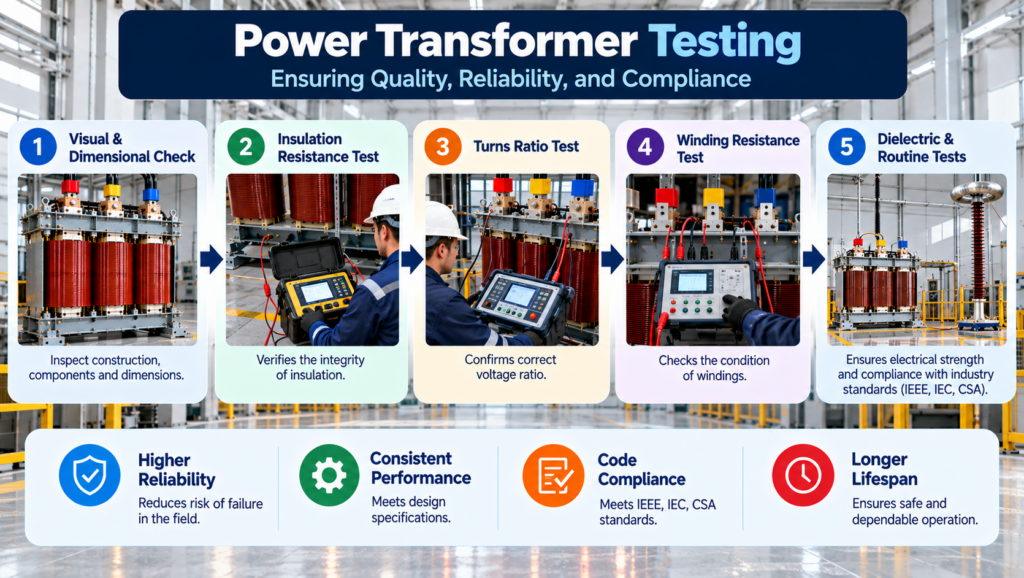
Power transformers are critical components in electrical distribution systems, and their reliability directly impacts the performance and safety of the entire network. Ensuring that each transformer meets its electrical, mechanical, and thermal design requirements is achieved through a series of standardized tests.
Transformer testing verifies design integrity, manufacturing quality, and compliance with industry standards. Every transformer built by Rex Power Magnetics undergoes rigorous factory testing to confirm that it performs as specified — efficiently, safely, and consistently throughout its service life.
This article outlines the types of tests performed on power transformers, their purpose, and how they ensure compliance and reliability in the field.
The Purpose of Transformer Testing
Transformer testing serves several critical objectives:
- Verification of Design and Manufacturing Quality: Confirms that the unit performs according to design specifications and manufacturing tolerances.
- Safety and Reliability: Ensures insulation, winding, and structural systems can withstand normal and transient operating stresses.
- Performance Validation: Confirms electrical parameters such as voltage ratio, impedance, losses, and efficiency meet published standards.
- Compliance: Demonstrates conformance with CSA, IEEE, and NRCan standards required for certification and installation approval.
- Early Defect Detection: Identifies insulation weaknesses, improper connections, or mechanical issues before the transformer is energized at site.
In short, testing provides both assurance and traceability — guaranteeing that every transformer leaving the factory is safe, efficient, and built to perform.
Categories of Transformer Tests
Testing is divided into three categories defined by IEEE C57.12.91 and CSA C9: routine tests, type tests, and special tests.

Routine Factory Tests
Routine tests are mandatory on all transformers before shipment. They confirm that each unit is built and performs according to design.
- Winding Resistance Test – A direct-current (DC) resistance measurement verifies conductor integrity and detects loose joints or poor connections. Consistent readings ensure uniform winding construction.
- Turns Ratio and Polarity Test – Confirms that the transformer’s voltage ratio and phase relationship match the design. Accurate ratio and polarity are essential for system compatibility and correct parallel operation.
- Insulation Resistance (Megger) Test – Applies a high-voltage DC source between windings and ground to verify insulation dryness and quality. Results are compared against standard minimum insulation resistance values.
- Applied Voltage (Hi-Pot) Test – A high AC voltage is applied to the windings to test insulation withstand capability to ground and between windings. This verifies dielectric strength under overvoltage conditions.
- Induced Voltage Test – The transformer is energized at twice the rated frequency and higher-than-rated voltage to stress inter-turn and inter-layer insulation. This confirms that dielectric design withstands normal and transient operating voltages.
- No-Load and Load Loss Tests – Measure magnetic (core) losses and electrical (conductor) losses at rated conditions. These determine transformer efficiency and verify compliance with CSA C802.2 or NRCan 2019 energy performance requirements.
- Impedance and Voltage Regulation – Measures the voltage drop under rated load to determine percentage impedance — critical for system fault calculations and parallel transformer operation.
All results are recorded in a certified factory test report, forming part of the transformer’s quality documentation package.
Type and Special Tests
Type and special tests are conducted periodically or upon request to validate design integrity and performance under specific conditions.
- Temperature Rise Test – Performed on representative units to verify that winding and core temperatures remain within insulation class limits (e.g., 150°C rise for Class R systems). This test confirms the cooling system’s effectiveness and transformer thermal design margin.
- Short-Circuit Withstand Test – Simulates mechanical and thermal stresses during fault events. Confirms that winding clamping, bracing, and conductor geometry can endure through-fault currents without displacement or deformation.
- Lightning Impulse Test – Applies simulated lightning surges to ensure insulation coordination and impulse withstand strength. This test is critical for medium- and high-voltage transformers exposed to overvoltage transients.
- Sweep Frequency Response Analysis (SFRA) – SFRA is a highly sensitive diagnostic test used to detect mechanical or structural changes in transformer windings, cores, and clamping structures. The test injects a low-voltage sinusoidal signal across a wide frequency range (typically 20 Hz to 2 MHz) and measures the transformer’s frequency response.
By comparing the measured response to a reference (typically from factory baseline or previous tests), engineers can detect:
- Winding displacement or deformation from mechanical shock or short-circuit forces.
- Core movement or loosened clamping structures.
- Faulty internal connections or open circuits.
SFRA is non-invasive and provides a “fingerprint” of the transformer’s mechanical integrity, making it invaluable for both factory quality control and field condition assessment.
Partial Discharge Measurement – Used in high-voltage dry-type transformers to detect microscopic insulation voids or imperfections that could lead to dielectric breakdown over time. Ensures clean, void-free impregnation or casting.
Sound Level Measurement – Verifies compliance with NEMA ST-20 and CSA noise limits, confirming that mechanical construction and core design minimize audible hum for sensitive installations such as hospitals, schools, and offices.
Testing Standards and Compliance
Transformer testing is conducted according to international and national standards, ensuring consistency, repeatability, and comparability between manufacturers.
Key standards include:
- IEEE C57.12.01 – General requirements for dry-type distribution and power transformers.
- IEEE C57.12.90 – Test code for transformer testing.
- CSA C9 – Canadian standard for dry-type transformer design, performance, and testing.
- NRCan 2019 – Defines minimum efficiency performance levels and verification testing for transformers sold in Canada.
Rex Power Magnetics tests every transformer in accordance with these standards, providing full test data and certification documentation upon completion.
Rex Power Magnetics Testing Capabilities
At Rex Power Magnetics, every transformer undergoes comprehensive electrical testing in our dedicated, fully equipped test facility. Our testing program ensures:
100% Routine Testing: Every transformer is verified for electrical, insulation, and performance parameters before shipment.
Calibrated Test Equipment: All measurement systems are regularly calibrated to national standards, ensuring traceable accuracy.
Type and Development Testing: Representative units are periodically subjected to temperature rise, impulse, and sound level tests to validate ongoing design performance.
Advanced Diagnostics: Infrared thermography, Sweep Frequency Response Analysis (SFRA), and partial discharge testing support quality control and product improvement.
Witness Testing: Customers and third-party inspectors are welcome to witness testing to verify compliance with specifications.
Each transformer is supplied with a detailed Factory Test Report (FTR) summarizing all measured parameters, losses, efficiency, and dielectric results, ensuring transparency and confidence in the delivered product.
Conclusion
Transformer testing is the cornerstone of reliability and safety assurance. It verifies that every unit meets its electrical, thermal, and mechanical design criteria before being placed in service.
Through adherence to IEEE, CSA, and NRCan standards — and through its investment in precision testing facilities — Rex Power Magnetics ensures that every transformer performs exactly as intended: safely, efficiently, and reliably.
From standard routine tests to specialized dielectric and temperature-rise evaluations, testing remains one of the most important steps in delivering transformers that power industries and communities with confidence.