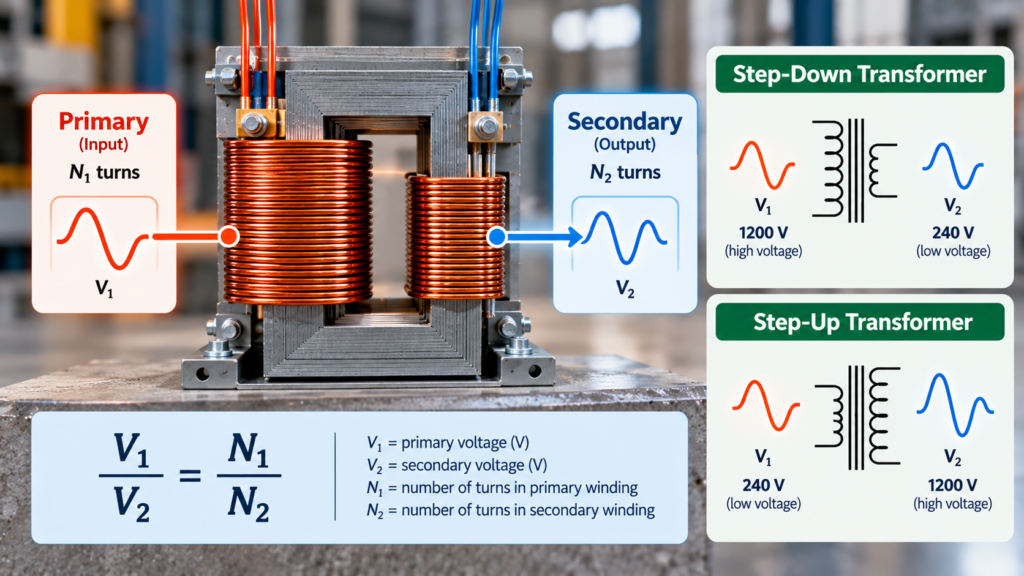
The turns ratio is one of the most fundamental concepts in transformer design and operation. It defines how voltage is transformed from primary to secondary and determines how current levels change accordingly.
Engineers, electricians, and students frequently search for the turns ratio of a transformer formula, or ask what the turn ratio of a transformer actually means in practical terms. Understanding the turns ratio of transformer windings is essential for voltage selection, fault calculations, impedance studies, and system design.
This article explains the turns ratio, presents the governing formula, and shows how it is used in real-world transformer applications.
What Is the Turns Ratio of a Transformer?
The turns ratio describes the relationship between the number of turns in the primary winding and the number of turns in the secondary winding.
In simple terms:
- More turns on a winding produce higher voltage
- Fewer turns produce lower voltage
The transformer does not “create” voltage — it changes voltage in proportion to the number of winding turns.
Turns Ratio of a Transformer Formula
The fundamental turns ratio of a transformer formula is:
Where:
Vp = Primary voltage
Vs = Secondary voltage
Np = Number of primary turns
Ns = Number of secondary turns
This formula shows that voltage ratio is directly proportional to turns ratio.
It can also be written as:

Example: Step-Down Transformer
A transformer rated:
- 480 V primary
- 120 V secondary
Using the formula:

This means the primary has four times as many turns as the secondary.
Turns ratio = 4:1
Voltage is reduced by a factor of four.
Example: Step-Up Transformer
A transformer rated:
- 208 V primary
- 600 V secondary

The secondary has approximately 2.88 times more turns than the primary.
Turns ratio ≈ 1:2.88
Relationship Between Turns Ratio and Current
While voltage is proportional to turns ratio, current behaves inversely.

If voltage increases, current decreases proportionally (ignoring losses). This is why transformers can step voltage up for transmission and reduce current, minimizing conductor losses.
Turns Ratio in Three-Phase Transformers
In three-phase transformers, the turns ratio still applies to each individual phase winding. However, line-to-line voltages depend on winding configuration (delta or wye).
For example:
- In a wye connection, line voltage = phase voltage × √3
- In a delta connection, line voltage = phase voltage
Therefore, when determining the turns ratio of transformer windings in three-phase systems, engineers must consider phase configuration carefully.
How to Use the Turns Ratio in Practice
Understanding the turn ratio of a transformer is useful for:
- Verifying nameplate voltage relationships
- Troubleshooting incorrect output voltage
- Confirming proper transformer connections
- Calculating reflected impedance
- Evaluating fault current
- Performing transformer testing
Turns ratio testing (TTR testing) is commonly used during commissioning to confirm winding integrity and correct connection.
Turns Ratio and Impedance Reflection
One important application of turns ratio is impedance reflection. Impedance seen from one side of the transformer reflects according to:

This squared relationship is critical in:
- Fault current studies
- Protection coordination
- System modeling
Small changes in turns ratio can significantly affect reflected impedance.
Turns Ratio and Tap Changers
Transformer taps adjust the effective number of turns in a winding. When a tap position is changed:
- The turns ratio changes
- The secondary voltage changes proportionally
For example, a +2.5% tap effectively increases primary turns relative to secondary, adjusting output voltage.
Common Misunderstandings About Turns Ratio
Several common misconceptions exist:
- Turns ratio is not the same as impedance percentage
- It does not directly determine kVA rating
- It does not change transformer efficiency
- It applies to phase windings, not always directly to line voltage
Understanding these distinctions prevents design errors.
Turns Ratio in Transformer Testing
During manufacturing and commissioning, turns ratio tests verify:
- Correct winding connections
- Proper tap position
- No shorted turns
- Accurate voltage ratio
Any deviation from expected turns ratio may indicate winding damage or connection errors.
Conclusion
The turns ratio of transformer windings defines the fundamental relationship between voltage and current in power systems. By applying the turns ratio of a transformer formula, engineers can determine voltage transformation, reflected impedance, and system behavior under load and fault conditions.
Understanding the turn ratio of a transformer is essential for proper sizing, troubleshooting, testing, and protection coordination. When applied correctly, it provides a powerful and practical tool for electrical system design.