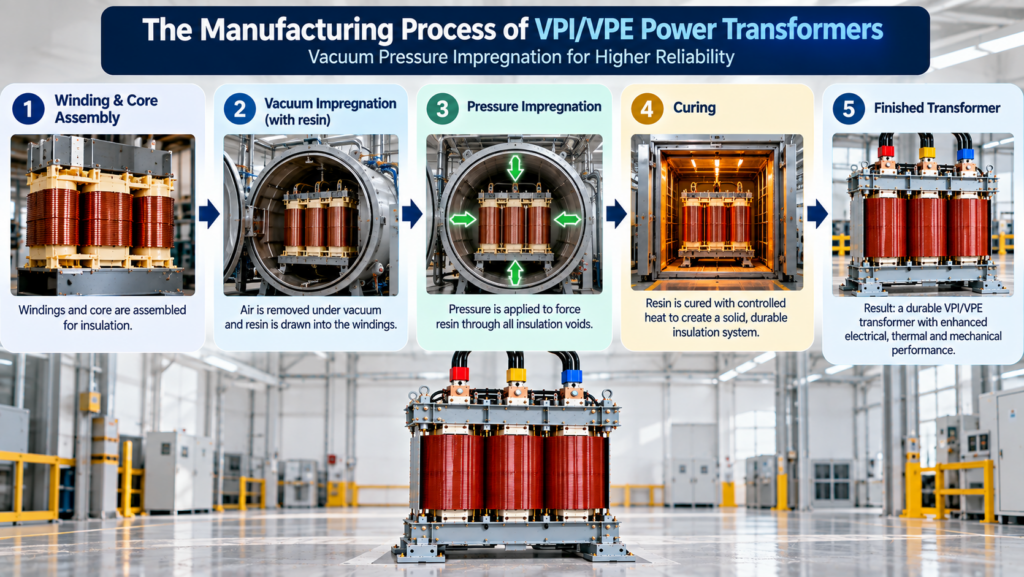
In dry-type transformers, the insulation system is central to both electrical performance and mechanical reliability. It provides dielectric separation between windings, structural rigidity against electromagnetic forces, and thermal endurance during continuous operation.
Among the most proven and widely adopted insulation technologies in modern transformer design are Vacuum Pressure Impregnation (VPI) and Vacuum Pressure Encapsulation (VPE). These processes combine vacuum drying, resin impregnation, and controlled curing to produce robust, long-lasting insulation that can endure harsh electrical and environmental conditions.
This article explains the VPI and VPE manufacturing processes, their advantages, and how these technologies enhance transformer reliability and service life — particularly as applied in Rex Power Magnetics dry-type power transformers.

Overview of VPI and VPE Insulation Methods
Both VPI and VPE processes are designed to seal transformer windings within a high-dielectric resin system. The goal is to eliminate air and moisture from the insulation material and fill any microscopic voids that could lead to partial discharge, corona inception, or tracking under voltage stress.
Vacuum Pressure Impregnation (VPI):
In this process, dry-type transformer coils are placed inside a sealed chamber where a vacuum removes all trapped air and moisture. A low-viscosity polyester or epoxy resin is then introduced under controlled pressure, forcing the resin deep into the windings and insulation layers. After impregnation, the coils are baked in an oven to cure the resin into a solid, rigid dielectric structure.
Vacuum Pressure Encapsulation (VPE):
The VPE process extends the same principles but adds multiple impregnation and curing cycles. Each successive cycle builds an additional layer of resin, resulting in a thicker, more durable coating that provides enhanced protection against moisture, contaminants, and environmental exposure.
While both methods improve insulation performance, VPE is typically specified for harsh or outdoor environments, whereas VPI is optimal for indoor and controlled applications where high dielectric strength and low partial discharge are the primary requirements.
The Manufacturing Process — Step by Step
Coil Preparation
Manufacturing begins with precision winding of the transformer coils using copper or aluminum conductors. The windings are layered and insulated using high-temperature materials such as polyester, Nomex®, or fiberglass, depending on the insulation class.
Before impregnation, the coils are preheated to remove residual moisture and to ensure thermal expansion stability. The core and coil assembly is prepared for processing with carefully maintained clearances, insulation wrapping, and supports.
Vacuum and Pressure Impregnation
The prepared coils are loaded into a vacuum pressure chamber, a sealed steel vessel designed to handle both deep vacuum and positive pressure.
Vacuum Stage:
Air and moisture are drawn out of the insulation and winding spaces under deep vacuum. This stage ensures that all voids and capillaries are empty, allowing complete resin penetration in the next step.
Pressure Stage:
Once the vacuum cycle is complete, a carefully formulated insulating resin is introduced into the tank. Compressed air or inert gas pressure forces the resin into every pore and layer of the winding. Resin viscosity, temperature, and time are closely controlled to ensure consistent coverage without over-saturation.
The result is full impregnation of the coil — a uniform, void-free insulation matrix with high dielectric and mechanical strength.
Resin Curing
After impregnation, the coils are transferred to a temperature-controlled curing oven. The curing process cross-links the resin polymer, forming a hard, glass-like dielectric coating that bonds and stabilizes the entire coil assembly.
For VPE transformers, this curing step is repeated after each resin immersion cycle. The process builds multiple layers of protection, increasing the surface coating thickness and providing a superior barrier to humidity, chemicals, and pollutants.
Precise temperature control and curing time are critical to achieving consistent mechanical and dielectric properties. Over-curing can cause brittleness, while under-curing may leave residual volatiles that reduce insulation performance.
Finishing and Assembly
Once cured, the coils are cooled, cleaned, and inspected before being integrated into the transformer assembly. Core connections, terminals, temperature sensors, and enclosure fittings are installed according to design specifications.
At this stage, the transformer undergoes a complete series of factory acceptance tests to verify performance and compliance with standards, including:
- Insulation resistance and applied voltage tests
- Induced voltage and turns ratio verification
- Partial discharge measurements
- Temperature rise and sound level tests (as applicable)
Each test ensures that the impregnation and curing processes have produced a transformer that meets or exceeds mechanical and dielectric requirements.
Benefits of the VPI/VPE Process
The VPI and VPE methods offer distinct advantages in reliability, durability, and operational stability:
Superior Electrical Insulation:
Resin impregnation eliminates air gaps that could lead to corona discharge or tracking, providing a uniform dielectric medium with high breakdown strength.
Mechanical Integrity:
The cured resin bonds the winding and insulation materials into a solid mass, increasing structural rigidity and resistance to vibration and short-circuit forces.
Moisture and Contaminant Resistance:
Especially in VPE designs, the encapsulating resin layer shields the transformer from humidity, dust, and corrosive airborne particles.
Thermal Stability:
The impregnation materials are rated for high-temperature operation and repeated thermal cycling, ensuring long-term performance.
Low Maintenance and Noise:
Rigid windings and stable insulation reduce vibration and mechanical hum, while minimizing the need for maintenance in clean, ventilated environments.
Rex Power Magnetics Manufacturing Expertise
At Rex Power Magnetics, the VPI and VPE processes are conducted in controlled manufacturing environments using advanced vacuum and pressure systems. Each impregnation cycle is monitored for resin temperature, viscosity, and vacuum level to ensure repeatable quality.
Our VPE process incorporates multiple immersion and cure cycles, building a durable protective coating that meets the demands of outdoor, industrial, or high-contamination environments. In-house testing — including partial discharge and dielectric withstand — confirms the integrity of every insulation system before shipment.
Rex also customizes insulation formulations and curing profiles to meet specific customer or environmental requirements, ensuring optimal performance in every application.
Conclusion
The Vacuum Pressure Impregnation (VPI) and Vacuum Pressure Encapsulation (VPE) processes are at the heart of reliable dry-type transformer manufacturing. Through careful control of vacuum, resin impregnation, and curing, these methods produce insulation systems with exceptional dielectric strength, mechanical integrity, and moisture resistance.
By applying these processes with precision and consistency, Rex Power Magnetics ensures that each transformer — from low-voltage distribution units to medium-voltage power designs — delivers safe, efficient, and maintenance-free performance throughout its service life.