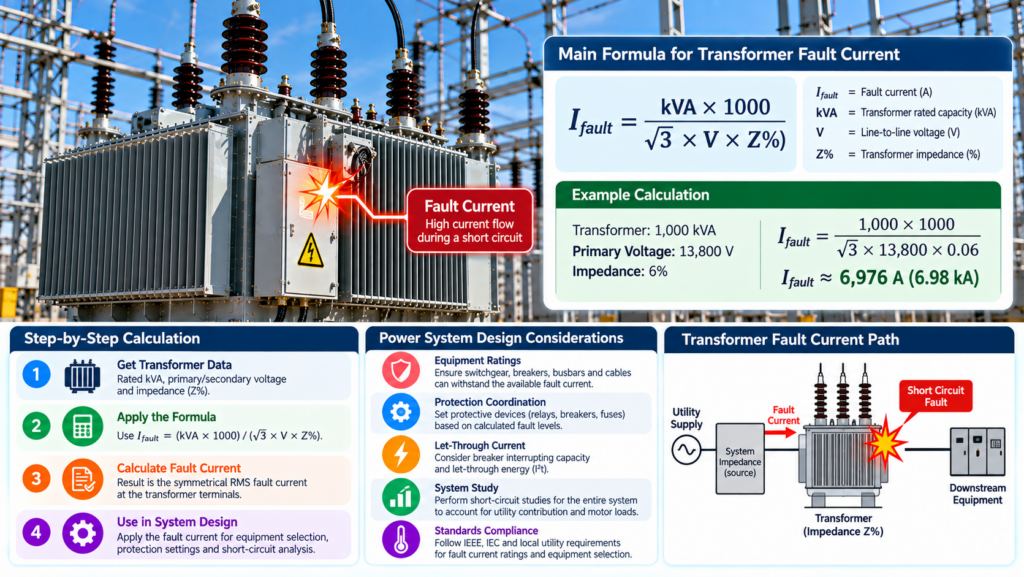
A transformer fault current calculation is one of the first steps in short-circuit analysis. It affects equipment interrupting ratings, bus bracing, protection coordination, and arc-flash studies. In practical terms, the available short-circuit current is highest closest to the source transformer and decreases as conductor and upstream source impedance are added downstream.
For most facility-level work, the starting point is the transformer secondary terminals. From there, engineers adjust the result for feeder impedance, utility source strength, motor contribution, and system X/R ratio as needed. This article explains the basic formulas, shows worked examples, and highlights the design considerations that matter in real installations.
What Limits Fault Current at a Transformer
At the transformer secondary, the key limiting factor is the transformer’s percent impedance (%Z). Percent impedance is determined by short-circuiting the secondary and increasing primary voltage until full-load current flows; the required voltage, expressed as a percentage of rated voltage, is the transformer impedance. Lower %Z means higher available fault current.
This is why two transformers with the same kVA and secondary voltage can produce very different fault currents if their impedance values differ. It is also why transformer impedance is such an important specification for both protection and equipment rating.
The Basic Fault Current Formula
For a first-pass calculation at the transformer secondary terminals, the standard method is:
- Isc = Ifl / Zpu
Where:
- Isc = symmetrical RMS short-circuit current at the transformer terminals
- Ifl = transformer full-load current
- Zpu = transformer impedance in per-unit, equal to %Z divided by 100
This is the same approach used in common engineering references for transformer secondary fault current calculations.
Full-load current formulas
For a three-phase transformer: Ifl = (kVA x 1000) / (sqrt(3) x Vll)
For a single-phase transformer: Ifl = (kVA x 1000) / V
These are the same full-load current relationships used in standard short-circuit calculation guides.
A Combined Shortcut Formula
Combining full-load current and impedance into one expression gives a convenient shortcut.
For three-phase transformers: Isc = (kVA x 1000) / (sqrt(3) x Vll x Zpu)
For single-phase transformers: Isc = (kVA x 1000) / (V x Zpu)
These formulas calculate the symmetrical RMS fault current at the transformer terminals, assuming the transformer is the dominant source and upstream source impedance is not limiting.

Example 1: Three-Phase Transformer Fault Current Calculation
Assume:
- Transformer rating = 750 kVA
- Secondary voltage = 480 V
- Impedance = 5.75%
First calculate full-load current:
- Ifl = (750 x 1000) / (1.732 x 480) = approximately 902 A
Convert impedance to per-unit:
- Zpu = 5.75% = 0.0575
Now calculate fault current:
- Isc = 902 / 0.0575 = approximately 15,687 A
So the available symmetrical fault current at the transformer secondary terminals is about 15.7 kA. This is the same method presented in widely used transformer secondary fault current references.
Example 2: Single-Phase Transformer Fault Current Calculation
Assume:
- Transformer rating = 50 kVA
- Secondary voltage = 240 V
- Impedance = 4%
First calculate full-load current:
- Ifl = (50 x 1000) / 240 = approximately 208.3 A
Then convert impedance:
- Zpu = 4% = 0.04
Then fault current:
- Isc = 208.3 / 0.04 = approximately 5,208 A
The available symmetrical fault current at the transformer secondary is therefore about 5.2 kA.
What the Basic Formula Assumes
The simple transformer-only method is useful, but it makes assumptions. It assumes the fault is at the transformer secondary terminals, the utility source is strong enough that transformer impedance dominates, and the result needed is symmetrical RMS current rather than peak asymmetrical current. In real systems, conductor impedance downstream of the transformer and source impedance upstream both reduce the fault level.
This is why available fault current decreases as you move away from the transformer through feeders, panelboards, and branch circuits.
Including Feeder and Source Impedance
When the fault is not directly at the transformer terminals, or when utility source strength is limited, a more complete approach is needed. In per-unit form, the fault current depends on the transformer impedance plus the impedance of the path to the fault location.
In practical terms:
- Ztotal = Zsource + Ztransformer + Zconductors
Then:
- Ifault = V / Ztotal
Using the per-unit method simplifies this because transformer per-unit impedance remains the same when referred from one side to the other.
This is the preferred method for larger studies, especially when analyzing switchboards, MCCs, or faults at remote buses rather than directly at the transformer terminals. IEC 60909 is the widely recognized international framework for these broader short-circuit calculations.
Symmetrical vs. Asymmetrical Fault Current
The formulas above produce symmetrical RMS fault current, which is the normal starting point for equipment rating and coordination studies. However, the first few cycles of a real fault also include a DC offset, and that can produce a significantly higher peak asymmetrical current. The severity of that peak depends on system X/R ratio.
This matters because:
- Breakers and fuses must interrupt the available current safely
- Bus structures and transformer windings must withstand the mechanical forces produced by peak current
- Arc-flash studies often need more than the simple terminal fault current value
So while the basic transformer fault current calculation is essential, it is not always the last step in a full protection study.
How Transformer Size and %Z Affect Fault Current
Transformer fault current rises with higher kVA and falls with higher impedance. That means a larger transformer with low %Z can produce very high short-circuit current, while a smaller transformer or one with higher impedance will contribute less. Typical transformer percent impedance values vary by transformer class and rating, and that variation is one reason fault current can differ substantially between otherwise similar installations.
This is also where design tradeoffs appear. Higher impedance helps reduce available fault current, which can ease equipment duty requirements, but it also increases voltage drop and can affect regulation. Lower impedance improves regulation but raises short-circuit current.
Practical Design Considerations
A technically sound transformer fault current calculation should feed directly into design decisions. At a minimum, it should be checked against:
- Equipment short-circuit current ratings
- Protective device interrupting ratings
- Bus and panel withstand capability
- Arc-flash study assumptions
- Future system expansion plans
In practice, this means the “transformer terminal fault current” is the starting point, not the end of the process. Designers still need to evaluate what happens downstream and how the system may change over time.
Common Mistakes
Several recurring mistakes appear in field calculations:
- Using line-to-neutral voltage instead of line-to-line voltage for three-phase calculations
- Forgetting to convert %Z into per-unit
- Assuming the transformer-only calculation applies at downstream equipment
- Ignoring utility source impedance or feeder impedance when they are significant
- Treating symmetrical RMS current as if it were the same as asymmetrical peak duty
Avoiding these errors leads to more reliable equipment selection and safer protection coordination.
Conclusion
Transformer fault current calculation starts with three inputs: kVA, secondary voltage, and percent impedance. From those values, engineers can calculate the available symmetrical short-circuit current at the transformer terminals using straightforward formulas. That basic result is essential for breaker selection, coordination, SCCR review, and arc-flash analysis.
For more accurate system studies, upstream source impedance and downstream conductor impedance should be added using a per-unit or equivalent-impedance approach. That is where short-circuit analysis moves from a quick transformer calculation into full power system design.