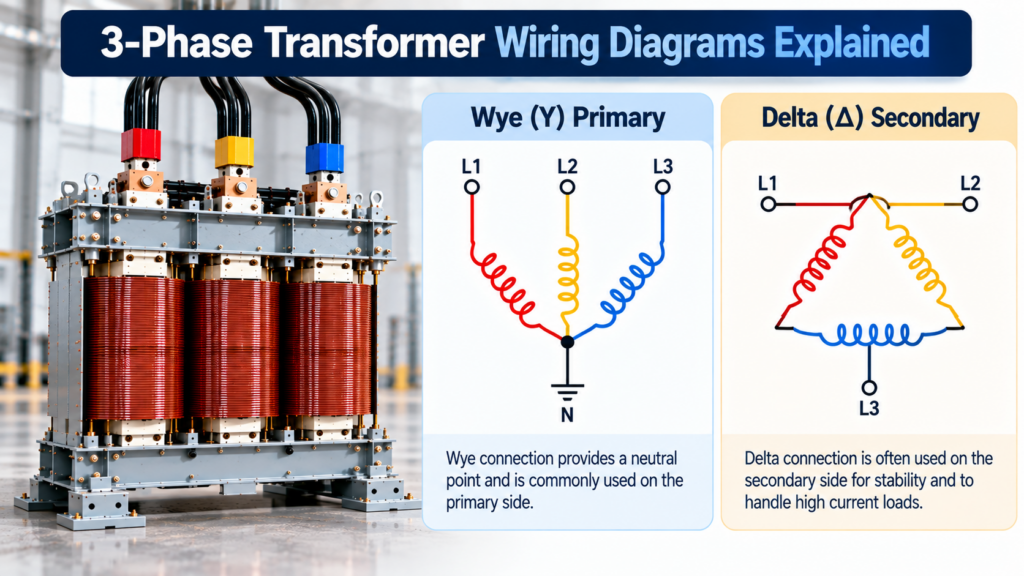
Three-phase transformers are the backbone of modern power distribution, supplying energy to industrial facilities, commercial buildings, and utility networks. To understand how these transformers are applied in real systems, engineers and electricians rely heavily on 3-phase transformer wiring diagrams.
At first glance, these diagrams can appear complex. However, once the basic connection types and symbols are understood, wiring diagrams become a powerful tool for interpreting voltage relationships, grounding methods, and system behavior. This article explains the most common 3-phase transformer wiring diagrams, how to read them, and what they reveal about system operation.
What Is a 3-Phase Transformer Wiring Diagram?
A 3-phase transformer wiring diagram is a graphical representation of how transformer windings are connected on the primary and secondary sides. Depending on the drawing type, it may show:
- Winding connections (delta, wye, zig-zag)
- Phase relationships
- Neutral connections and grounding
- Voltage transformation
- Terminal designations
Most system-level drawings use single-line diagrams, where one line represents all three phases. More detailed schematic diagrams may show individual windings and terminals.
Understanding the diagram format is the first step in interpreting the wiring.
Common 3-Phase Transformer Connection Types
The majority of 3-phase transformer wiring diagrams fall into a small number of standard connection types. Each has distinct electrical characteristics and applications.
Delta–Delta (Δ–Δ) Connection
In a delta–delta transformer, both the primary and secondary windings are connected in a closed delta loop.
This connection:
- Does not provide a neutral
- Is tolerant of unbalanced loads
- Can continue operating with one transformer winding out of service (open-delta operation)
- Blocks zero-sequence currents
Delta–delta wiring diagrams are common in older industrial systems and some utility applications where grounding is handled elsewhere.
Delta–Wye (Δ–Y) Connection
The delta–wye connection is one of the most widely used configurations in power distribution.
In this arrangement:
- The primary is delta-connected
- The secondary is wye-connected
- A neutral is available on the secondary side
Delta–wye wiring diagrams often indicate whether the wye neutral is grounded. This configuration provides isolation between primary and secondary grounding systems and helps manage harmonics and fault currents.
Wye–Delta (Y–Δ) Connection
In a wye–delta transformer, the primary winding is wye-connected and the secondary winding is delta-connected.
This configuration:
- Is commonly used to supply motor loads
- Eliminates the need for a secondary neutral
- Helps isolate downstream faults from the supply
- Requires careful grounding on the primary side
Wiring diagrams for wye–delta transformers typically emphasize grounding of the primary neutral.
Wye–Wye (Y–Y) Connection
Wye–wye transformers have both primary and secondary windings connected in wye.
While this configuration provides neutrals on both sides, it requires careful grounding and design consideration to avoid issues such as neutral instability or voltage imbalance.
Wye–wye wiring diagrams often include grounding resistors, grounding transformers, or other stabilization methods to ensure proper operation.

Zig-Zag and Grounding Transformer Diagrams
Zig-zag transformers are used primarily for grounding and neutral creation rather than voltage transformation.
In wiring diagrams, zig-zag connections are shown with interleaved winding arrangements. These diagrams indicate:
- Creation of a neutral point
- Path for zero-sequence currents
- Ground-fault current control
Zig-zag wiring diagrams are common in grounding applications and harmonic mitigation systems.
Reading Voltage Information on Wiring Diagrams
Transformer wiring diagrams often include voltage labels that show:
- Primary line-to-line voltage
- Secondary line-to-line voltage
- Secondary line-to-neutral voltage (if applicable)
Understanding whether voltages are expressed as line-to-line or line-to-neutral is essential. Misinterpreting these values can lead to incorrect equipment selection or unsafe installations.
Grounding Shown in 3-Phase Wiring Diagrams
Grounding is a critical part of transformer wiring diagrams. It may be shown as:
- A solidly grounded neutral
- A resistor-grounded neutral
- An ungrounded system
- A grounding transformer connection
The grounding method affects fault current magnitude, surge protection, and protection coordination. Wiring diagrams clearly indicate grounding intent, and these details must be followed precisely during installation.
Phase Rotation and Polarity in Diagrams
Three-phase wiring diagrams implicitly define phase rotation and polarity. When transformers are paralleled or connected to rotating machinery, correct phase sequence is essential.
Polarity dots, terminal markings, and vector group notations may appear in more detailed diagrams. These indicators help ensure compatibility between transformers and the systems they serve.
One-Line vs. Detailed Schematic Diagrams
Most system drawings use one-line diagrams for clarity and simplicity. These show transformer connections symbolically rather than depicting every conductor.
Detailed schematics may be used for:
- Control circuits
- Protection schemes
- Factory testing
- Troubleshooting
Knowing which type of diagram you are viewing helps set expectations about the level of detail provided.
Common Wiring Diagram Mistakes
Misinterpretation of transformer wiring diagrams can lead to serious issues. Common mistakes include:
- Assuming a neutral exists when it does not
- Overlooking grounding details
- Misreading delta and wye symbols
- Confusing line-to-line and line-to-neutral voltages
- Ignoring polarity or phase rotation
Careful review of diagrams before installation prevents costly errors.
Conclusion
3-phase transformer wiring diagrams provide essential insight into how transformers interact with electrical systems. By understanding common connection types, grounding methods, and voltage relationships, engineers and electricians can interpret these diagrams with confidence.
Whether reviewing a high-level one-line diagram or a detailed schematic, the ability to read and understand 3-phase transformer wiring diagrams is a fundamental skill in power system design and installation.