BIL — Basic Impulse Level — is one of those transformer specifications that gets carried over from one project to the next without much thought, until the day it matters. Most of the time, the standard BIL for the voltage class is the right answer and the question never comes up. On the day the application calls for higher BIL, or the environment shifts the calculation, or a surge event exposes a margin that wasn’t actually there, the specification suddenly matters very much.
This article covers what BIL actually measures, how the IEEE and CSA standards organize the available ratings, when to specify above the standard minimum, and one specific thing BIL doesn’t protect against — switching transients — that catches engineers who treat BIL as a universal measure of transformer ruggedness.
What BIL Actually Measures
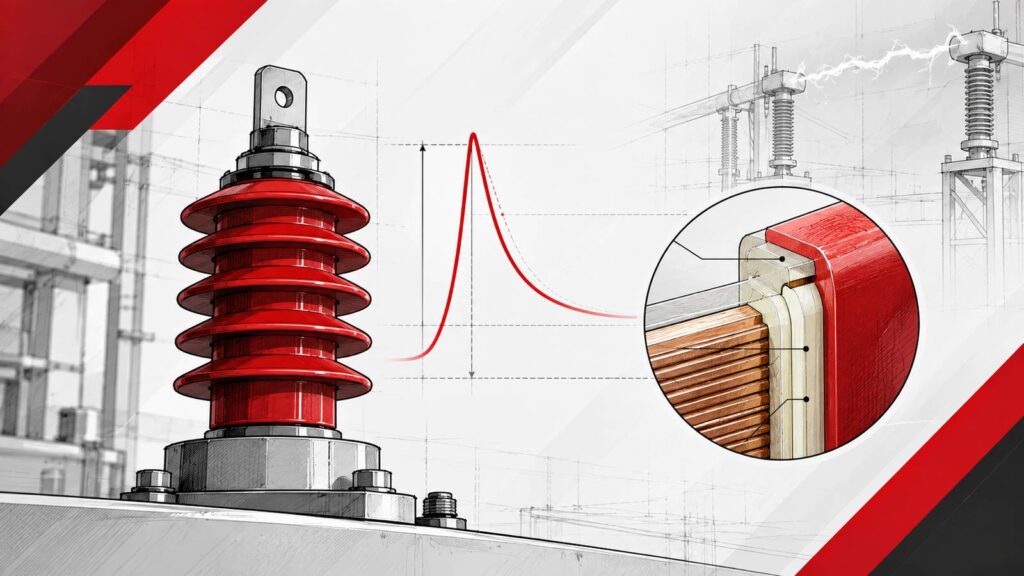
BIL is the peak voltage a transformer’s insulation can withstand from a standardized lightning impulse waveform — specifically the 1.2 × 50 microsecond impulse, which rises to peak in 1.2 microseconds and decays to half-peak by 50 microseconds. The standardized waveform was chosen decades ago to approximate the voltage profile of a lightning surge reaching a transformer through an overhead line or underground cable.
The number is the peak voltage in kilovolts that the insulation system can survive when subjected to this waveform during factory testing. A 95 kV BIL transformer has insulation that can withstand a 95 kV peak impulse of the standard shape without flashover, puncture, or measurable degradation.
BIL is a withstand rating, not an operating rating. The transformer is never expected to see 95 kV in normal service — the rating is the margin against transient events. The wider the gap between BIL and the worst transient the transformer will actually experience, the lower the probability of insulation failure.
IEEE and CSA Standard BIL Levels
Both IEEE C57.12.01 and CSA C9 define standard BIL levels by voltage class for dry-type transformers. The standards align closely on most values, with CSA following IEEE conventions in North America. Each voltage class has a defined minimum BIL and one or more higher optional levels for applications requiring additional margin.
| System Voltage Class | Standard / Minimum BIL | Higher Optional BIL Levels |
|---|---|---|
| 1.2 kV | 10 kV | 20, 30 kV |
| 2.5 kV | 20 kV | 30, 45 kV |
| 5.0 kV | 30 kV | 45, 60 kV |
| 8.7 kV | 45 kV | 60, 95 kV |
| 15 kV | 60 kV | 95, 110 kV |
| 25 kV | 110 kV | 125, 150 kV |
| 34.5 kV | 150 kV | 200 kV |
| 46.0 kV | 200 kV | 250, 300 kV |
Two points worth emphasizing about this table. First, the standard (minimum) BIL is what’s supplied by default unless the specification calls for something higher. Many installations run on standard BIL successfully for decades. Second, the higher optional levels exist because some applications genuinely need them — they’re not just upsells, they’re engineered responses to known elevated-surge environments.
When Standard BIL Is Enough
The standard BIL for a given voltage class is sufficient for typical applications with reasonable surge exposure. Indoor distribution transformers in commercial and industrial facilities, fed from utility services with normal surge protection, generally don’t need anything above the standard minimum. The decades of operating experience that informed the standards reflect this — the standard values are conservative enough for most installations.
Cost is the other side of this. Higher BIL means more insulation, larger physical size, and higher purchase cost. Specifying above the standard minimum without a real application reason adds cost without adding meaningful protection.
When to Specify Higher BIL
Several application patterns justify higher-than-minimum BIL.
Direct overhead line exposure. Transformers connected to overhead distribution lines, particularly in areas with frequent lightning activity, see surge events more often and at higher magnitude than transformers on shielded indoor feeders. Higher BIL provides margin for the surges that the upstream protection won’t always catch in time.
Outdoor and harsh-environment installations. Dry-type transformers installed outdoors face conditions that gradually erode the effective dielectric strength of the insulation system. Moisture from rain and humidity, condensation cycles between day and night temperatures, accumulated dust and dirt, salt contamination near roadways or coastal sites, and the slow chemical degradation that comes with continuous environmental exposure all reduce the margin the rated BIL was supposed to provide. The transformer’s measured BIL is based on clean, dry, factory-test conditions; service conditions are different. Specifying higher BIL on outdoor units — pad-mounted installations, EV charging sites, temporary power, mining operations, and similar exposed locations — restores margin that environmental conditions take away over time. The same logic applies to industrial environments with conductive dust, chemical vapors, or other airborne contamination that doesn’t fit a “harsh outdoor” description but produces the same kind of cumulative degradation.
High-altitude installations. Air’s dielectric strength decreases with altitude as the air thins. Installations above 1,000 m (3,300 ft) above sea level may need higher BIL to maintain the same effective insulation margin. CSA and IEEE both address altitude derating explicitly.
Switching-rich environments. Frequent switching produces frequent transients, and the cumulative effect of repeated mild transients can erode insulation over time. Higher BIL provides margin for this cumulative degradation, particularly important on transformers feeding capacitor banks, motor circuits with frequent starts, or other inherently switch-heavy loads.
Critical or hard-to-replace installations. Where the cost of failure is high — data centers, hospitals, mining operations, offshore platforms — higher BIL is cheap insurance against the surge that pushes a standard-rated unit past its margin.
Coordination with available surge arresters. Surge arresters protect by clamping voltage below a defined level, typically the maximum discharge voltage at a specified current. The protective margin is the difference between the transformer’s BIL and the arrester’s protective level, expressed as a percentage:
IEEE recommends a minimum protective margin of 20% for lightning impulse. If the available arresters can’t deliver that margin against the standard BIL, higher BIL (or different arrester selection) is the remedy.
What BIL Doesn’t Protect Against
BIL is defined by a specific waveform — the 1.2 × 50 µs lightning impulse. Transients of significantly different shape don’t behave the same way against BIL-rated insulation, and this is where the most expensive misunderstandings happen.
Switching transients are different. Vacuum or SF6 breaker switching of transformers through short cable runs produces voltage transients with much faster rise times than the standard impulse — rates of voltage rise (dv/dt) reaching levels that the insulation simply can’t handle, even at voltages well below BIL. The mechanism that fails the transformer is not magnitude alone but turn-to-turn breakdown from the steep wavefront, and it can happen at peak voltages 30 to 50% of nominal BIL.
This is the documented mechanism behind transformer failures in data centers, paper mills, hospitals, and ship propulsion systems where vacuum breakers switch close-coupled transformers. The transformers passed BIL testing before installation and still failed in service, because BIL alone doesn’t characterize fast-front switching transients. RC snubbers, sized to slow the dv/dt to within the transformer’s tolerance, are the proven mitigation.
Repetitive transients. The single-shot BIL test doesn’t characterize cumulative degradation from repeated milder transients. An installation that produces frequent moderate-amplitude transients can erode insulation over years even though no single event approaches BIL.
Internal resonance. Each transformer has natural frequencies determined by its winding inductance and capacitance. When a transient excites one of those frequencies, voltage amplification within the winding can produce internal stress well beyond what the terminal voltage measurement would suggest. BIL testing doesn’t reveal this behaviour because the standard impulse waveform doesn’t typically excite winding resonances.
The practical conclusion: BIL is necessary but not sufficient. For installations with known fast-switching exposure, BIL alone is the wrong specification to rely on, and additional analysis — switching transient studies, dv/dt characterization, snubber sizing — is appropriate.
Conclusion
BIL is a meaningful, well-defined, and useful specification, and the standard values in the IEEE and CSA tables are appropriate for the typical installations they were developed around. Where it goes wrong is when it gets treated as more than it is — a universal measure of transformer toughness against any kind of transient. It isn’t. BIL characterizes the standard lightning impulse, and the protection it represents is bounded by that waveform.
The right way to think about BIL is as one specification within a broader insulation coordination problem. Standard BIL for most applications. Higher BIL where the environment, altitude, exposure, or criticality justifies it. And separate, application-specific analysis where switching transients or other non-standard waveforms are part of the picture. Get all three right and the transformer’s insulation does its job invisibly for the life of the equipment.