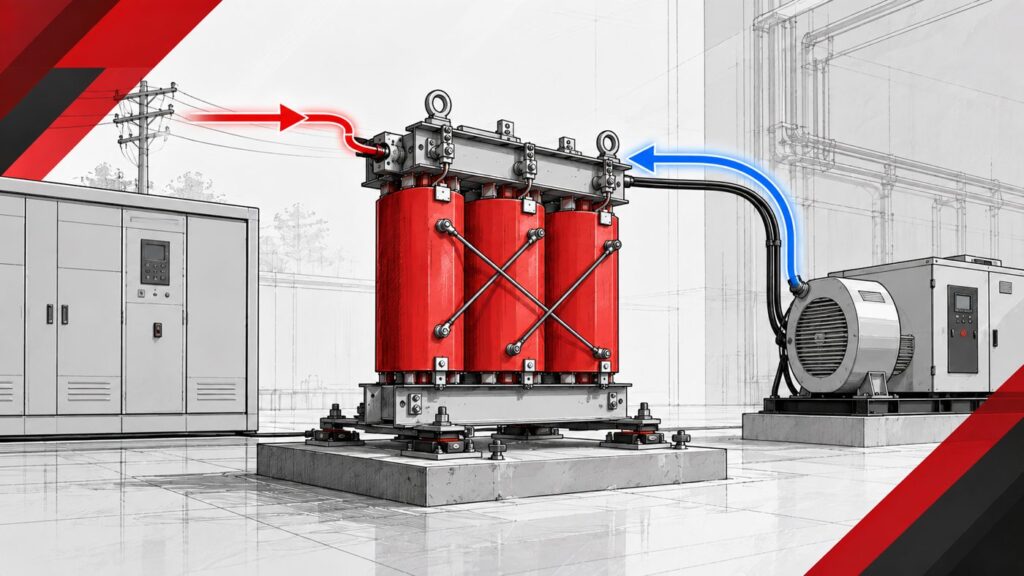
A distribution transformer built to step 480 V down to 208 V looks, on paper, like it should also work in reverse: apply 208 V to the secondary and get 480 V at the primary. The math is the same in both directions. The turns ratio doesn’t care which side is energized. For applications that need to step low voltage up to medium voltage at low cost — solar inverter interconnections, small backup generators, equipment voltage matching — reverse feeding a standard distribution transformer is an obvious shortcut.
Sometimes it works fine. Sometimes the resulting voltage is significantly off, the transformer runs hot, the inrush trips the upstream breaker, and the installation gets blamed on “the transformer” when the actual problem is the application. This article covers what’s happening electrically when you reverse-feed a transformer, when it’s a reasonable choice, and when it isn’t.
The Basic Idea
A two-winding transformer has a high-voltage winding and a low-voltage winding. In normal operation, the high-voltage side is the primary and the low-voltage side is the secondary. Reverse feeding swaps the roles: low voltage applied to what was the secondary, high voltage delivered from what was the primary.
The turns ratio sets the voltage relationship, and in an ideal transformer the ratio is the same regardless of which winding is energized. Energy still transfers from the primary winding through the core to the secondary winding by the same electromagnetic induction. Direction of power flow doesn’t change the physics.
The complications come from the fact that real transformers aren’t ideal, and standard distribution transformers are designed and built around the assumption that the high-voltage winding is the primary. Several design details follow from that assumption, and reversing the feed direction violates them in ways that range from negligible to significant.
The Voltage Tolerance Problem
The first practical issue with reverse feeding shows up most clearly on smaller transformers.
Control transformers and distribution transformers below 3 kVA are typically designed with a small voltage compensation built into the secondary winding. The secondary has slightly more turns than a strict ratio calculation would suggest, with the extra turns compensating for the voltage drop the transformer itself produces under load — the I×Z drop across the winding impedance and the resistive losses. The result is that the transformer delivers very close to nominal secondary voltage at rated load, even though the actual no-load secondary voltage is slightly higher than the nameplate ratio would imply.
This is called a compensated winding, and it’s invisible during normal operation because it does exactly what it’s supposed to do.
In reverse, the compensation works against you. The extra turns that boost the secondary voltage at rated load now reduce the primary-side voltage in reverse-feed operation. A reverse-fed control transformer or small distribution unit can deliver a primary voltage noticeably below nominal, and downstream equipment may or may not tolerate it. Larger distribution transformers typically have little or no compensation built in and don’t show the same effect, but the small-unit case is the one that bites most often in practice because these are also the transformers people are most tempted to reverse-feed for convenience.
Tap selection helps where it’s available. If the reverse-fed transformer has taps on what was originally the primary winding (now the output), selecting a higher tap on that winding compensates for the compensated-winding effect. Most standard distribution transformers have these taps. Many small encapsulated control transformers and buck-boost units do not, which limits how much can be corrected after the fact.
The relationship is straightforward:
An important safety constraint applies here: the input voltage in reverse-feed operation should not exceed the nominal rated secondary voltage of the transformer. Energizing the secondary winding above its rated voltage can damage the insulation (which is coordinated to the rated voltage, not above it) and overexcite the core, driving it into saturation with the magnetizing current rising sharply as a result. Where the incoming voltage is lower than the rated secondary voltage, the taps on what was originally the primary winding can be used to boost the output back up.
The Inrush Problem
When any transformer energizes, the core takes a moment to establish its normal flux pattern. During that brief interval — typically a few cycles — the magnetizing current spikes to several times the rated current, an event called inrush current. This is normal and expected, and primary-side protective devices are coordinated to ride through it.
Reverse-feeding makes the inrush significantly higher relative to the winding being energized. The low-voltage winding is built with larger conductor and lower impedance than the high-voltage winding, since it normally carries higher current. When you energize from that lower-impedance LV side, the inrush flows through a path with less impedance to limit it, and the peak inrush current as a multiple of the LV winding’s rated current is significantly higher than the corresponding multiple on the HV side under normal energization.
The practical consequence is nuisance tripping of the protective breaker. A breaker sized to the LV winding’s normal load current may not be able to ride through the inrush of a reverse-fed energization. Special consideration of the protection sizing — either upsizing the breaker with appropriate coordination, specifying an instantaneous trip with sufficient margin, or accepting occasional nuisance trips during energization — is part of the design rather than an afterthought. Soft-start methods that gradually energize the transformer, sometimes used on solar interconnection installations, avoid the problem entirely.
Grounding: A Critical Consideration for Delta-Wye Transformers
One issue specific to reverse-fed delta-wye transformers deserves explicit attention because getting it wrong creates a real code and safety problem.
In normal forward operation, a delta-wye transformer has the delta primary on the supply side and the wye secondary on the load side. The wye secondary is a separately derived service — its neutral is bonded to the building ground and to the transformer enclosure, establishing a new grounded reference point downstream of the transformer. This is standard practice and required by code in most jurisdictions.
When the same transformer is reverse-fed — energized from the wye side instead of the delta side — the wye is no longer a separately derived service. It’s now the input winding, not the source of a downstream grounding system. The neutral on the energized wye should not be connected to building ground, and it should not be bonded to the transformer enclosure.
If the wye neutral is bonded as it would be in normal operation, the result is an unintended ground path that can carry significant fault current, defeat protective device coordination, and create a shock hazard. The grounding configuration has to follow the actual power flow direction, not the markings on the transformer’s wiring diagram.
Codes and standards address this explicitly in most jurisdictions. Any reverse-fed delta-wye installation should be reviewed against applicable codes and confirmed with the local authority having jurisdiction (AHJ) before commissioning.
When Reverse Feeding Works
Several application patterns are genuinely well-suited to reverse feeding:
Small step-up applications with available taps. Backup generators, small solar inverters, and low-power test setups where a +2.5% or +5% tap on the now-output winding can compensate for the compensated-winding effect. Verify the taps exist and are accessible before committing.
Loads that tolerate voltage variation. Resistive heating, lighting on robust ballasts, motors with comfortable voltage margin. A 2.5% low voltage at the output doesn’t matter if the load doesn’t notice.
Short-term or temporary applications. Site testing, equipment commissioning, temporary power. The compensation issue and inrush concerns matter less when the installation isn’t permanent.
Properly specified step-up applications using the right transformer. Many manufacturers build transformers specifically designed for step-up service. These have the compensated winding on the input side rather than the output, appropriate insulation coordination for the energization side, and tap arrangements that suit step-up duty. If the application is permanent and the duty is real, this is the right path — not reverse-feeding a step-down unit.
When Reverse Feeding Doesn’t Work
Several patterns are problematic:
Voltage-sensitive loads with no margin. Equipment specified for a tight voltage tolerance, motors already operating near their lower limit, or installations where the supply itself is below nominal. The cumulative voltage shortfall can push loads out of their operating range.
Transformers without primary-side taps on the output winding. Compensation isn’t possible without taps. Buck-boost transformers, small encapsulated units, and some specialty designs simply don’t have what you need to correct the voltage.
Installations requiring high BIL on the energization side. The low-voltage winding of a step-down transformer has insulation coordinated to its operating voltage, not to medium voltage. Reverse-feeding an installation where the energization side will see significant transient voltages can stress insulation that wasn’t designed for it.
Frequent switching applications. The inrush behavior matters more when energizations are frequent. Repeated high-inrush events accelerate wear on switching equipment and stress on protective devices.
Critical installations. Anywhere downtime is expensive or the consequences of an unexpected voltage variation are significant, the cost of a purpose-built step-up transformer is small compared to the cost of finding out that the reverse-fed unit doesn’t actually meet the requirements.
Conclusion
Reverse feeding a transformer is one of those things that works often enough to be tempting but breaks down often enough to deserve careful evaluation. The basic physics supports it; the practical details — compensated windings on small units, tap availability, the input-voltage-not-exceeding-rated-secondary constraint, inrush behavior, and grounding configuration on delta-wye installations — constrain it. For small, voltage-tolerant, well-specified applications, reverse feeding is a legitimate and economical choice. For permanent step-up duty at any scale, a transformer designed for the application is almost always the better answer, and the cost difference is usually less than the engineering effort spent making a reverse-fed unit work properly.
The decision comes down to honestly assessing what the installation actually needs. Get the voltage tolerance right, confirm the tap arrangement, account for the inrush behavior, handle the grounding correctly for delta-wye configurations, and reverse feeding works. Always review applicable codes and standards and consult with the local authority having jurisdiction before reverse-feeding transformers — the requirements vary, and the consequences of getting it wrong are real.