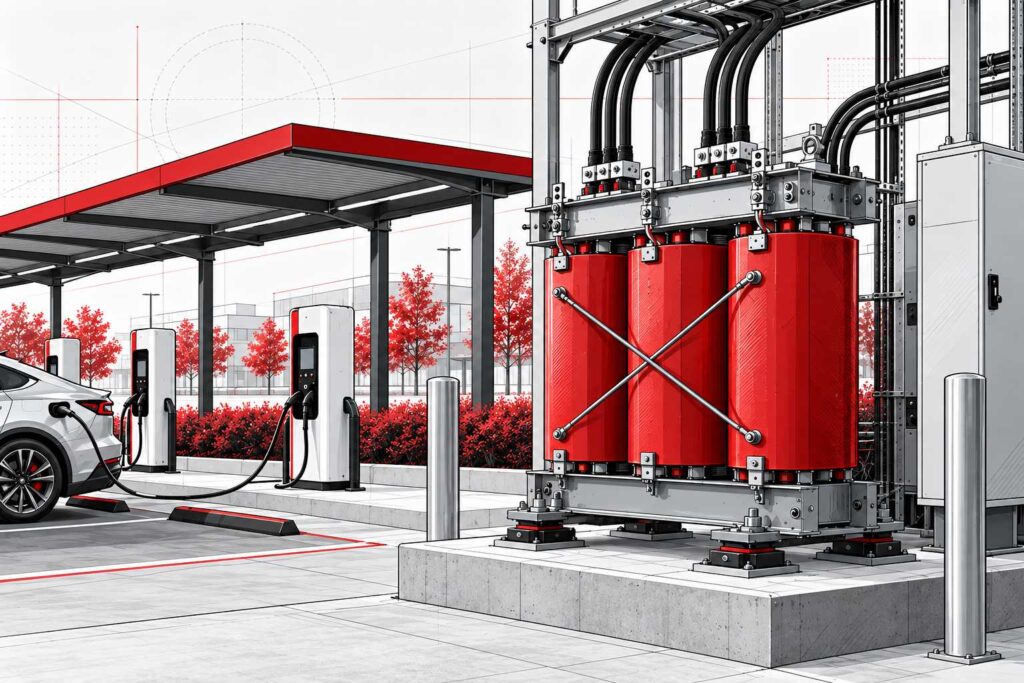
EV charging looks like a simple electrical load until you start looking at it more carefully. A residential Level 1 charger is a household appliance. A bank of DC fast chargers at a highway-adjacent site is a power-electronic load profile that can stress a distribution transformer in ways that ordinary commercial loads never do — sustained high current, significant harmonic content, asymmetric DC components, and brief but heavy transients during session start and stop.
The transformer that feeds the chargers has to handle all of that without losing its rated service life. This article covers the differences between Level 2 and Level 3 charging from a transformer-specification standpoint, the 600 V to 480 V challenge that Canadian installations face, and the construction details that separate a reliable charger transformer from a commodity unit.
Level 2 vs. Level 3 Chargers: Different Load, Different Transformer
The two categories share a name but represent fundamentally different electrical loads.
- Level 2 chargers are AC chargers. They deliver 208 V or 240 V single-phase, or 208/480 V three-phase, directly to an onboard charger inside the vehicle. The onboard charger does the AC-to-DC conversion. Typical power levels are 3.3 to 19.2 kW for residential and commercial units, with a few higher-power units reaching 80 A at 208 V. The transformer feeding Level 2 chargers sees a relatively benign load — modest harmonic distortion (typically 5 to 8% THD on current), reasonable power factor (above 0.95 for modern units), and demand that builds up gradually as sessions start.
- Level 3 chargers — DC fast chargers — are an entirely different category. They contain their own AC-to-DC conversion equipment, taking 480 V three-phase input and delivering 200 to 920 V DC directly to the vehicle battery. Power levels start at 50 kW and reach 350 kW or more per dispenser, with multiple dispensers at a single site commonly exceeding 1 MW of total demand. The transformer sees a power-electronic load: significant harmonic content (often 12 to 25% THDI depending on rectifier topology), variable power factor, fast-changing demand profile as sessions start and stop, and depending on the rectifier design, asymmetric DC components that don’t show up on conventional ammeters.
The transformer specification implications are direct. A Level 2 installation can use a conventional general-purpose distribution transformer with normal sizing margin. A Level 3 installation needs explicit attention to harmonic loading, K-factor rating where appropriate, DC offset capability, and often a larger physical size for the same nominal kVA to handle the additional losses.
Sizing for Charger Diversity
One of the practical questions on every EV charging project is how much diversity to apply when sizing the supply transformer. The answer differs sharply between Level 2 and Level 3 installations.
Level 2 installations — workplace charging, multi-unit residential, commercial parking — usually justify significant diversity. Not every charger is in use at once, sessions are long and overlap only partially, and the load building up to peak is gradual. Diversity factors of 0.4 to 0.7 are typical depending on the use case.
Level 3 installations don’t get the same break. DC fast charging sessions are short and intensive, and a busy site easily reaches full simultaneous output across all dispensers during peak hours. Diversity factors of 0.8 to 1.0 are typical for dedicated fast-charging sites. Underestimating diversity is the most common sizing error in this application and produces transformers that run hotter than expected within the first year of operation.
Future capacity matters more than usual. Charger installations expand far more often than they get reduced, and the cost of upsizing a transformer at design time is small compared to replacing it once the installation is operating.
The 600 V to 480 V Problem in Canadian Installations
Canadian commercial distribution is built around 600 V three-phase. EV charging equipment, even when sourced for both US and Canadian markets, is overwhelmingly designed around 480 V three-phase input. The mismatch shows up at almost every Canadian Level 3 site and at many larger Level 2 installations.
The straightforward solution is a step-down transformer ahead of the chargers, taking the available 600 V supply down to the 480 V the chargers expect. The configuration is conventional — a 600 V delta primary feeding a 480Y/277 V secondary — and the sizing follows the same logic as any other charger transformer.
Autotransformers are sometimes used for this duty as well, since the 600 V to 480 V ratio is modest enough that an autotransformer’s smaller size and lower cost can be attractive. The trade-off is the loss of galvanic isolation between the supply and the charging equipment, which matters more for the harmonic and DC-offset interaction with the chargers than for safety alone. Most Level 3 installations specify isolated transformers; autotransformers see more use in lighter-duty Level 2 applications where the harmonic profile is benign.
Core construction is the other consideration that’s specific to this application. Conventional three-legged cores assume balanced loading and provide no flux path for DC or zero-sequence components. EV chargers don’t always cooperate — DC fast chargers can inject small DC components back into the AC supply (typically under 1% of rated current, but cumulative across multiple chargers), Level 2 installations often grow phase-by-phase and operate with persistent imbalance, and on a three-legged core a lost upstream phase can develop induced voltage through magnetic coupling that masks the phase loss from downstream protection. Five-legged cores — three wound legs plus two unwound return legs — provide an explicit flux path for DC, zero-sequence, and unbalanced components, eliminating the saturation risk from DC offset, handling unbalanced loading without excess heating, and allowing lost-phase voltage to collapse properly so phase-loss relays see the fault. The extra cost is justified at Level 3 sites with multiple high-power dispensers and increasingly worth considering for larger Level 2 installations as well.
K-Factor and Harmonic Considerations
Both Level 2 and Level 3 chargers produce harmonic current, but the spectra are different enough to drive different specifications.
Level 2 chargers typically produce low-order harmonics (mostly 5th and 7th from single-phase or six-pulse rectifier topologies) at modest amplitude. A K-4 rated transformer is generally sufficient.
Level 3 chargers depend strongly on the rectifier topology. Older six-pulse designs produce significant 5th, 7th, 11th, and 13th harmonics. Twelve-pulse and active front-end designs produce much cleaner spectra but introduce switching frequencies. K-13 ratings are common for dedicated Level 3 supply transformers, with higher K ratings for the most demanding installations.
K-factor rating alone is not a substitute for proper sizing. The K rating addresses the transformer’s ability to handle harmonic losses without overheating; it doesn’t address the upstream effects of harmonic injection on the rest of the facility. Harmonic mitigation at the charger level, harmonic filtering, or active harmonic mitigation may be required separately depending on the size of the installation and the sensitivity of other loads.
Other Specification Considerations
EV charging transformers don’t sit in clean indoor electrical rooms the way most distribution transformers do. They’re frequently outdoors, exposed to weather, in public-facing locations, and often without the maintenance attention that conventional indoor equipment receives. Three considerations follow from that.
Sound levels. Charging sites are commonly located close to where people actually are — parking lots adjacent to retail, workplace charging near building entrances, fleet depots with adjacent offices. Audible noise that would be unremarkable in a basement electrical room can become a complaint generator in these locations. Standard distribution transformers are typically rated around 55 to 65 dBA at rated load; quieter constructions are available in the 50 dBA range and below. Specifying explicit sound level limits at design time is far easier than retrofitting acoustic enclosures later. The point is more relevant for transformers that operate near rated load continuously, which charger transformers often do during peak hours.
Electrostatic shielding. The inverters and rectifiers in EV chargers generate high-frequency switching noise that propagates back into the supply. Without an electrostatic shield between the primary and secondary windings, that noise couples capacitively into the supply system and can interfere with sensitive equipment elsewhere on the bus — protective relays, metering, communications, building automation. An electrostatic shield (a grounded conductive layer between the primary and secondary windings) breaks the capacitive coupling and significantly reduces conducted noise transmission. This is standard practice for transformers feeding power-electronic loads and worth specifying explicitly for any Level 3 installation.
Enclosure ratings. Outdoor charger transformers face rain, snow, ice, dust, salt spray near roadways, and occasional vandalism or vehicle impact. NEMA 3R is the minimum reasonable rating for outdoor installations; NEMA 4 or NEMA 4X is appropriate for harsher environments or coastal installations. The other reality of charging-site transformers is reduced maintenance attention — site owners often don’t have on-site electrical staff, and inspection cycles can stretch out beyond what indoor equipment typically sees. Sealed or fully enclosed construction reduces the consequences of skipped maintenance. Encapsulated or cast-coil winding construction handles moisture and contamination ingress that VPI construction may not tolerate over multi-year intervals between inspections.
Pad-mount construction is common at larger sites, with the transformer placed on a concrete pad behind a vehicle barrier and the charger dispensers connected via short underground runs. The pad-mount enclosure provides both the environmental rating and the tamper resistance needed for public locations.
Conclusion
EV charging transformers are not commodity distribution transformers with a different label. Level 2 and Level 3 installations present meaningfully different load profiles, and the transformer specification has to follow the actual electrical characteristics rather than the nominal kVA alone. Canadian sites face the additional consideration of getting from 600 V supply to 480 V charger input efficiently and safely, with construction details — isolated versus autotransformer, three-legged versus five-legged core — that matter more here than in conventional distribution. And the physical realities of outdoor, public-facing, lightly-maintained installations push sound levels, electrostatic shielding, and enclosure ratings out of the optional category and into the specification.
The pattern that produces reliable EV charging infrastructure is the same as in any other power-electronic application: specify for the actual load, not the nameplate; allow for growth; and respect the differences between the equipment that’s actually being supplied and the general-purpose loads the transformer might otherwise serve. When those three are handled at design time, the transformer disappears into the background — which is exactly what it should do.