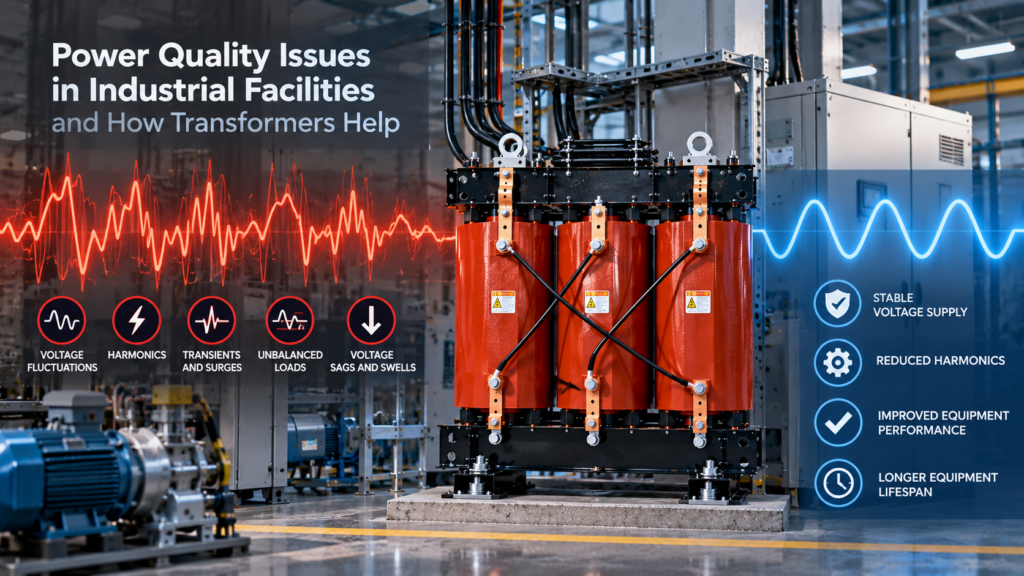
Industrial facilities are harder on their electrical supply than they used to be. The shift from line-frequency motors and incandescent lighting to variable frequency drives, switching power supplies, UPS systems, LED drivers, and inverter-based equipment has changed the load profile from “mostly linear” to “mostly not.” The transformers and conductors built to feed that earlier load are now being asked to feed something fundamentally different, and the symptoms show up as overheating equipment, nuisance tripping, sensitive electronics misbehaving, and capacity that has somehow disappeared.
Power quality is a broad subject, but for most industrial sites two issues dominate: harmonic distortion and transient overvoltages. Both have well-understood causes, and both have transformer-based mitigation strategies that have been refined over decades. This article covers what’s happening electrically, why it matters, and how the right transformer selection addresses problems that would otherwise require active filtering or expensive electronics.
Harmonic Distortion: The Dominant Industrial Power Quality Problem
A linear load draws current in proportion to the voltage applied to it. A non-linear load doesn’t — it draws current in pulses, in short bursts at the peaks of the voltage waveform, or in patterns shaped by switching power electronics. The Fourier transform of those non-sinusoidal currents shows up as components at frequencies other than the fundamental: the 5th, 7th, 11th, 13th harmonics from six-pulse rectifiers; the 3rd, 9th, and 15th (triplen harmonics) from single-phase electronic loads; and higher-frequency content from PWM switching.
The consequences of harmonic current are real and quantifiable:
Transformer overheating
Harmonic currents produce I2R losses just like fundamental currents, but they also produce eddy current losses that scale with the square of the harmonic frequency. A 15% harmonic component at the 5th harmonic produces roughly 25 times the eddy losses of the same magnitude at the fundamental.
- Neutral overload. Triplen harmonics from single-phase loads don’t cancel in the neutral — they add. A neutral conductor sized for balanced operation can be carrying 1.5 to 2 times the phase current under heavy triplen load.
- Capacitor failure. Power factor correction capacitors present low impedance to harmonic currents, drawing far more harmonic current than rated and failing prematurely.
Equipment misbehavior
Voltage distortion at the bus — produced by harmonic current flowing through system impedance — can cause sensitive electronics, control systems, and metering to behave unpredictably.
Lost capacity
A transformer feeding a harmonic-rich load operates at higher temperature than the linear-equivalent kVA would suggest, eating into the margin the design assumed.
Transformer Solutions for Harmonics
Two transformer types address harmonic loading in different ways.
K-factor rated transformers are designed to handle harmonic-rich loads without overheating. The construction includes larger conductors to handle additional losses, an oversized neutral conductor (typically 200%) to handle triplen harmonics, and electrostatic shielding between windings. K ratings — K-4, K-9, K-13, K-20, K-30 — correspond to the harmonic load profile the transformer can tolerate. K-4 covers light office loads; K-13 is typical for facilities with significant VFD and UPS content; K-20 and above serve the most demanding installations like data centers and large variable-speed drive plants.
The K-factor calculation itself is straightforward. For a measured harmonic spectrum:
Where Ih is the RMS current at harmonic h, I1 is the fundamental current, and the summation runs across all significant harmonics. A measured K value should be compared against the transformer’s K rating — if the load exceeds the transformer, the transformer is being thermally overloaded even when nameplate kVA looks fine.
K-factor rated transformers tolerate harmonics. They don’t reduce them. The harmonic current still flows upstream into the rest of the facility.
Harmonic mitigating transformers (HMTs) take a different approach. Rather than simply tolerating harmonics, HMTs cancel specific harmonics within the transformer itself, reducing the harmonic content that propagates back to the supply. The cancellation happens in the magnetic circuit through phase-shifting and zigzag winding configurations, and the specific construction varies depending on whether the unit is built for a single load or for paired loads.
Single-output HMTs use zigzag-connected secondaries to address triplen harmonics (3rd, 9th, 15th) at their source. Triplen harmonics from single-phase electronic loads — computers, LED drivers, switching power supplies, electronic ballasts — don’t cancel in the neutral the way fundamental currents do; they add. On a conventional wye-connected transformer, that triplen current flows through the neutral conductor, back through the transformer winding, and up into the supply system, where it shows up as voltage distortion at the bus. A single-output HMT with a zigzag secondary winding provides a circulating path for triplen harmonics within the transformer itself, trapping them magnetically and dramatically reducing both the neutral current and the upstream harmonic content. This is the right configuration for office buildings, data centers, and any installation dominated by single-phase electronic loads.
Dual-output HMTs address the harmonics produced by three-phase rectifier loads — primarily 5th, 7th, 11th, and 13th — through phase shifting between two secondary windings. One secondary is configured for 0° phase shift and the other for 30°, effectively creating a 12-pulse system when the loads on both secondaries are roughly balanced. The 5th and 7th harmonics produced by one secondary are 180° out of phase with those produced by the other and cancel at the primary. The result is upstream harmonic content that looks more like a 12-pulse rectifier system even though the connected loads are conventional 6-pulse drives.
Some HMT designs combine both approaches — phase shifting between dual secondaries to cancel non-triplen harmonics, with zigzag winding configurations to trap triplens. These hybrid configurations are useful where the load mix includes both three-phase drives and significant single-phase electronic content, which is common in modern industrial facilities with mixed manufacturing and office areas.
The choice between single-output and dual-output construction comes down to the dominant load type. Single-output HMTs serve installations where triplens dominate. Dual-output HMTs serve installations where three-phase rectifier loads dominate, and where the load can be split reasonably evenly between the two secondaries. Loading imbalance between the two secondaries reduces the cancellation effect proportionally, so dual-output specification requires some attention to how the connected loads will actually be distributed.
HMTs are more complex and more expensive than K-factor rated transformers but produce a cleaner overall system rather than just protecting the transformer itself. The decision often comes down to whether the goal is to protect the supply transformer (K-factor) or to clean up the facility (HMT).
Voltage Transients: The Other Major Concern
Transients are brief but severe voltage excursions — capacitor switching spikes, lightning surges, motor starting events, breaker switching transients on medium-voltage systems, and the ringing that follows any sudden change in current through an inductive circuit. A typical transient might last microseconds to milliseconds but reach voltages many times nominal.
The damage is often invisible at the time. A transient that doesn’t immediately fail equipment can still degrade insulation cumulatively. Repeated exposures to even moderate transients erode insulation, and the eventual failure looks unrelated to the cause because months or years pass between the cause and the symptom.
Transformer Solutions for Transients
For low-voltage industrial distribution — the transformers that step from 480 V or 600 V down to utilization voltage at panelboards and equipment — the dominant transient mitigation strategy is electrostatic shielding within the transformer itself.
An isolation transformer with an electrostatic shield includes a grounded conductive layer between the primary and secondary windings. The shield breaks the capacitive coupling path that would otherwise let high-frequency transients pass directly from one winding to the other. Without the shield, the inter-winding capacitance acts as an unintended high-pass filter, letting transients, switching noise, and high-frequency content cross the transformer almost unimpeded. With the shield, that capacitive coupling is intercepted and grounded out before it reaches the load.
The shielding effect is most valuable in two directions, and the same construction addresses both:
- Protecting sensitive loads from the supply. Lab instruments, medical equipment, computer rooms, process control systems, and similar electronic loads are vulnerable to high-frequency noise and transients that ride on the supply voltage. An isolation transformer with electrostatic shielding between the supply and the sensitive load significantly reduces what gets through.
- Protecting the supply from noisy loads. VFDs, switching power supplies, UPS systems, and inverter-based equipment generate high-frequency switching noise that propagates back into the supply through inter-winding capacitance. A shielded transformer between these loads and the rest of the facility prevents that noise from contaminating the bus and affecting other equipment.
For installations where both directions matter — a manufacturing facility with sensitive controls and significant power-electronic loads on the same bus, for example — electrostatic shielding addresses the high-frequency interaction that would otherwise create persistent, hard-to-diagnose problems.
Shielding doesn’t address every form of transient. Lightning-induced surges, severe upstream switching events, and other high-energy transients still need surge protection devices coordinated with the transformer. But for the routine high-frequency transient and noise environment of a modern industrial facility — the kind that produces equipment misbehavior, intermittent faults, and “we don’t know why it keeps happening” symptoms — electrostatic shielding does most of the work.
Specification as a System Decision
The mistake that drives most power quality problems isn’t selecting the wrong individual transformer — it’s treating the transformer as a commodity rather than as part of an integrated power system.
A facility expanding its VFD population without re-evaluating the supply transformer eventually discovers that the K rating that was adequate at design time isn’t anymore. A control room added to a manufacturing plant without an isolation transformer eventually has unexplained equipment failures from conducted noise. A specification that ignored the harmonic spectrum of the actual load eventually produces a transformer running well above its design temperature.
The corrective pattern is the same in each case. Measure what’s actually happening — harmonic surveys, transient recording, thermal monitoring — before specifying. Match the transformer construction to the actual load, not the nominal load. And treat the supply transformer as a power quality component, not as inert infrastructure.
Conclusion
Power quality problems in industrial facilities rarely have a single cause and rarely have a single solution. What they do have, almost without exception, is a transformer at the boundary between the source of the problem and the equipment that suffers from it. The transformer either makes the problem worse by being unsuited to the load, or makes it better by being specifically built for the conditions it has to handle.
K-factor rated transformers protect against harmonic-induced overheating. Harmonic mitigating transformers — in single-output configurations for triplen-dominated loads and dual-output configurations for three-phase rectifier loads — actively reduce the harmonic content that reaches the supply. Electrostatic shielding in isolation transformers blocks the high-frequency transient and noise transmission that produces most of the hard-to-diagnose equipment problems in modern facilities. None of these is a universal solution, but together they cover the harmonic and transient problems that produce the majority of industrial power quality complaints — quietly, reliably, and without the recurring operational cost of active filtering or electronic compensation.