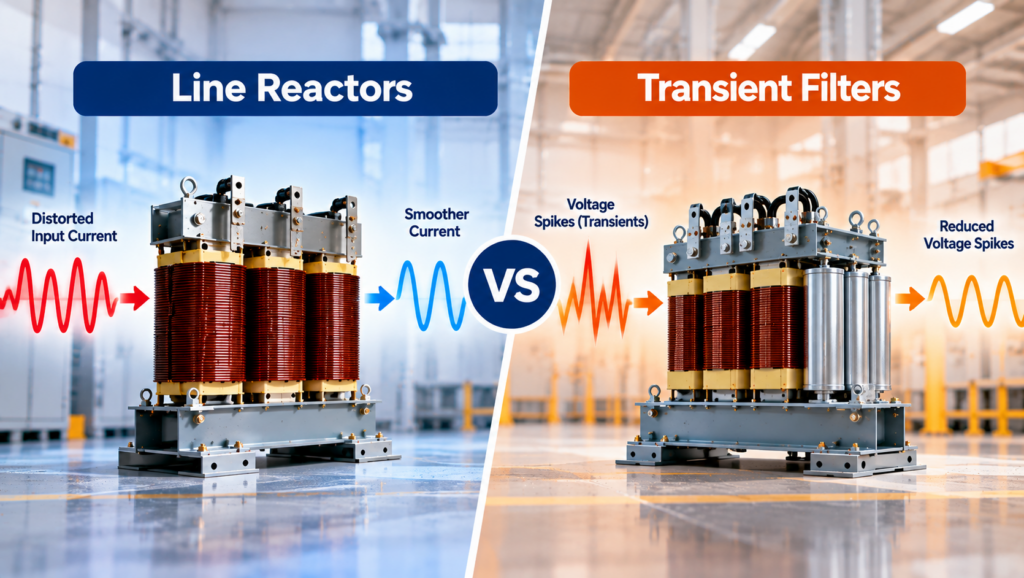
Variable Frequency Drives (VFDs) have become an essential part of modern power and motor control systems. They provide precise speed regulation, improve process efficiency, and significantly reduce energy consumption across industrial and commercial facilities. However, the same pulse-width modulation (PWM) technology that enables VFD efficiency also introduces power quality challenges—most notably current harmonics, voltage transients, and high-frequency switching noise.
To mitigate these effects and ensure compliance with harmonic standards such as IEEE 519, electrical systems commonly employ line reactors and transient filters. Both are passive, highly reliable components designed to improve current waveform quality, protect equipment, and extend the life of connected motors and drives. While they share similarities, each serves a distinct function and offers unique performance characteristics.

Harmonics and Transients in VFD Systems
A VFD operates by first rectifying incoming AC voltage into DC, then converting that DC back into a variable-frequency AC signal for motor control. This conversion process is inherently non-linear and introduces two main power quality issues:
Line-side harmonics: The rectifier stage draws current in pulses, creating distortion in the supply current waveform. These harmonics increase transformer losses and may cause upstream voltage distortion.
Load-side transients: The inverter stage generates steep voltage transitions (high dv/dt) that stress motor insulation and may produce reflected wave overvoltages on long motor leads.
Together, these phenomena reduce efficiency, generate excessive heat, and may lead to premature failure of motors, drives, and upstream equipment. Passive mitigation components such as line reactors and transient filters help address these problems by controlling current and voltage distortion at their source.
Line Reactors: Function and Applications
A line reactor is an inductive device designed to add controlled impedance into a circuit, limiting the rate of current change and smoothing waveform distortion. In VFD systems, reactors can be placed on either the line side (input) or the load side (output).
Line-Side Reactors (Input Reactors)
Installed between the power source and the VFD, line-side reactors:
- Reduce current harmonics typically by 30–40%.
- Protect the VFD from upstream voltage spikes and transients.
- Limit inrush current and reduce nuisance overcurrent tripping.
- Improve overall current balance and extend equipment life.
A typical line-side reactor provides 3% or 5% impedance relative to system voltage, which offers an effective balance between harmonic attenuation and voltage drop.
Load-Side Reactors (Output Reactors)
Installed between the VFD and motor, load-side reactors:
- Limit dv/dt (rate of voltage rise) from the VFD inverter output.
- Reduce reflected wave voltage on long cable runs.
- Decrease motor insulation stress and extend motor life.
- Minimize audible noise and heating in motor windings.
Load-side reactors are especially recommended for systems where motor lead lengths exceed 15 to 30 metres (50 to 100 feet).
Transient Filters: Function and Benefits
A transient filter combines resistive (R) and inductive (L) elements in a single passive network. This configuration attenuates harmonic currents more effectively than a standalone reactor while preventing the resonance issues that can occur in purely inductive or capacitive filtering systems.
Construction and Operation
Inductors oppose rapid changes in current, reducing the amplitude of harmonic components.
Resistors provide damping, dissipating residual harmonic energy and stabilizing system response.
Together, they create a balanced impedance path that smooths current flow and minimizes harmonic propagation without relying on capacitors.
Applications
R–L filters are typically installed on the input side of the VFD to:
Improve current waveform and lower total harmonic distortion (THD).
Support compliance with IEEE 519 harmonic limits at the point of common coupling (PCC).
Reduce transformer and cable heating caused by harmonic currents.
Prevent resonance between VFDs and other system components.
Advantages
Effective harmonic reduction, often lowering current THD to 8–10% under typical load conditions.
No capacitors, thus eliminating the risk of resonance with system capacitance.
Minimal maintenance and long operating life due to simple, robust construction.
Compact footprint relative to complex harmonic filter assemblies.
Comparing Line Reactors and Transient Filters

Selection Guidelines

Selecting the appropriate device depends on system characteristics, harmonic objectives, and cost considerations.
For general installations:
A 3% input line reactor is typically sufficient to limit transients and moderately reduce harmonic current distortion.
For systems with multiple VFDs or tighter harmonic targets:
An R–L filter provides deeper harmonic attenuation and damping, improving compliance with IEEE 519 limits.
For long motor leads or high dv/dt applications:
A load-side reactor remains the preferred solution to protect motor insulation.
Confirm system performance:
Always verify harmonic levels at the PCC relative to the system short-circuit ratio (Isc/IL) and design with margin for future load expansion.
Benefits of Proper Application
When correctly specified and installed, line reactors and R–L filters deliver significant benefits:
- Improved VFD and motor reliability.
- Reduced nuisance trips and voltage stress.
- Compliance with IEEE 519 harmonic limits.
- Reduced heating in transformers, cables, and conductors.
- Lower overall system losses and improved power factor.
- Enhanced operational safety and uptime.
Conclusion and Industry Perspective
Line reactors and R–L filters are essential tools for managing harmonics and transients in variable frequency drive systems. Both are simple, proven, and maintenance-free solutions that improve waveform quality and safeguard critical equipment. Line reactors offer an economical choice for general protection, while R–L filters deliver enhanced harmonic reduction and resonance control for more demanding applications.