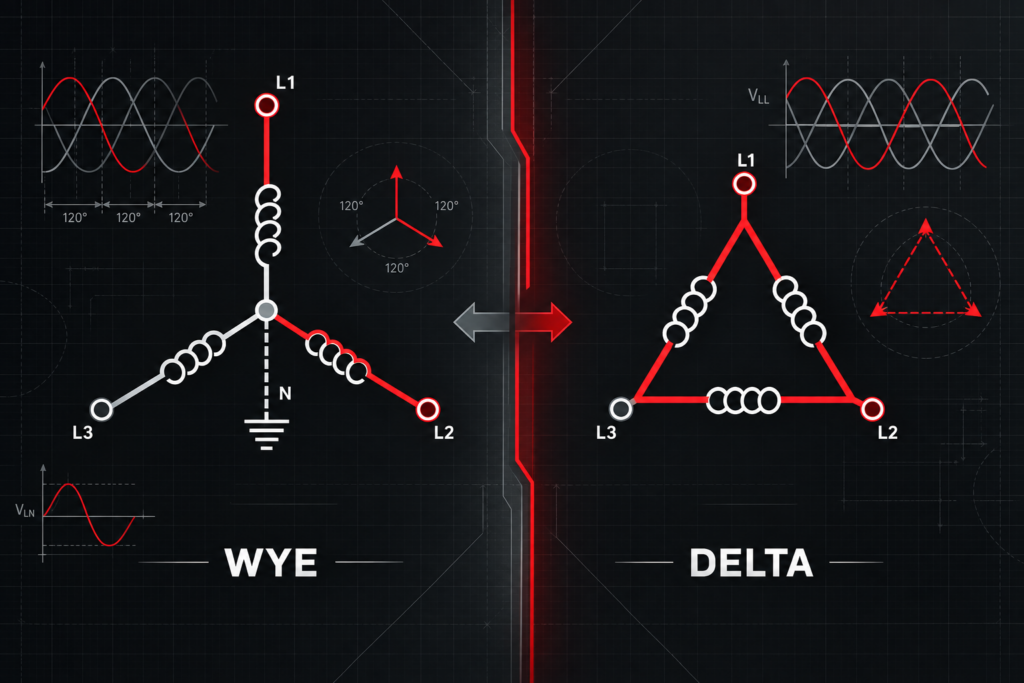
The choice between wye and delta connections on a transformer doesn’t usually come up as a standalone decision. It gets bundled into the broader specification — standard delta-wye for most commercial distribution, standard wye-delta for some industrial applications — and the engineering implications often go unexamined until something behaves differently than expected. A neutral that should be there isn’t. A third-harmonic problem turns out to have been caused by the connection choice three years earlier. A reverse-fed transformer creates a grounding compliance issue that nobody anticipated.
This article walks through what the two most common configurations — delta-wye and wye-delta — actually do, how grounding works in each, and the practical implications for system behavior that come with each choice.
The Two Connections, Briefly
In a delta connection, the three windings of a three-phase transformer are connected end-to-end to form a closed triangle. Each winding sits between two line conductors, with no neutral point. Line voltage equals phase voltage, but line current is √3 times phase current.
In a wye connection (also called star), each winding has one end connected to a common point — the neutral — and the other end connected to a line conductor. Line current equals phase current, but line voltage is √3 times phase voltage.
The voltage and current relationships:
Wye: Vline = √3 × Vphase, Iline = Iphase
These aren’t just calculation differences. They determine how the transformer interacts with the system on both sides.
Delta-Wye: The Default for Distribution
The delta-primary, wye-secondary transformer is the workhorse of commercial and light industrial distribution. A 600 V or 480 V delta primary feeding a 208Y/120 V or 480Y/277 V secondary is the standard configuration for most buildings in North America. There are good reasons for the dominance.
Neutral availability. The wye secondary provides a neutral point, which gives access to phase-to-neutral voltage in addition to phase-to-phase. On a 208Y/120 V system, the building gets 208 V three-phase for motors and equipment, plus 120 V single-phase for lighting and receptacles, from the same transformer. The neutral conductor carries the unbalanced single-phase current back to the transformer without flowing through the phase conductors.
Separately derived service. When the wye secondary’s neutral is bonded to the building ground and the transformer enclosure, the secondary becomes a separately derived system. This establishes a new grounded reference downstream of the transformer, independent of the upstream supply’s grounding configuration. The result is a clean grounding system on the secondary that doesn’t depend on the integrity of the supply’s ground.
Triplen harmonic handling. Third, ninth, and fifteenth harmonics from single-phase electronic loads — computer power supplies, LED drivers, switching ballasts — add in the neutral rather than canceling. On a delta-wye transformer, those triplen currents flow in the neutral conductor, into the wye winding, and then circulate within the delta primary winding. They don’t propagate into the upstream system. This is one of the under-appreciated benefits of the delta-wye configuration for facilities with significant single-phase electronic loads.
Phase shift. A delta-wye transformer introduces a 30° phase shift between primary and secondary. This is generally invisible to downstream operation, but it matters when paralleling transformers or when phase-shifted configurations are used deliberately for harmonic cancellation (the basis of 12-pulse and 24-pulse rectifier supplies).
Wye-Delta: Industrial and Step-Up Applications
Wye-primary, delta-secondary transformers serve a different set of applications.
The primary is wye for two main reasons. First, it gives a neutral point on the supply side, which is useful for grounding the primary system through a resistor or directly. Second, it provides a path for the third-harmonic excitation current that all transformer cores need — on a wye-delta, that excitation flows from the line through the wye neutral and into the delta secondary, where it circulates as a balanced current within the delta loop.
The delta secondary suits applications that don’t need a neutral. Three-phase motors don’t need a neutral. Three-phase rectifier loads don’t need a neutral. Many industrial loads run delta-connected on the secondary side, drawing balanced three-phase power without requiring single-phase access from the same transformer.
Wye-delta is also common in step-up applications where the LV input comes from inverters or generators that produce a neutral point, and the MV output feeds a delta-connected distribution system. The phase shift is the same 30° (in the opposite direction from delta-wye), which again becomes a consideration when paralleling or when phase-shifting is intentional.
Grounding: Grounded vs. Ungrounded Wye
The wye configuration enables two fundamentally different grounding strategies, and the choice has significant implications for system behavior.
Solidly grounded wye connects the wye neutral directly to ground (or through a very low impedance). This is the standard configuration for most commercial and light industrial distribution. The advantages are straightforward:
- Fault current is high and easily detected, allowing protective devices to clear ground faults quickly.
- The phase-to-ground voltage on healthy phases stays at nominal during a ground fault, limiting voltage stress on equipment.
- Equipment grounding and bonding are simple and unambiguous
The trade-off is that any ground fault produces a high-current event that typically trips the upstream breaker, taking the entire downstream system offline.
Ungrounded or high-resistance grounded wye systems connect the neutral through a high-impedance resistor or leave it floating. This is common in industrial applications where continuity of operation matters more than fault clearing speed. The behavior differs significantly:
- A first ground fault produces minimal fault current — just the capacitive charging current of the system — and doesn’t trip protection. The system continues to operate, but the unfaulted phases now sit at line-to-line voltage above ground.
- A second ground fault on a different phase becomes a phase-to-phase short through ground, with high fault current.
- Ground fault detection requires dedicated relaying because the fault doesn’t show up as a current trip event.
High-resistance grounded systems trade fault current magnitude for operational continuity. They’re common in mining, process industries, and other applications where unplanned shutdowns are far more expensive than the cost of locating a first ground fault while the system continues to run. The trade-off is real — the elevated phase-to-ground voltage during a fault stresses insulation throughout the system, and the time pressure to locate and clear the first fault before the second one occurs creates operational complexity.
The delta side is inherently ungrounded unless one corner is intentionally grounded. A delta-delta transformer’s secondary has no neutral and therefore no natural ground reference. If grounding is required on a delta secondary, it’s typically established artificially through a grounding transformer (zigzag or wye-broken-delta configuration).
Practical Implications
Several decisions follow from the connection choice rather than appearing as separate specifications.
Reverse-fed delta-wye transformers stop being separately derived services. When the wye is energized instead of the delta, the wye is no longer a downstream source — it’s the input winding. The neutral should not be bonded to building ground in this configuration. This catches reverse-feed installations regularly and is a real code-compliance issue.
Phase shift coordination matters when paralleling. Two transformers with different vector groups — one delta-wye and one wye-wye, for example — have a 30° phase difference between secondaries and cannot be paralleled. The vector group designation (Dyn11, Yd1, etc.) captures the connection and phase shift in a single notation.
Harmonic behavior depends on the connection. Triplen harmonics from single-phase loads benefit from the wye-neutral path in a delta-wye configuration but propagate freely on wye-wye systems. Three-phase harmonic-rich loads (VFDs, rectifiers) interact with the connection differently than single-phase loads.
Available voltages depend on which winding has the neutral. A delta secondary gives only line-to-line voltage. A wye secondary gives both line-to-line and line-to-neutral. This is determined entirely by the connection choice and can’t be changed without rewiring the transformer.
Conclusion
Wye and delta aren’t just two ways to draw the same transformer. They produce different grounding behavior, different harmonic handling, different fault response, and different voltage availability on each side. The default delta-wye configuration suits most commercial distribution because the wye secondary’s neutral, separately derived service, and triplen-trapping behavior all align with how typical commercial loads actually behave. Wye-delta and other configurations exist because some applications need what they offer instead.
The honest assessment is this: the connection choice is rarely revisited once specified, but it shapes everything downstream — what voltages are available, how grounding works, how harmonics propagate, how faults clear. When the application is standard, the default choice is correct. When the application is non-standard, the connection choice is worth thinking about explicitly rather than inheriting from past projects.