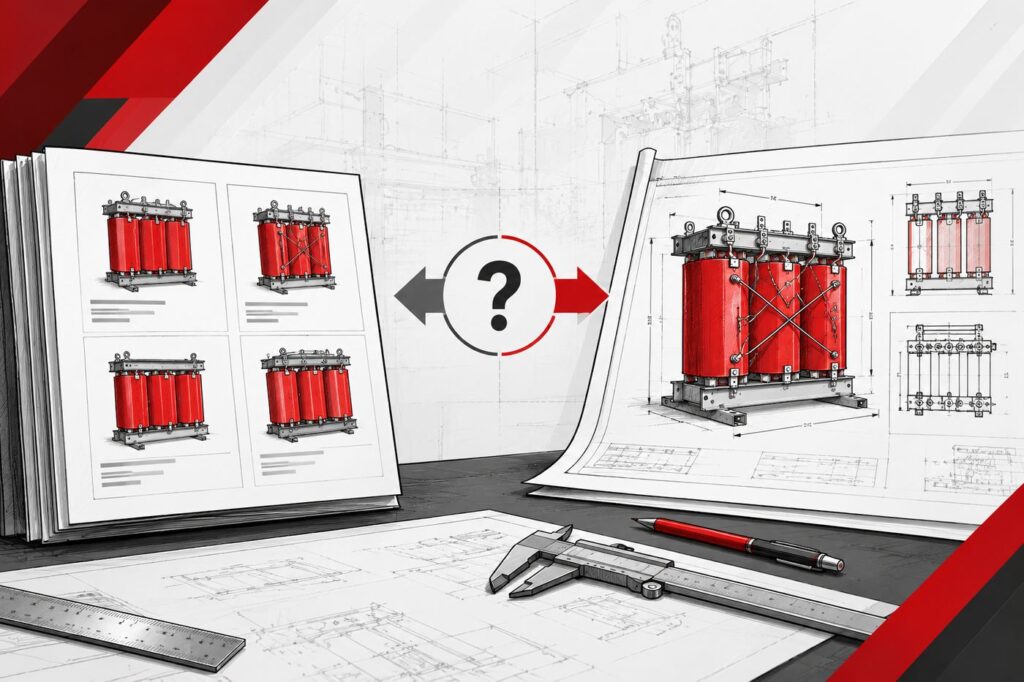
Most transformer specifications get filled from a catalog. The voltages match, the kVA rating is close enough, the enclosure type is available, lead time is acceptable, and the standard product is the right answer. For the large majority of commercial and industrial installations, that’s how it should be — standard products are well-understood, predictably priced, and supported by decades of operating experience.
Sometimes the catalog doesn’t have what the application needs. The voltage ratio doesn’t exist in the standard product line. The footprint won’t fit through the door of the existing electrical room. The harmonic profile of the connected load doesn’t match any off-the-shelf K-factor rating. The temperature class needs to be tighter than standard for life-extension reasons. At that point the decision shifts from “which standard unit fits” to “do we need a custom unit, and is it worth what that involves.”
This article covers when custom transformers are genuinely the right answer, what the practical realities of specifying and buying custom actually look like, and where the line between “modified standard” and “fully custom” usefully falls.
When Standard Is the Right Answer
Before talking about custom, it’s worth being clear about when it isn’t necessary. Standard transformers work well for the cases they were designed around:
- Standard voltage ratios — 600/480/240/208/120 V combinations on the LV side, common MV voltages (4.16, 13.8, 25, 34.5 kV) on the HV side.
- Standard kVA ratings — 15, 30, 45, 75, 112.5, 150, 225, 300, 500, 750, 1000 kVA and similar.
- Standard enclosures — ventilated indoor, NEMA 3R outdoor, encapsulated for small units.
- Standard temperature classes — 150°C rise for typical commercial, 115°C or 80°C rise for installations targeting longer life or harmonic-rich environments.
- Standard K-factor ratings — K-1, K-4, K-13, K-20 for typical harmonic load profiles.
If the application fits the standard catalog within reasonable margin, taking the catalog unit is almost always the right call. Custom isn’t a status upgrade — it’s a response to a real engineering constraint that the catalog doesn’t address.
When Custom Earns Its Place
Several specific patterns push installations toward custom construction:
Non-standard voltage ratios. Imported equipment built for European or Asian voltage systems, specialty process equipment with unusual voltage requirements, OEM-specified ratios for system matching, or installations where the voltages on both sides of the transformer are dictated by external factors that don’t align with North American standards. Off-the-shelf transformers exist in standard ratios; voltage matching outside those ratios needs custom design.
Specialized harmonic profiles. K-factor ratings beyond standard catalog (K-30, K-40), harmonic mitigating transformers with specific cancellation requirements, drive isolation transformers tailored to particular VFD topologies, or installations where the harmonic spectrum has been measured rather than estimated. Standard K-factor units cover typical profiles; unusual or measured profiles often need custom design to size the conductors, insulation, and shielding to the actual load.
Footprint and clearance constraints. Retrofit installations where existing space doesn’t accommodate standard dimensions. Tight electrical rooms, equipment-skid integration, vehicle-mounted installations, marine applications, and any situation where the transformer has to fit a non-standard envelope. Custom design can sometimes reduce footprint significantly compared to the standard unit at the same kVA, at the cost of higher unit price and longer lead time.
Unusual environments. Severe-duty applications — mining, marine, hazardous locations, chemical processing, high-altitude installations — that need construction beyond what standard products provide. Encapsulation, special insulation systems, corrosion-resistant materials, specific certifications, and explicit testing for the operating environment all push past standard catalog construction.
Specialty configurations. Multi-winding transformers for phase-shifting in 12-pulse or 24-pulse rectifier supplies. Zigzag-grounding transformers built to specific impedance requirements. Neutral grounding transformers for HRG systems with non-standard parameters. Five-legged cores for DC offset and zero-sequence handling in EV charging or inverter applications. Air-core reactors for current limiting at specific impedances. None of these is exotic in a manufacturing sense, but the application-specific parameters usually don’t match a standard SKU.
Tighter performance specifications. Lower sound levels for noise-sensitive installations, lower no-load losses for energy-cost-sensitive applications, lower temperature rise for life-extension, higher BIL for surge-exposed installations, tighter regulation for voltage-sensitive loads. The standard product meets the standard performance threshold; applications that need better than standard performance often need custom design.
The Practical Realities
Custom transformers carry real trade-offs that should factor into the specification decision before the order is placed.
Lead time. Standard transformers typically ship in 4 to 12 weeks depending on availability and configuration. Custom units start at around 12 weeks and routinely run 16 to 24 weeks for complex designs, with longer times for specialty components. Material lead time on grain-oriented silicon steel, copper, and specialty insulation can dominate the schedule for custom builds, particularly in tight supply markets. Projects with hard commissioning dates need to factor lead time into the equipment specification, not the other way around.
Cost. Custom designs typically cost 30 to 100% more than the closest standard equivalent, sometimes considerably more for highly specialized configurations. The premium pays for engineering time, lower production efficiency on a one-off build, and the testing required to validate the custom design. For one or two units, that premium is the cost of getting what the application actually needs. For larger quantities, custom designs become more cost-competitive as the engineering cost amortizes across more units.
Engineering involvement. Buying a standard transformer requires a model number and a few options. Buying a custom transformer requires a detailed specification, drawings, technical review with the manufacturer’s engineering team, prototype or first-article approval in some cases, and ongoing communication during the build. Specification quality matters — ambiguous specs produce builds that don’t quite match expectations, and changes during the build are expensive. A clean, complete specification at the start saves time and cost throughout.
Support and spares. Standard transformers have established service channels, available spare parts, and known field experience. Custom units have whatever support the original manufacturer commits to provide. Mid-life maintenance, replacement, or modification of a custom unit is typically more involved than for a standard unit, and the specification stage is the right time to think about long-term support, not after commissioning.
Where the Line Falls
Not every non-standard requirement needs a fully custom build. There’s a useful middle ground:
Modified standard products use a standard catalog unit as the starting point and modify specific parameters — non-standard taps, different enclosure type, additional terminal arrangements, specific certifications. The base design and most components remain standard, which keeps lead time and cost closer to standard product than to fully custom. Many transformer manufacturers, Rex Power Magnetics included, regularly produce modified standard units for applications that need small departures from the catalog.
Fully custom designs start from the application requirements and design the transformer to match. Core, windings, insulation system, cooling, enclosure, and testing all reflect the specific application. The cost and lead time premium is significant, but the result is a transformer that genuinely fits the application rather than one chosen from the closest available standard.
The decision between modified-standard and fully-custom comes down to how many of the application’s requirements depart from the standard product. One or two minor deviations usually justify modified standard. Multiple significant deviations — non-standard voltages plus unusual footprint plus specialty environment, for example — push past modification into fully custom territory.
Conclusion
Custom transformers exist because real applications sometimes don’t fit catalog products. The standard catalog is broad and well-engineered, but it can’t anticipate every voltage ratio, every footprint, every harmonic profile, every environment. When the application falls outside what the catalog supports, custom is the right answer — not because it’s better, but because it actually fits.
The decision deserves honest evaluation on both sides. Custom carries real cost, lead time, and engineering overhead. Standard carries the risk of forcing the application into a unit that doesn’t quite match. Match the choice to the requirement, factor the practical realities into the project schedule and budget, and the transformer specification ends up working with the rest of the project rather than constraining it.