Updated: August 17th, 2026
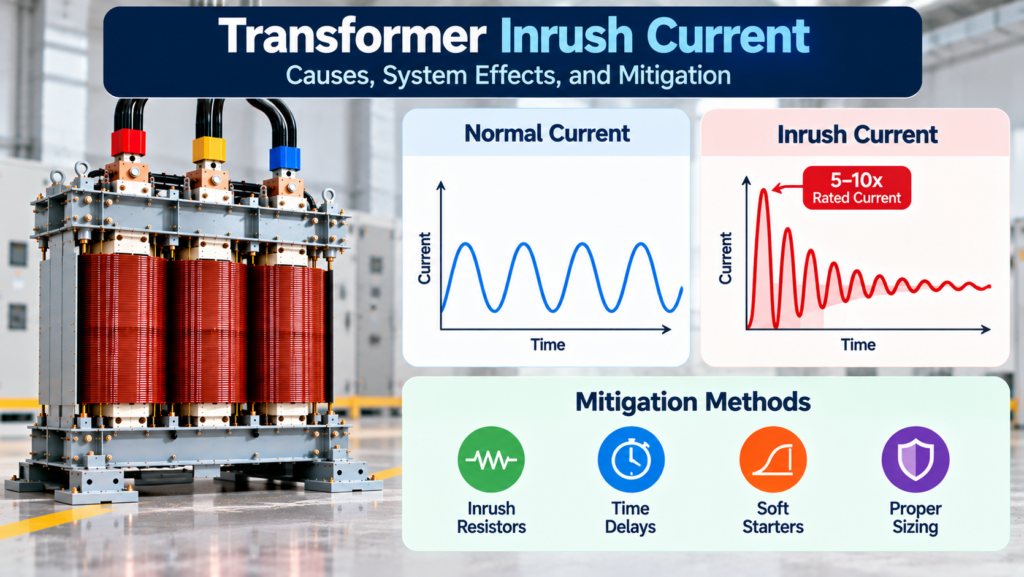
When a transformer is energized, the current drawn from the source is not always close to its normal no-load value. Under an unfavourable combination of switching instant and residual core flux, the magnetic core can be driven deeply into saturation. The transformer then draws a large, asymmetric magnetizing current known as transformer inrush current.
Inrush is an expected energization transient, not evidence that the transformer is overloaded or faulted. It can nevertheless operate fuses or circuit breakers, restrain or challenge protective relays, and produce a temporary voltage disturbance. The practical task is therefore not to eliminate every transient, but to understand the credible inrush duty and coordinate the transformer, source, switching equipment, and protection around it.
What Causes Transformer Inrush Current?
Transformer voltage and core flux are linked by electromagnetic induction. In simplified terms, core flux is proportional to the time integral of the applied winding voltage. During steady operation, the positive and negative volt-seconds of the alternating voltage produce a balanced flux waveform around the core’s normal operating point.
At energization, that balance has not yet been established. If voltage is applied at an unfavourable point on the waveform, the first volt-second interval can drive flux largely in one direction. A de-energized transformer may also retain residual flux. When it is in the same direction as the new transient flux, the combined value can move beyond the core’s normal operating range.
The magnetizing inductance falls sharply as the core enters saturation. Current then rises until it is limited by the source impedance, winding resistance, leakage reactance, and the nonlinear magnetic characteristics of the core. This is why a transformer can draw several multiples of rated current even when its secondary is open and no load power is being delivered.
For a simple single-phase case, closing near a voltage zero can produce the largest flux offset, while closing near a voltage peak can reduce it. A three-phase transformer is more complicated. The pole-closing sequence, winding connection, core construction, residual flux in each leg, and phase relationship all affect the result, and the best closing instant is not necessarily identical for every pole.

Which Factors Determine the Magnitude and Duration?
There is no universal inrush multiplier or decay time. Rules of thumb can support early screening, but protection settings and voltage-dip studies should use information suited to the actual transformer and system.
Residual flux is one of the most influential variables because it changes the flux starting point at the next energization. The switching instant and pole scatter determine how the applied volt-seconds combine with that residual flux. Supply voltage also matters: operation above rated volts per hertz moves the core closer to saturation before transient offset is considered.
Core geometry, joint construction, material, normal operating flux density, air gaps, and winding arrangement shape the saturation characteristic. No single feature, such as grain-oriented steel or step-lap construction, guarantees low inrush by itself. A low-loss core design and a low-inrush design involve related but not identical trade-offs and must be evaluated as a complete magnetic design.
The system determines how much current can flow after saturation begins. A strong source with low upstream impedance can supply a higher peak. A weaker source limits current more strongly, but the same inrush flowing through its greater impedance may produce a more serious voltage dip. Transformer impedance also contributes to the current path, although nameplate percent impedance alone does not describe the nonlinear magnetizing branch responsible for inrush.
Transformer rating is not a sufficient predictor. Larger units can produce substantial absolute current, but the multiple of rated current does not follow a simple kVA rule. The energized winding also matters. In applications such as reverse feeding a transformer, the protective device can see a different inrush duty from that assumed for normal forward energization.
What Does the Inrush Waveform Look Like?
Inrush current is normally nonsinusoidal and strongly asymmetric. One polarity can contain large, narrow current peaks as the core enters saturation, while the opposite half-cycle is much smaller. The waveform usually falls quickly during the first cycles and then decays more gradually as resistance and system losses remove the flux offset. A smaller transient component can remain after the visually dominant peak has passed, so duration should be judged against the relevant protection curve rather than by one fixed time value.
Magnetizing inrush often contains significant even-harmonic content, particularly second harmonic. Transformer differential protection has historically used harmonic restraint or blocking to remain secure during energization. However, second-harmonic content is not constant and may be lower for some transformer designs or switching conditions. Modern protection may combine harmonic quantities with waveform, differential, voltage, or other logic. Relay settings should therefore follow the protection study and the device manufacturer’s application guidance, not a universal second-harmonic threshold.
Inrush must also be distinguished from load starting current and internal fault current. Motor starting occurs because a connected motor draws high current while accelerating. Transformer inrush occurs in the magnetizing branch when core flux is established, even with the secondary unloaded. An internal fault can also create high current, but protection cannot simply assume that every large current immediately after closing is harmless inrush.
How Should Inrush Current Be Estimated?
An exact transformer inrush current calculation requires more than rated kVA and voltage. A credible model may include the core’s nonlinear magnetization characteristic, residual flux, winding resistance and leakage reactance, source short-circuit strength, system X/R ratio, breaker pole-closing times, connection, grounding, and other transformers already connected to the bus.
For routine distribution applications, manufacturer energization data and the protective device’s time-current curve may be enough to confirm ride-through. The inrush envelope should be checked against the fuse minimum-melting curve or breaker and relay characteristics while preserving the required response to overloads and faults. Rex’s guide to transformer fuse sizing explains why full-load current is only the starting point for this coordination.
Electromagnetic transient studies are appropriate when the source is weak, the transformer is large relative to the system, several units may be energized together, voltage-sensitive loads share the bus, or switching occurs frequently. EMTP or PSCAD can evaluate alternative closing conditions rather than one deceptively precise result. CIGRE Technical Brochure 568 provides guidance on voltage dips, temporary overvoltages, modelling, and mitigation.
How Can Inrush Affect the Electrical System?
The most visible consequence is nuisance operation. A fuse, circuit breaker, or overcurrent relay may respond if its pickup and time characteristics do not provide enough margin above the credible inrush envelope. Simply increasing the protective-device rating is not a complete solution because the revised device must still protect conductors, meet applicable code requirements, interrupt the available fault current, and coordinate with transformer and downstream protection.
Inrush also creates a voltage drop across the source and feeder impedance. The resulting dip may reset controls, disturb contactors, affect variable-frequency drives, or cause lighting and electronic equipment to malfunction. A low-impedance source may permit a higher inrush current but maintain its bus voltage better; a weak source may supply a lower current yet experience a deeper voltage dip.
Energizing one transformer can also disturb transformers already connected to the same bus. The system voltage distortion and flux response can produce sympathetic inrush in an energized unit, extending the disturbance or involving protection beyond the transformer being switched. This interaction is particularly relevant when multiple transformers share a weak source.
The transient electromagnetic forces and sound can be noticeable, but inrush should not be treated as equivalent to a short circuit. Fault-current forces are normally the primary mechanical withstand concern. Frequent energization can still impose repeated duty on breakers, contactors, fuses, and transformer windings, so the intended switching frequency should be disclosed during specification.
How Can Transformer Inrush Be Reduced or Managed?
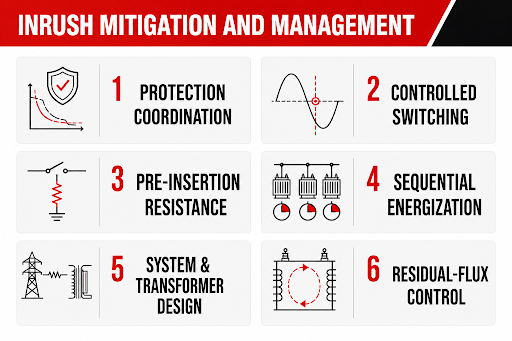
The correct method depends on whether the real problem is excessive current, unacceptable voltage dip, protection operation, or frequent switching. Several measures may be appropriate:
Protection coordination: Correct fuse, breaker, and relay characteristics allow normal inrush to pass while maintaining the required response to faults. This manages the consequence; it does not reduce the inrush itself. IEEE C37.91-2021 provides transformer-protection guidance within its stated scope and notes that some techniques may also be applied outside that scope.
Controlled switching: Point-on-wave closing can select pole-closing instants that reduce transient flux. The strongest schemes account for transformer connection, core behaviour, breaker operating scatter, and residual flux rather than relying on a fixed voltage angle.
Pre-insertion resistance: A switching device can insert resistance briefly during energization and bypass it after the transient has been limited. The resistor value, energy duty, insertion time, and switching sequence must be engineered for the application.
Sequential energization: Staggering multiple transformer energizations prevents their worst transients from occurring together. Disconnecting or minimizing downstream load does not eliminate magnetizing inrush, but it separates the core-energization event from simultaneous load pickup.
System and transformer design: Source configuration, feeder impedance, core flux density, transformer connection, and switching duty can be evaluated together. Adding a reactor or other impedance may reduce peak current, but it can also affect voltage regulation, losses, and normal operation.
Residual-flux control: Controlled de-energization or demagnetization can reduce uncertainty before the next closing operation. These techniques are generally reserved for applications where switching frequency or system sensitivity justifies the added equipment and control.
Information Needed During Specification and Commissioning
Inrush becomes easier to manage when it is treated as an application requirement rather than discovered during first energization. The transformer manufacturer and protection engineer should know the source voltage and short-circuit strength, upstream impedance, winding connection, grounding arrangement, intended energization side, breaker or contactor characteristics, switching frequency, connected transformer capacity, allowable bus-voltage dip, and sensitivity of other loads.
Commissioning should confirm that the installed transformer, tap position, protection settings, switching sequence, and system configuration match the study basis. Initial energization should follow an approved procedure and be observed by qualified personnel. Rex’s transformer commissioning guide covers the checks needed before a unit is placed in service.
Conclusion
Transformer inrush current begins with transient core flux, but its practical severity is determined by the complete electrical system. Residual flux and closing instant influence saturation; magnetic design shapes the current waveform; source impedance determines the current available and the resulting voltage dip; and protective-device characteristics determine whether the event causes an outage.
Rules of thumb are useful for screening, but they cannot replace transformer-specific data or a system study where energization duty is critical. Reliable operation comes from coordinating the transformer, source, switching method, and protection for the actual installation.