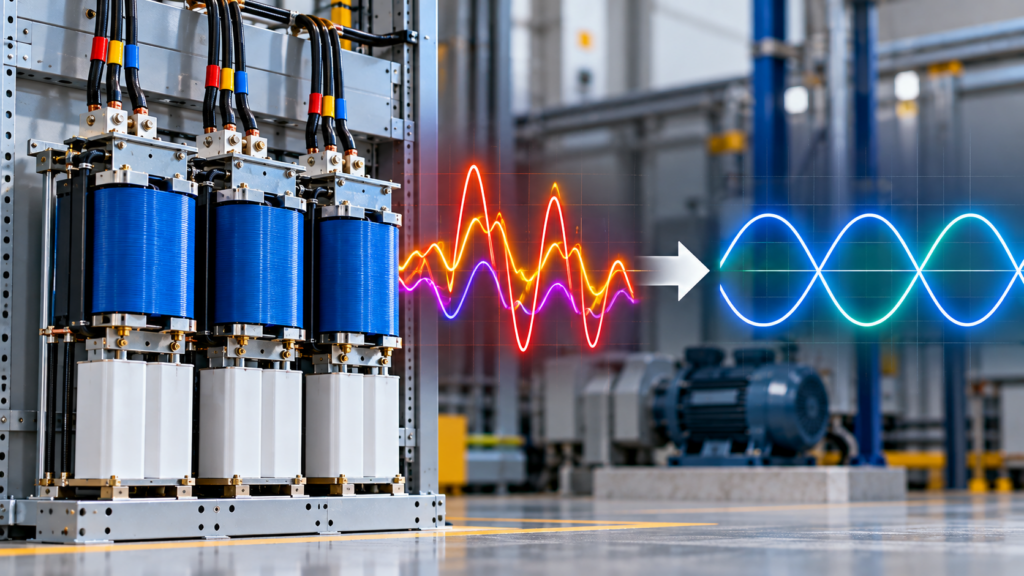
Modern electrical systems increasingly rely on power electronic equipment such as variable frequency drives (VFDs), rectifiers, uninterruptible power supplies (UPS), and renewable energy inverters. While these technologies improve control and efficiency, they also introduce harmonic currents into the power system.
Harmonics distort the normally sinusoidal waveform of electrical current and voltage. If not properly managed, they can lead to overheating in transformers, nuisance tripping of protective devices, reduced system efficiency, and premature equipment failure. One of the most widely used solutions for controlling harmonics is the passive harmonic filter.
Passive harmonic filters use combinations of inductors, capacitors, and resistive elements to reduce harmonic distortion and improve overall power quality. This article explains how passive harmonic filters work, why they are used, and how they contribute to more reliable electrical systems.
Understanding Harmonics in Power Systems
In an ideal electrical system, current and voltage waveforms are sinusoidal. However, non-linear loads draw current in pulses rather than in a smooth waveform. This behavior produces harmonic currents at integer multiples of the fundamental frequency.
In North American systems operating at 60 Hz, common harmonic frequencies include:
- 180 Hz (3rd harmonic)
- 300 Hz (5th harmonic)
- 420 Hz (7th harmonic)
These harmonic currents circulate throughout the power system and interact with system impedance. The result can be voltage distortion, increased heating in conductors and transformers, and reduced system efficiency.
Controlling harmonic distortion is therefore essential to maintaining power quality.
What Is a Passive Harmonic Filter?
A passive harmonic filter is an electrical network designed to reduce harmonic distortion by providing a low-impedance path for specific harmonic frequencies. The filter is typically installed in parallel with the load and diverts harmonic currents away from the power system.
Passive filters are composed of combinations of:
- Inductors (reactors)
- Capacitors
- Sometimes damping resistors
These components are arranged so that the filter resonates at a specific harmonic frequency. When harmonic currents occur at that frequency, they are absorbed by the filter rather than flowing through the upstream power system.

Types of Passive Harmonic Filters
Several configurations of passive harmonic filters are used depending on the harmonic spectrum present in the system.
Single-Tuned Filters
Single-tuned filters are designed to target a specific harmonic frequency, such as the 5th or 7th harmonic. These filters use a series combination of inductance and capacitance tuned to the desired frequency.
Single-tuned filters are commonly used in industrial systems with predictable harmonic sources, such as six-pulse rectifiers or VFD installations.
High-Pass Filters
High-pass filters are designed to attenuate a broad range of higher-order harmonics rather than targeting a single frequency. These filters combine inductance, capacitance, and resistance to provide low impedance at higher harmonic frequencies.
They are often used in combination with single-tuned filters to address a wider harmonic spectrum.
Second-Order Filters
Second-order filters provide improved harmonic attenuation and are commonly used in systems where multiple harmonic frequencies must be controlled. These filters are designed with a specific damping characteristic to avoid excessive resonance.
How Passive Harmonic Filters Improve Power Quality
Passive harmonic filters contribute to improved system performance in several ways.
By diverting harmonic currents away from the main power distribution system, they reduce total harmonic distortion (THD) in both current and voltage waveforms. Lower harmonic distortion improves transformer performance and reduces heating in electrical equipment.
Passive filters can also improve system power factor. Because they incorporate capacitive elements, they may provide reactive power compensation that supports voltage stability.
Additionally, reducing harmonic distortion improves the performance of protective devices and minimizes interference with sensitive electronic equipment.
Typical Applications for Passive Harmonic Filters
Passive harmonic filters are widely used in industrial and commercial installations where harmonic-producing loads are present.
Common applications include:
- Variable frequency drive systems
- Industrial rectifiers
- Data centers and UPS systems
- Mining and heavy industrial processes
- Renewable energy installations
In many of these environments, harmonic levels must meet power quality standards such as those outlined in IEEE 519.
Passive Filters vs Active Harmonic Filters
Passive harmonic filters are one of several technologies used to manage harmonics. Another common approach involves active harmonic filters, which use power electronics to inject corrective currents into the system.
Passive filters differ in several important ways.
They are generally simpler and more cost-effective for applications where the harmonic spectrum is predictable. They also require less control complexity and have a proven track record in industrial environments.
However, passive filters are designed for specific harmonic frequencies. If system conditions change significantly, their effectiveness may be reduced. Active filters offer greater flexibility but at a higher cost and complexity.
Selecting the appropriate filtering approach depends on system requirements and harmonic characteristics.
Design Considerations for Passive Harmonic Filters
Proper filter design requires careful analysis of the electrical system. Factors such as system impedance, load characteristics, and harmonic spectrum must be considered.
One important concern is resonance. Improperly designed filters can interact with system capacitance or inductance, potentially amplifying certain harmonic frequencies instead of reducing them.
Engineers must therefore evaluate the system carefully before installing passive filters to ensure proper tuning and stable operation.
The Role of Reactors in Passive Filters
Reactors play a central role in passive harmonic filters by controlling current flow and defining the filter’s resonant frequency. Air core reactors are commonly used because they avoid magnetic saturation and maintain stable inductance even under high harmonic currents.
Proper reactor design ensures the filter performs consistently while withstanding the thermal and electrical stresses associated with harmonic currents.
Conclusion
As modern electrical systems incorporate more power electronic equipment, harmonic distortion has become an increasingly important concern. Passive harmonic filters provide a practical and reliable method for reducing harmonic currents and improving power quality.
By using carefully designed combinations of inductors, capacitors, and resistive elements, passive filters divert harmonic currents away from the electrical distribution system. The result is improved efficiency, reduced equipment stress, and more stable system operation.
When properly designed and applied, passive harmonic filters remain one of the most effective tools for managing harmonics in modern power systems.