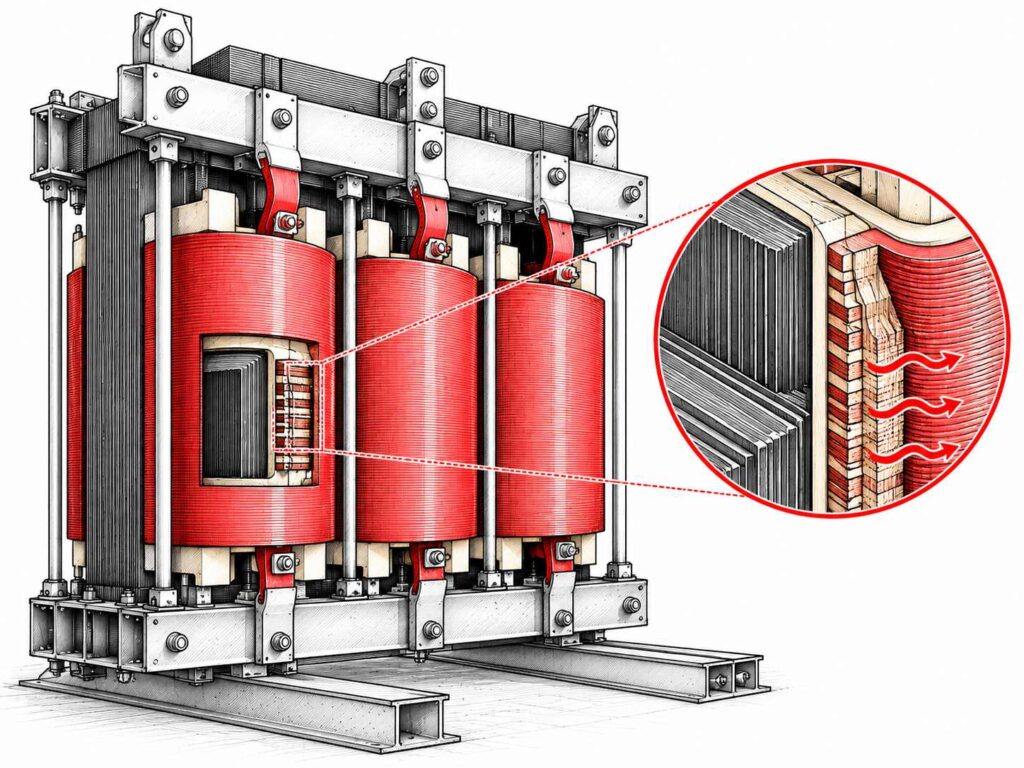
Transformers operate continuously in most electrical systems, often for decades at a time. Although they contain no moving parts, their impact on overall energy efficiency is significant. Even small improvements in transformer performance can translate into measurable reductions in energy consumption, operating costs, and greenhouse gas emissions over the life of an installation.
Understanding how transformers influence energy efficiency requires examining the sources of transformer losses, how those losses are managed through design, and how proper specification contributes to long-term power loss reduction. This article explores the role of transformers in system efficiency and explains how design decisions directly affect real-world performance.
Understanding Transformer Losses
Transformer losses fall into two primary categories: no-load losses and load losses. Both affect energy efficiency, but they behave differently.
No-load losses (also called core losses) occur whenever the transformer is energized, regardless of whether it is supplying load. These losses result from hysteresis and eddy currents in the magnetic core. Because they are constant, no-load losses accumulate continuously throughout the transformer’s operating life.
Load losses, sometimes referred to as conductor losses, occur only when current flows through the windings. These losses increase with the square of the load current and are therefore highest when the transformer operates near full capacity. Additional stray losses caused by leakage flux and harmonic currents also contribute to total load losses.
Efficiency is maximized when the transformer is designed so that the balance between no-load and load losses matches its expected duty cycle.

Efficiency and Transformer Design
Transformer efficiency is defined as the ratio of output power to input power. Modern dry-type transformers commonly achieve efficiencies above 98%, but even small improvements in loss performance can yield meaningful long-term savings.
Design factors influencing efficiency include:
- Core material selection and lamination quality
- Conductor sizing and geometry
- Winding configuration
- Cooling design
- Impedance selection
For example, increasing conductor cross-sectional area reduces winding resistance and load losses but increases initial material cost. Likewise, higher-grade core steel reduces hysteresis losses but affects overall transformer size and manufacturing complexity.
Engineering a transformer for efficiency involves optimizing these competing variables for the intended operating profile.
Load Profile and Real-World Efficiency
A transformer rarely operates continuously at full load. Many commercial and institutional transformers operate at 30–60% of rated capacity for extended periods.
In lightly loaded applications, no-load losses may dominate total losses. In heavily loaded systems, load losses become the primary contributor. Therefore, proper transformer sizing plays a critical role in energy efficiency.
Oversizing a transformer may increase no-load losses unnecessarily. Undersizing increases load losses and thermal stress. Correct kVA selection, based on realistic load analysis, improves long-term efficiency and reliability.
Harmonics and Their Impact on Losses
In modern facilities with non-linear loads—such as VFDs, LED lighting, and data processing equipment—harmonic currents increase transformer heating and stray losses.
Harmonics can:
- Increase conductor losses
- Raise eddy current losses
- Elevate operating temperature
- Reduce effective efficiency
Design strategies such as K-rated transformers, harmonic mitigating designs, or appropriately sized conductors help control these additional losses and maintain energy efficiency under real-world operating conditions.
Temperature Rise and Insulation Life
Transformer efficiency is closely tied to operating temperature. Higher losses produce higher temperatures, which accelerate insulation aging and reduce service life.
Using higher-temperature insulation systems while designing for lower operating temperature rise can improve longevity and efficiency stability over time. This approach provides thermal margin for elevated ambient temperatures, harmonics, and future load growth without compromising performance.
In dry-type transformers, careful airflow management and proper cooling classification (AN/ANN or AF/AFN) also influence thermal efficiency.
Regulatory and Efficiency Standards
Minimum efficiency requirements for transformers are established by regulatory bodies. In Canada, Natural Resources Canada (NRCan) sets minimum efficiency standards for many distribution transformer classes. These regulations ensure baseline performance but do not necessarily represent optimized lifecycle efficiency.
Specifying transformers solely to minimum compliance may not yield the lowest lifetime operating cost. Evaluating total ownership cost—including energy losses over the transformer’s life—often supports selecting higher-efficiency designs.
Power Loss Reduction Through System Design
Beyond transformer construction itself, system-level decisions also affect overall efficiency.
These include:
- Selecting appropriate impedance to balance voltage drop and loss
- Proper tap setting to maintain nominal voltage
- Avoiding unnecessary oversizing
- Coordinating protection to prevent overheating events
- Ensuring proper ventilation and installation conditions
Energy efficiency is not determined solely by transformer nameplate performance—it depends on correct application.
Dry-Type Transformer Considerations
Dry-type transformers, particularly VPI/VPE and cast coil designs, offer opportunities for optimized efficiency in commercial and industrial installations. Careful coil design, vacuum pressure impregnation processes, and high-grade core materials contribute to stable performance and reduced losses.
Selecting the appropriate dry-type design for the environment ensures that efficiency gains are not offset by temperature-related degradation or harmonic stress.
Long-Term Financial and Environmental Impact
Because transformers operate continuously, their cumulative losses over 20–30 years often exceed their initial purchase cost in energy value. Even a modest reduction in losses can result in significant energy savings over the life of the equipment.
From an environmental perspective, reducing transformer losses contributes directly to lower overall energy demand and reduced emissions associated with power generation.
Transformer efficiency is therefore both a financial and sustainability consideration.
Conclusion
Transformers play a critical role in energy efficiency within electrical power systems. Through careful design, proper sizing, and thoughtful application, both no-load and load losses can be minimized, improving long-term performance and reducing operating costs.
Energy efficiency is not merely a regulatory requirement—it is a design objective. When transformers are specified and applied correctly, they become an essential component of sustainable and cost-effective power system operation.