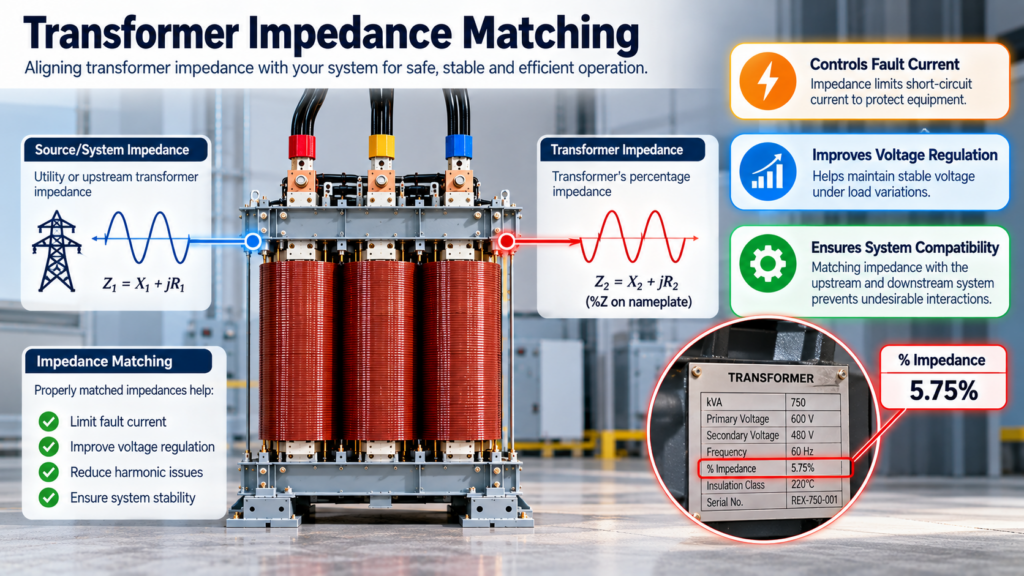
Transformer impedance is often discussed in the context of fault current limitation, but its role in impedance matching is just as critical—particularly when transformers operate in parallel or supply common loads. Impedance matching affects how load current is shared, how voltages behave under load, and how reliably transformers operate over time.
Poor impedance matching can lead to circulating currents, uneven loading, excessive heating, and reduced transformer life, even when transformers appear compatible on paper. Understanding how impedance works, how matching is achieved, and what level of mismatch is acceptable allows engineers to design systems that operate predictably and reliably. This article explains transformer impedance matching in practical terms, including commonly accepted tolerances used in real-world power systems.
What Is Impedance Matching in Transformers?
In power systems, impedance matching does not mean matching transformer impedance to the load, as is done in signal or communications systems. Instead, impedance matching refers to ensuring that transformers connected to the same electrical system—most often in parallel—have compatible impedance characteristics.
The objective of impedance matching is to:
- Ensure balanced load sharing
- Prevent circulating currents between transformers
- Maintain stable voltage regulation
- Avoid thermal overstress of windings
Impedance matching is therefore about compatibility and proportionality, not exact equality.
Why Impedance Matching Matters
Parallel Transformer Operation
When transformers operate in parallel, their impedances determine how load current divides between them. Transformers do not inherently “know” their kVA ratings; they share load according to impedance.
If two transformers have different impedances, the transformer with lower impedance will carry a greater share of the load, while the higher-impedance unit will carry less. Under heavy loading, this imbalance can cause one transformer to overload and overheat even though the combined load is within the total installed capacity.
Circulating Currents
Impedance mismatch—especially when combined with small voltage ratio differences—can cause circulating currents between transformers. These currents do not supply the load but still generate losses and heat within the windings, reducing efficiency and accelerating insulation aging.
Voltage Regulation and Stability
Transformers with different impedances experience different voltage drops as the load increases. When operating together, this can lead to unequal secondary voltages and unstable load sharing, particularly during load changes.
Transformer Impedance Fundamentals
Transformer impedance is expressed as a percentage (%) or per-unit (pu) value and represents the voltage required to drive rated current through the transformer under short-circuit conditions.
Impedance is made up of:
- Resistance, which contributes to conductor losses and heating
- Leakage reactance, which dominates impedance and limits fault current
- Leakage reactance is determined primarily by winding geometry and spacing. As a result, impedance is fundamentally a design characteristic and cannot be adjusted once the transformer is manufactured.
How Impedance Affects Load Sharing
When transformers operate in parallel, load sharing is inversely proportional to impedance. In simple terms, lower impedance means higher load share.
The relationship can be expressed as: I1/I2 = Z2/Z1
This explains why even modest differences in impedance can produce significant differences in current distribution, particularly under high or continuous loading.
Acceptable Impedance Tolerance for Parallel Transformers
In practice, transformer impedances are never exactly identical. Manufacturing tolerances, design choices, and rating differences all introduce variation. The key question is how much variation can be tolerated without causing unacceptable load imbalance.
For transformers of equal kVA rating, industry practice generally considers the following impedance tolerance acceptable:
- Within ±7.5% of the average impedance value
- Preferably within ±5% for critical or continuously loaded applications
As an example, two 1000 kVA transformers with impedances of 5.0% and 5.3% will usually share load satisfactorily. However, pairing a 5.0% unit with a 6.0% unit may result in noticeable imbalance, particularly as loading approaches rated capacity.
For transformers of unequal kVA ratings, proper load sharing requires impedance values to be inversely proportional to kVA rating. Even when this proportionality is achieved, impedance tolerance should still remain within similar per-unit limits to ensure stable operation.
It is also important to consider the X/R ratio. While percent impedance governs steady-state load sharing, differences in X/R ratio influence dynamic behavior during load changes and fault events. Significant X/R mismatch can lead to transient circulating currents even when percent impedance appears acceptable.
When Tighter Impedance Matching Is Advisable
More restrictive impedance tolerances should be considered when:
- Transformers operate near full load on a continuous basis
- Harmonic content is significant
- Loads are sensitive or mission-critical
- Transformers are from different manufacturers or design families
- Long service life and thermal margin are priorities
In these cases, specifying impedance tolerance closer to ±5%—or confirming acceptability with the manufacturer—is strongly recommended.
Impedance Matching vs. Fault Current Limitation
Transformer impedance also plays a key role in limiting short-circuit current. Designers must balance the desire for lower impedance (better voltage regulation and load sharing) against the benefits of higher impedance (reduced fault current and easier protection coordination).
This trade-off is resolved during transformer design and specification. Once installed, impedance cannot be changed without adding external components such as reactors.
Common Misconceptions About Impedance Matching
A common misconception is that transformers with the same kVA rating are automatically suitable for parallel operation. In reality, impedance variation between designs—or even between production runs—can prevent proper load sharing.
Another misconception is that impedance matching only matters for large transformers. In practice, mismatches can be problematic even in smaller systems, especially where loads are continuous or thermal margin is limited.
Conclusion
Transformer impedance matching is essential for stable parallel operation, balanced load sharing, and long-term reliability. While exact impedance equality is not required, excessive mismatch leads to circulating currents, overheating, and reduced transformer life.
Understanding impedance concepts, applying accepted tolerance guidelines, and verifying compatibility before paralleling transformers are simple but critical steps in sound power system design. When impedance matching is addressed early, transformers integrate smoothly into the system and perform as intended throughout their service life.