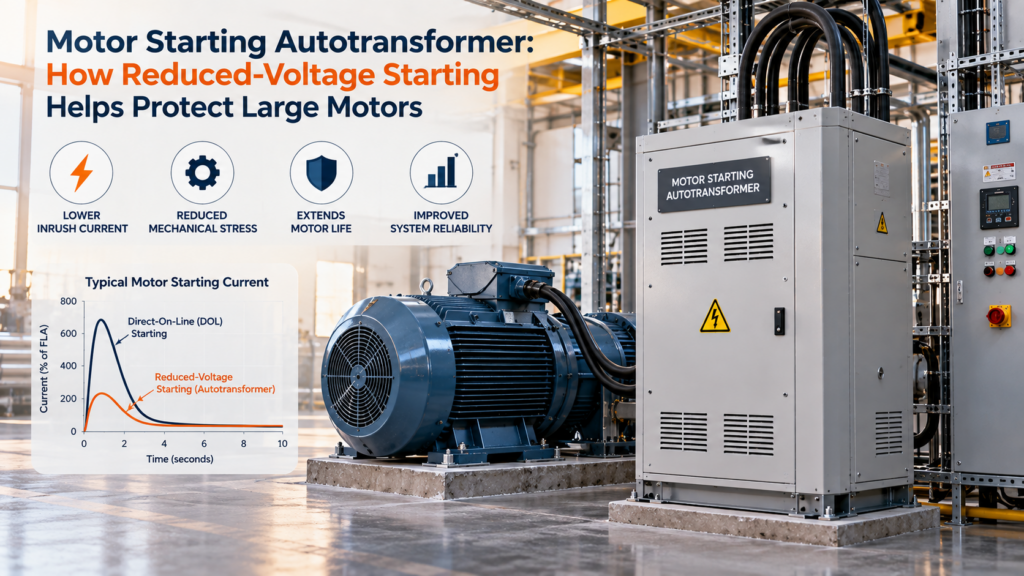
Across-the-line starting works fine for small motors. For a 5 hp pump in a mechanical room, throwing the contactor in and accepting six to seven times full-load current for a few seconds is a trivial event — the utility doesn’t notice, the wiring handles it, and the motor itself doesn’t care.
It’s a different problem at scale. A 1,000 hp motor starting across the line draws an inrush of 4,000 to 7,000 amperes for several seconds, dragging the bus voltage down, stressing the supply transformer, hammering the motor windings with mechanical and thermal stress, and yanking on the driven equipment with starting torque that can be 1.5 to 2 times the rated value. For large motors, reduced-voltage starting isn’t a refinement — it’s how the equipment survives the daily start cycle.
The autotransformer starter is one of the oldest and still one of the most effective methods. It uses a tapped autotransformer to apply reduced voltage during the acceleration period, then transitions the motor to full line voltage once it’s near operating speed. This article covers how the method works, the mathematical relationships that govern its performance, the open-vs-closed transition decision, and how it compares to soft starters and VFDs.
The Problem with Across-the-Line Starting
An induction motor at standstill looks like a transformer with a short-circuited secondary. The locked-rotor impedance is low and the inrush current is high — typically 600–700% of full-load current for a NEMA Design B motor. Three consequences follow.
Voltage sag at the bus. Inrush current flows through the upstream system impedance, dropping voltage at the bus that feeds the motor. Other loads on that bus see the sag too, which can drop out contactors, restart sensitive electronics, or cause lighting to flicker noticeably.
Mechanical and thermal stress. The motor windings see high I2R heating during the acceleration period. The starting torque is also high — often 1.5 to 2 times rated torque — which yanks on couplings, shafts, gearboxes, and the driven load.
Utility constraints. Some utilities limit the size of motors that can be started across the line, particularly on weaker rural feeders. Reduced-voltage starting is sometimes a code or utility requirement, not just a design choice.
Reduced-voltage starting addresses all three by limiting the current and torque during the acceleration period, at the cost of longer acceleration time.
How Autotransformer Starting Works
The autotransformer starter applies a reduced voltage to the motor during the start sequence, typically through tap selections of 50%, 65%, or 80% of line voltage. Once the motor approaches running speed, the autotransformer is switched out and the motor connects directly to the line.
The mathematical relationships are direct, and they’re what make autotransformer starting attractive compared to other reduced-voltage methods. With a tap ratio a (expressed as a decimal, e.g., 0.65 for a 65% tap):
Imotor = a × ILR
Iline = a2 × ILR
Tstart = a2 × TLR
Where ILR and TLR are the locked-rotor current and torque the motor would draw across the line.
The important point is that motor current scales linearly with the tap (the motor sees reduced voltage and draws reduced current), but line current scales with the square of the tap. This is the autotransformer’s key advantage over a series resistor or reactor starter, where line current and motor current are the same. The autotransformer effectively trades voltage for current the way any transformer does, and the utility-side benefit is significantly better than the motor-side reduction.
A Worked Example
Consider a 600 hp, 4160 V motor with a locked-rotor current of 720 A and a locked-rotor torque of 150% of full-load torque. Compare the three standard taps:
50% tap (a = 0.50):
Imotor = 0.50 × 720 = 360 A
Iline = 0.25 × 720 = 180 A
Tstart = 0.25 × 150% = 37.5%
65% tap (a = 0.65):
Imotor = 0.65 × 720 = 468 A
Iline = 0.4225 × 720 = 304 A
Tstart = 0.4225 × 150% = 63%
80% tap (a = 0.80):
Imotor = 0.80 × 720 = 576 A
Iline = 0.64 × 720 = 461 A
Tstart = 0.64 × 150% = 96%
The 50% tap dramatically reduces line current and torque, but the starting torque (37.5% of rated) may be too low to accelerate a loaded compressor or pump. The 80% tap gives nearly full starting torque but reduces line current only modestly. The 65% tap is the most common compromise for typical pump and fan applications — meaningful current reduction with usable starting torque.
Tap selection isn’t arbitrary. It comes from matching the motor’s reduced-voltage starting torque against the driven load’s torque-speed curve. If the available starting torque doesn’t exceed the load torque at every speed during acceleration, the motor will stall or accelerate too slowly to clear thermal limits.
Open vs. Closed Transition
At the end of the start sequence, the motor has to transition from the autotransformer to the line. How that transition happens matters.
Open transition disconnects the autotransformer first, then connects the motor to the line. There’s a brief interval during which the motor is unpowered and coasting. When line voltage is restored, the motor sees a transient as flux re-establishes — effectively a partial re-energization. The transient current can approach across-the-line inrush levels briefly, partially undoing the soft-start benefit.
Closed transition — the Korndorfer connection — sequences the switching so that the motor remains energized throughout. The autotransformer’s common winding briefly acts as a series reactor between the line and the motor, then is fully removed once the motor is connected directly. There’s no interruption of motor current and no re-energization transient.
Closed transition is now standard on most autotransformer starters above a few hundred horsepower. It requires more contactors and more sequencing logic but eliminates the most significant residual disadvantage of the autotransformer method.
How Autotransformer Starting Compares
Four reduced-voltage starting methods are commonly used. Each has a place.
Autotransformer starting gives the best torque-per-amp of any reduced-voltage method, because line current scales with the square of the tap. It’s robust, mechanically simple, and well-suited to applications where the start sequence is infrequent and predictable.
Series reactor starting places a reactor in series with the motor during start, then shorts it out for run. Simpler than an autotransformer but with worse line-current performance — line current and motor current are the same, so the utility-side benefit is smaller for the same motor voltage reduction.
Soft starters use silicon-controlled rectifiers (SCRs) to phase-control the voltage during starting, ramping voltage smoothly from a starting value up to line voltage. They’re flexible, take little space, and offer adjustable ramp times. They also inject harmonics during the ramp, dissipate heat in the SCRs, and don’t reduce line current as effectively as an autotransformer at equivalent motor torque. For applications with frequent starts, the heat dissipation becomes a sizing constraint.
Variable frequency drives (VFDs) control both voltage and frequency, giving smooth controlled acceleration with full torque available at low speed. They’re the technically superior solution for most starting problems — but they’re also far more expensive, electronically complex, and they add ongoing operational considerations (harmonic loading, motor insulation stress from PWM, cooling, software). For applications that need only starting reduction and not speed control during normal operation, a VFD is usually overkill.
The decision typically comes down to application specifics. Autotransformer starters remain widely used for large medium-voltage motors driving pumps, fans, and compressors, where the motor runs at fixed speed once started and the start frequency is moderate. The construction is rugged, the failure modes are mechanical and predictable, and the equipment lasts for decades.
Specification Considerations
Several factors drive autotransformer starter sizing and specification:
Duty cycle. Autotransformers have a thermal rating based on how often the motor is started and how long each acceleration period lasts. Standard duty is typically defined as a limited number of starts per hour with specified acceleration time. Heavy-duty applications need explicit derating or an oversized autotransformer.
Tap selection. Most starters offer the standard 50/65/80 taps with selection at commissioning. Some offer only one or two taps to reduce cost.
Transition type. Closed transition is standard for most applications; open transition is acceptable for smaller motors or where the brief re-energization transient is acceptable.
Enclosure and environment. Indoor NEMA 1, outdoor NEMA 3R, hazardous-location, and severe-duty constructions are all available depending on the installation.
Control integration. Modern starters interface with PLCs or DCS systems for sequencing, protection, and diagnostics. Specifications should match the control architecture of the surrounding system.
Conclusion
Autotransformer starting solves a real and well-defined problem. It limits inrush current and starting torque on large motors during the acceleration period, protecting the motor, the driven equipment, and the upstream electrical system from the stresses of across-the-line starting. The mathematical relationships are clean — line current scales with the square of the tap, which gives autotransformer starting its characteristic advantage over series-impedance methods.
The technology hasn’t been displaced by soft starters or VFDs because the application logic is different. When the requirement is simply to limit starting current and torque on a fixed-speed motor, with rugged construction and decades of service life, a motor starting autotransformer remains the right tool. Closed transition handles the one residual disadvantage, and tap selection matched to the load makes the difference between a successful start and a stalled one.