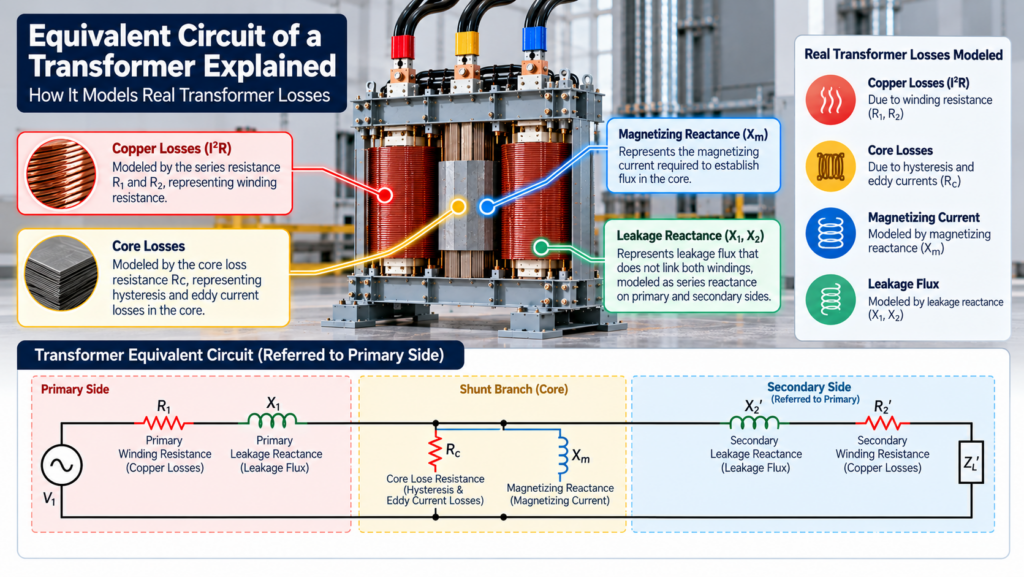
Transformers are often described as simple devices: two windings, a magnetic core, and no moving parts. In reality, transformer behavior is influenced by losses, leakage flux, and non-ideal characteristics that affect efficiency, voltage regulation, and thermal performance. To understand and predict this real-world behavior, engineers rely on the equivalent circuit of a transformer.
The equivalent circuit is a simplified electrical model that represents how a transformer behaves under load. It allows engineers to analyze losses, calculate voltage drop, estimate efficiency, and evaluate performance under different operating conditions. This article explains the transformer equivalent circuit in practical terms and shows how it represents real transformer losses without resorting to excessive mathematics.

Why an Equivalent Circuit Is Needed
An ideal transformer would transfer power with no losses, no voltage drop, and perfect magnetic coupling. Real transformers, however, experience:
- Core losses due to magnetization
- Conductor losses due to winding resistance
- Voltage drop caused by leakage reactance
- Heating that limits continuous loading
The equivalent circuit provides a way to model these effects using familiar electrical components such as resistors and inductors. By representing physical phenomena as circuit elements, engineers can analyze transformer performance using standard circuit techniques.
Overview of the Transformer Equivalent Circuit
The transformer equivalent circuit is composed of two main parts:
- The magnetizing (excitation) branch, which represents core behavior
- The series impedance branch, which represents winding resistance and leakage reactance
- These elements together describe how the transformer behaves under both no-load and load conditions.
Although the equivalent circuit can be drawn in several forms, all versions represent the same physical effects.
The Magnetizing Branch: Modeling Core Behavior
The magnetizing branch is connected in parallel with the ideal transformer and represents what happens in the core when voltage is applied.
Core Loss Resistance
One component of the magnetizing branch is a resistance that represents core (no-load) losses. These losses occur whenever the transformer is energized, regardless of load, and are primarily due to:
- Hysteresis losses in the core material
- Eddy current losses within the laminations
- This resistance models the real power consumed by the core and explains why transformers draw power even at no load.
Magnetizing Reactance
The other component of the magnetizing branch is the magnetizing reactance, which represents the current required to establish magnetic flux in the core. This current is largely reactive and does not transfer power to the load.
Magnetizing current:
- Exists whenever the transformer is energized
- Is typically a small percentage of the rated current
- Increases if the core approaches saturation
Together, the core loss resistance and magnetizing reactance explain the no-load current, the no-load losses, and the effects of core saturation.
The Series Impedance: Modeling Winding Effects
The series elements of the equivalent circuit represent losses and voltage drop associated with the windings.
Winding Resistance
Each transformer winding has finite electrical resistance. This resistance causes conductor losses, often referred to as load losses, which increase with the square of load current.
These losses:
- Are negligible at no load
- Increase rapidly as the load increases
- Contribute directly to the winding temperature rise
In the equivalent circuit, winding resistance accounts for real power loss and heating under load.
Leakage Reactance
Leakage reactance represents magnetic flux that does not link both windings. This leakage flux produces inductive reactance that limits current and causes voltage drop under load.
Leakage reactance:
- Is a function of winding geometry and spacing
- Dominates transformer impedance
- Helps limit short-circuit current
In practical terms, leakage reactance explains why transformer secondary voltage decreases as load increases.
Referring to the Equivalent Circuit to One Side
For analysis convenience, all elements of the equivalent circuit are often referred to either the primary or secondary side. This is done by scaling resistances and reactances by the square of the turns ratio.
Referring to the circuit to one side:
- Simplifies calculations
- Allows transformer behavior to be analyzed as a single circuit
- Does not change the physical meaning of losses or impedance
This approach is widely used in system studies and performance calculations.
How the Equivalent Circuit Models Transformer Losses
The equivalent circuit separates transformer losses into two distinct categories:
- No-Load (Core) Losses
- Represented by the core loss resistance
- Present whenever the transformer is energized
- Independent of load
- Load (Conductor) Losses
- Represented by winding resistance
- Increase with load current
- Responsible for most heating under load
This separation helps engineers understand why lightly loaded transformers may still consume power and why heavily loaded transformers experience rapid temperature rise.
Voltage Regulation and the Equivalent Circuit
Voltage regulation describes the change in secondary voltage from no load to full load. In the equivalent circuit, voltage regulation is primarily caused by:
- Winding resistance
- Leakage reactance
As load current flows through the series impedance, a voltage drop occurs. The magnitude of this drop depends on the impedance value and the power factor of the load. Lagging power factor loads generally experience greater voltage drop due to reactance.
Efficiency Analysis Using the Equivalent Circuit
Transformer efficiency is calculated by comparing output power to total input power. The equivalent circuit makes this possible by clearly identifying loss components.
Efficiency depends on:
Core losses (constant with load)
Load losses (varying with current)
The equivalent circuit allows engineers to determine the load point at which efficiency is maximized and to evaluate how efficiency changes with operating conditions.
Limitations of the Equivalent Circuit
While the equivalent circuit is extremely useful, it has limitations. It assumes linear behavior and does not fully capture:
- Core saturation effects at high flux
- Harmonic distortion from non-sinusoidal loads
- Temperature-dependent changes in resistance
- Mechanical effects during short-circuit events
Despite these limitations, the equivalent circuit remains a powerful and widely used modeling tool for transformer analysis.
Conclusion
The equivalent circuit of a transformer provides a practical framework for understanding how real transformers behave. By representing core losses, magnetizing current, winding resistance, and leakage reactance with simple circuit elements, it allows engineers to analyze losses, voltage regulation, and efficiency with clarity.
Although simplified, the equivalent circuit bridges the gap between physical transformer construction and system-level performance. For designers, specifiers, and operators alike, it remains an essential tool for understanding and applying transformers in real power systems.