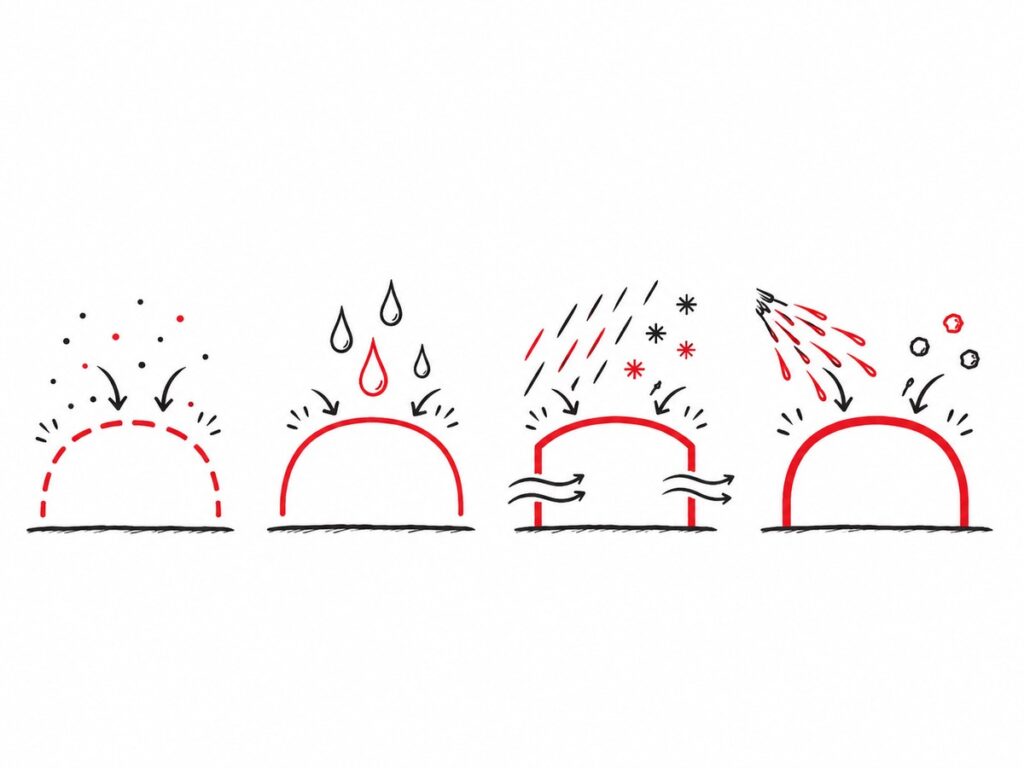
A dry-type transformer specified correctly for voltage, kVA, impedance and temperature rise can still be wrong for its installation if the enclosure is an afterthought. A standard indoor enclosure where wind-driven rain reaches the ventilation openings has an obvious problem; the opposite mistake is less obvious: a sealed, corrosion-resistant enclosure in a clean electrical room adds cost, restricts airflow and changes the physical design without improving the application.
The enclosure is part of the transformer’s thermal and environmental design: it determines what can reach the core and coils, how freely heat leaves, what materials and finishes are required and, sometimes, how large the final assembly becomes. NEMA 250 defines the Type ratings used across electrical equipment, and Canada’s CSA enclosure requirements use a harmonized Type system, so the designations carry across the border. For dry-type transformers, Types 1, 2, 3R, 4 and 4X cover most applications — but they are not four increasingly “better” versions of the same box: each addresses a different exposure, and the correct choice starts with the installation environment, not the highest number available.
Why the Wrong Enclosure Rating Costs You Later
An enclosure specification has consequences before the unit is energized: panel geometry, ventilation routes, gasketing, hardware, coating, material and proportions all change between a vented indoor design and an outdoor or tightly enclosed build — Rex’s published enclosure drawings show separate families for Type 1, 3R, 4/4X and 12 construction, each with its own dimensions and weights.
Getting the rating wrong after manufacture is rarely just swapping sheet-metal panels. A different enclosure can move cable entries, conduit routing, mounting, ventilation clearances and lifting arrangements; on a retrofit, a depth or height change can interfere with a pad, doorway, bus connection or service clearance. And there is a thermal consequence: the transformer rejects its losses to the surrounding air, and if the enclosure changes that path, the design must account for it. The enclosure belongs at the same specification stage as kVA, temperature rise and ambient — not after the core and coils are designed.
NEMA Enclosure Types Explained

A NEMA Type rating describes the environmental protection the enclosure provides. It does not define the winding insulation system, temperature rise, cooling method or hazardous-location approval — those are specified separately. NEMA’s enclosure-types guide summarizes the ratings; the key ones for dry-type units are below.
| Type | Location | Protection Provided | Typical Transformer Application |
|---|---|---|---|
| 1 | Indoor | Access to hazardous parts; falling dirt | Clean, dry electrical rooms; standard ventilated construction |
| 2 | Indoor | Type 1 plus dripping and light splashing of liquids | Indoor rooms where dripping from above is credible |
| 3R | Indoor / outdoor | Rain, sleet and snow; undamaged by external ice formation | Standard outdoor dry-type units, usually still ventilated |
| 4 | Indoor / outdoor | Windblown dust; rain, sleet, snow; splashing and hose-directed water | Washdown areas |
| 4X | Indoor / outdoor | Type 4 plus an additional degree of corrosion resistance | Marine, coastal and corrosive process environments |
| 12 | Indoor | Circulating dust, falling dirt, dripping non-corrosive liquids | Industrial interiors with dust or oil mist |
NEMA 1 — Indoor General Purpose
Type 1 is the normal starting point for a dry indoor electrical room: its job is preventing accidental access to energized parts and limiting ordinary falling dirt, not solving a water problem. It allows the most direct natural-air cooling — cool air in low, heated air out high — and there is little reason to restrict it in a clean, conditioned room. The qualification: “indoors” does not automatically mean dry, and a unit below piping, near a building entrance or subject to condensation or dripping may need more than Type 1.
NEMA 2 — Indoor, Drip-Proof
Type 2 remains an indoor enclosure but adds protection against dripping and light splashing. It fits where the unit is indoors but the room cannot be treated as dry — and the exposure still has to fit the rating: Type 2 is not an outdoor rain enclosure and no substitute for Type 3R. Occasional dripping, wind-driven rain, hose-directed washdown and salt-laden moisture are four different conditions, not one “weather-resistant” requirement — specify from the source and direction of exposure.
NEMA 3R — Outdoor Rain, Sleet and Snow
Type 3R is the common choice when a unit operates outdoors without the washdown and corrosion exposure associated with Type 4X. A point that is easy to miss: 3R does not necessarily mean sealed. Outdoor units can still be ventilated, with hoods, baffles and protected openings keeping weather off the protected parts while air circulates — preserving much of an indoor unit’s natural-convection cooling at the cost of a deeper enclosure. Outdoor location alone does not finish the specification: airborne contamination, ambient temperature, solar loading, snow accumulation and atmospheric corrosiveness still matter.
NEMA 4 — Watertight
Type 4 protects, indoors or outdoors, against windblown dust, rain, sleet and snow plus splashing and hose-directed water — the washdown rating: a process area cleaned with a hose needs Type 4 whether or not it is outdoors. Unlike 3R, Type 4 construction is effectively sealed: ventilated cooling is normally unavailable, and the thermal design must suit a non-ventilated enclosure.
NEMA 4X — Corrosion-Resistant
Type 4X adds an additional degree of corrosion resistance to Type 4 protection. It belongs where water protection alone is not enough: salt-laden coastal and marine sites, and industrial locations with corrosive atmospheres. Type 4X enclosures are often stainless steel, though the rating is a performance requirement, not a mandate for one material. The 3R-vs-4X distinction matters commercially: specifying 4X everywhere “for safety” imposes material, sealing and thermal-design requirements the project may not need.
Ventilated vs. Non-Ventilated Construction
The NEMA number and the cooling construction are not the same specification. A ventilated transformer relies on enclosure openings for natural circulation: air enters low, absorbs heat from the core and coils, and leaves high. A non-ventilated construction prevents that exchange, so heat must move through the internal air and structure and out through the enclosure surface. Rex uses totally enclosed, non-ventilated construction for encapsulated designs, among others, while its standard ventilated units are offered with several enclosure types. The trade-off: fewer openings improve protection but remove an efficient heat-transfer path, and the transformer must be designed around that fact.
How Ventilation Affects Temperature Rise
Essentially all losses become heat, and in a ventilated unit convection continuously carries part of it away; restricting airflow raises the thermal resistance between windings and surrounding air. A properly rated non-ventilated transformer accounts for this at design; what is not sound is sealing a core-and-coil assembly designed for a ventilated enclosure in a cabinet and assuming the original kVA and temperature-rise performance survive. The same principle applies in the field — louvres blocked by walls, stored material or snow reduce heat rejection. Rex’s article on thermal management in dry-type transformers covers airflow, ambient conditions and winding temperature in more detail.
How Enclosure Choice Affects Budget and Floor Space
The cost difference between enclosure types is more than sheet metal. Outdoor construction needs weather-protected ventilation paths, hoods and more complex panel geometry; Type 4 and 4X add sealing requirements; and stainless steel changes material cost and fabrication again.
Dimensions change too: the published enclosure drawings carry separate dimensional schedules for Type 1, 3R, 4/4X and 12 construction — a warning not to carry a Type 1 footprint into a project drawing and assume a later change to 3R or 4X fits the same space. On retrofits especially, settle the enclosure type before room dimensions, housekeeping pads, cable routing and access paths are frozen.
Matching the Rating to the Installation Environment
The right enclosure is the lowest Type that fully satisfies the actual environmental requirement, plus the separate material, temperature, corrosion and certification requirements.
Indoor Commercial and Light Industrial
For a clean electrical room, Type 1 is the starting point; where dripping is credible but the unit stays indoors, Type 2. The decision should be based on the room, not the building category: a unit on the mechanical level of an office tower may face more water than one in a clean manufacturing electrical room, and “indoors” does not make their requirements identical.
Outdoor Utility and Industrial
For normal outdoor weather, Type 3R provides rain, sleet and snow protection without the more restrictive construction of 4X. The installation still has to preserve the enclosure’s drainage and ventilation paths: site grading, snow, roof runoff and conduit entry all matter, and a correctly rated enclosure can be defeated by a conduit penetration or blocked opening that gives water a direct path.
Marine, Washdown and Corrosive Environments
Marine and coastal installations add a corrosion problem to the enclosure question: salt-laden air, spray, humidity and restricted maintenance access make material and coating as important as the Type rating. Rex’s marine-duty transformers can incorporate Type 4X enclosures, stainless hardware, marine-grade coatings and sealed terminations for vessel, offshore and coastal service — but the right construction depends on the actual exposure, not the word “marine” alone.
Hazardous Locations Are a Separate Question
A NEMA 4X enclosure is not a hazardous-location approval. Types 1 through 4X are environmental ratings for non-hazardous conditions; water or corrosion protection says nothing about suitability for an atmosphere with flammable gases, vapours or combustible dust, which requires equipment evaluated for the area classification. Rex’s hazardous location transformers carry CSA and UL Class I, Division 2 certification with Type 3R enclosures standard and Type 4 or 4X available on certain configurations. The specification needs two answers: what environment must the enclosure resist, and what area classification must the transformer satisfy?
Enclosure Material and Coating
The Type rating defines required performance, not the sheet metal or finish. A powder-coated carbon-steel enclosure is appropriate for many indoor and outdoor installations, while a corrosive marine or process environment may justify stainless steel or a project-specific coating system — specifying “NEMA 4X” without considering the actual corrosive agent, cleaning method and material compatibility leaves part of the environmental design unresolved. Steel gauge is similar, following enclosure dimensions, doors and panels, structural loading and the applicable certification requirements rather than a rule of thumb.
Rex Power Magnetics Perspective
Rex builds dry-type transformers with Type 1, 2, 3R, 4, 4X and 12 enclosure options, in powder-coated steel with 304 and 316L stainless available on several families. The published enclosure drawings give width, depth, height and weight for each family with PDF, DWG and STEP downloads — the place to start checking fit against the room, pad, access route and connections — planning information, not a substitute for the order’s certified drawing. Where the application is still taking shape, the product configurator develops the electrical requirements and enclosure selection together, rather than leaving the enclosure as a purchasing detail settled afterwards.
Conclusion
Enclosure ratings are environmental design requirements, not accessory codes added at the end of a specification. Type 1 suits normal indoor service, Type 2 adds indoor drip protection, Type 3R handles ordinary outdoor weather, Type 4 adds washdown-level water protection, and Type 4X adds corrosion resistance on top — and none of them, by itself, defines the transformer’s thermal design or hazardous-location suitability.
The practical sequence: establish where the transformer will operate, identify the water, dust and corrosion exposure, determine whether the construction can stay ventilated, then select the material and Type — carrying the result into the checks on temperature rise, dimensions, mounting, cable entry and cost. Most enclosure problems are easier to solve on a drawing than after the unit arrives on site.