Transformer pricing is usually discussed in terms of copper, aluminum, labour and factory capacity; core steel belongs in the same conversation. In a dry-type transformer, the core is a major material input and a principal determinant of no-load loss, and its steel grade affects efficiency, physical design, manufacturing method and the quantity of material purchased and processed.
That makes grain-oriented electrical steel, or GOES, more than a metallurgical detail. A design can be electrically straightforward and still hinge on the availability of the grade its loss target, dimensional envelope or efficiency requirement demands. When low-loss grades tighten, the result reaches the quotation as higher material cost, a longer schedule, a revised core design, or all three.
What Is Grain-Oriented Electrical Steel?
Electrical steel is an iron-silicon alloy developed for equipment that magnetizes and demagnetizes repeatedly; cores use thin laminations rather than solid steel because laminating restricts circulating eddy currents.
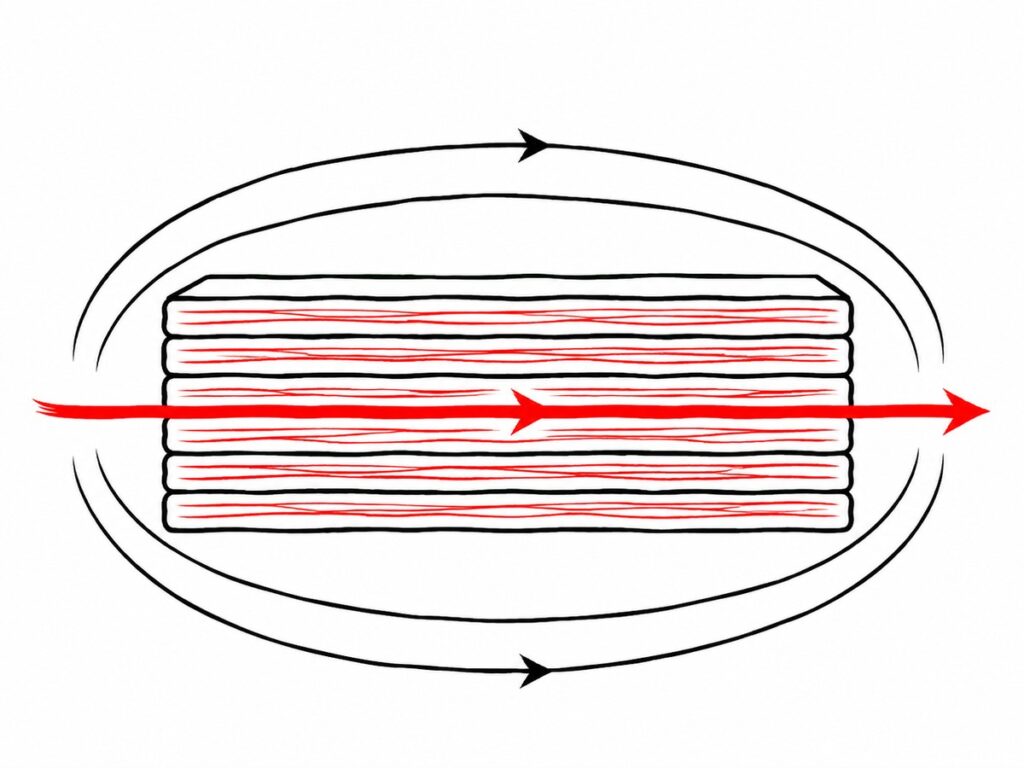
GOES adds controlled crystal orientation: rolling and heat treatment make the material’s magnetic properties strongest in the rolling direction, and the core is cut and assembled so the principal flux follows that direction as closely as geometry allows. The U.S. Department of Energy’s distribution-transformer rulemaking defines GOES as steel processed so that optimal flux density is increased in the rolling direction, and distinguishes conventional, high-permeability and domain-refined variants rather than treating all GOES alike.
How Grain Orientation Reduces Core Losses
Every flux reversal loses energy: partly hysteresis, the energy needed to move magnetic domains through each cycle, and partly eddy currents induced in the core material. Grain orientation improves the magnetic path — when flux stays close to the rolling direction, the material magnetizes more efficiently and with lower loss — while thin insulated laminations restrict eddy-current paths; higher-performing grades go further through improved permeability, thinner material and, in some cases, domain refinement.
Why Core Material Matters for Transformer Performance

No-load loss exists whenever rated voltage is applied, even at little or no load, and occurs primarily in the core; load loss arises mainly in the windings and rises with current. A distribution transformer can stay energized for years, so a core-loss reduction applies every hour the unit is connected, not only at high demand.
This is why core material grows in importance as efficiency rules tighten: the DOE 2029 efficiency standards for dry-type transformers reduce allowable losses and push designs toward lower-loss core material. DOE finalized the amended standards in April 2024, with compliance currently scheduled for April 23, 2029 and about 75% of the U.S. distribution-transformer market expected to meet them with GOES. For cross-border projects, see where U.S. and Canadian efficiency rules diverge.
Core Steel Grade and Its Effect on Efficiency
A higher-performing grade reduces specific core loss, but the effect on the complete transformer is not a one-for-one substitution: the designer can also change flux density, core cross-section, winding geometry and conductor quantity, and those variables interact. A lower-loss steel can cut no-load loss with a similar core, or reduce core mass while still meeting the required efficiency; a design constrained by dimensions, sound, temperature rise or total owning cost arrives at a different optimum.
Changing core geometry also changes mean turn length, conductor requirement, impedance and overall dimensions, so the core cannot be optimized independently of the winding design: the target is the required loss, thermal and electrical performance at acceptable cost, and steel grade is one tool for reaching it.
GOES Grade Families at a Glance
| Material | What It Is | Loss Performance | Practical Considerations |
|---|---|---|---|
| Conventional GOES | Grain-oriented silicon steel, standard grades | Baseline for oriented steels | Widest availability; established processing |
| High-permeability GOES | Tighter grain alignment, improved coatings | Lower loss at higher flux density | Fewer qualified mills per grade and thickness |
| Domain-refined GOES | High-permeability steel with additional domain-refinement processing | Lowest-loss GOES grades | Most specialized supply; some variants sensitive to annealing |
Core Construction: Cutting, Stacking and the Destruction Factor
A steel datasheet’s loss figure is measured on ideal samples; turning coils of that steel into a finished core degrades it. Every shearing or slitting operation leaves a band of mechanical stress along the cut edge that impairs domain movement, burrs can bridge lamination insulation and open local eddy-current paths, and clamping and handling add further stress. The ratio of the assembled core’s measured loss to the material’s nominal specific loss is the destruction factor (or building factor), always greater than one; how much greater is largely a construction question.
Joint design is the biggest lever: at every corner the flux leaves the rolling direction and crosses an air gap, crowding into adjacent laminations. Mitred joints keep flux close to the rolling direction through the corner, and step-lap stacking — offsetting the joint through successive layers — spreads each gap across several laminations, cutting localized saturation, loss and no-load sound versus a simple butt-lap arrangement. Cutting quality, lamination flatness, laminations per step and stacking care all show up in the destruction factor — why two cores of the same grade and geometry can measure different no-load losses. A low-loss grade is only worth its premium when the cutting and stacking preserve what was paid for.
The Global GOES Supply Chain
GOES is not commodity sheet steel replaceable with an equivalent coil from any mill: its production requires tightly controlled rolling, annealing, coating and, for some grades, domain refinement, so far fewer producers supply transformer-grade material than general steel, and capability differs by grade. A mill may make GOES but not the exact high-permeability or domain-refined grade a design uses, and even where comparable material exists, the manufacturer must account for loss data, thickness, coating, processing behaviour and the finished-core guarantee.
A Concentrated Group of Producers
The practical supply risk is not the number of steel companies; it is the number of qualified sources for the grade, thickness and performance level a design requires. DOE’s 2024 rulemaking documented supply constraints affecting low-loss GOES grades in the U.S. market and noted that manufacturers did not always have access to the full range of core steels.
The issue remains current. In June 2026, DOE issued a request for information on changes to the price, quality, specifications and available capacity of GOES serving the U.S. market, and on availability, lead times and constraints in core manufacturing — cutting, winding, stacking, annealing and related equipment. The RFI is part of a broader DOE re-examination of the 2024 standards’ supply-chain and manufacturing burdens — worth watching for anyone planning around the 2029 date.
Not every order is exposed to a steel shortage: standard designs on commonly available grades move through normal procurement, and the risk rises with a narrow material specification, a particularly low-loss grade, a large steel quantity, or a delivery date with little room for substitution.
Why Lead Times Fluctuate
Electrical steel is only one part of transformer lead time, but it becomes the controlling part when the required material is unavailable: steel production is followed by slitting, cutting or winding, core assembly and the manufacturer’s own schedule, and a constraint at any stage shifts the date the core is ready for coil assembly.
Nor can a delay always be solved by a last-minute grade change. Substituting core steel changes predicted no-load loss, excitation current, flux-density margin, core mass and dimensions; a design already close to an efficiency or dimensional limit has to be recalculated before production continues. DOE has identified material shortages, including GOES, among the factors behind broader transformer supply constraints, and its supply-chain analysis treats material availability, component capacity and production time together. GOES is not the only cause of lead-time volatility — but it becomes the schedule driver when the design depends on material that is hard to substitute.
How Core Material Choice Affects Cost
The relationship between core material and transformer cost is not linear. A premium low-loss grade costs more per kilogram but may let the designer use less core steel, or avoid adding material elsewhere to reach an efficiency target. A cheaper grade with higher specific losses can force a larger core or lower operating flux density to stay within the loss limits — and those changes propagate: a larger core increases steel weight and mean turn length, longer turns increase conductor use, the enclosure and bracing can grow, and more laminations mean more material to cut, handle and assemble. The lowest-priced steel does not necessarily produce the lowest-priced transformer.
Nor is the most expensive grade automatically right: if the unit meets its efficiency, temperature-rise, sound and dimensional requirements on a more readily available grade, lower-loss material adds cost without solving a requirement. DOE’s rulemaking record describes the same trade-off: efficiency gains come from optimization until a given combination of core and conductor material hits what DOE calls an “efficiency wall” — beyond it, further loss reduction requires higher-grade steel, different conductor material or a core-and-coil redesign.
What This Means for Project Timelines
The core-steel decision should begin not with a mill grade but with the performance the transformer has to meet: efficiency, guaranteed losses where applicable, kVA, voltage, frequency, temperature rise, impedance, sound, enclosure, dimensional limits and delivery date, established early enough for the manufacturer to optimize the complete design. Where the specification allows more than one acceptable material or grade, that flexibility widens sourcing without changing the required performance.
The reverse matters too: a required steel grade, unusually low evaluated losses or a tightly constrained footprint should be stated before quotation, because adding it after drawings or procurement have started can force a core redesign and reset the schedule. This is especially relevant on non-standard projects: as Rex’s guide to custom vs. standard transformers discusses, custom construction already carries more engineering and procurement dependency, and a narrow core-material requirement adds another variable before the delivery date is firm.
Conclusion
Grain-oriented electrical steel sits at the intersection of transformer physics and transformer procurement: its magnetic properties determine a large part of no-load loss, while its grade, availability and processing requirements influence how the core is designed, priced and scheduled.
Most buyers need not manage the steel supply chain directly. What matters is understanding why two units with the same kVA and voltage can have different core constructions, why a tighter loss requirement changes material cost, and why constrained GOES availability can affect delivery even when the design is otherwise conventional. The core is a designed magnetic component built around a specialized material — treating it that way at the specification stage gives the manufacturer room to optimize performance, cost and schedule before any of the three becomes a project problem.