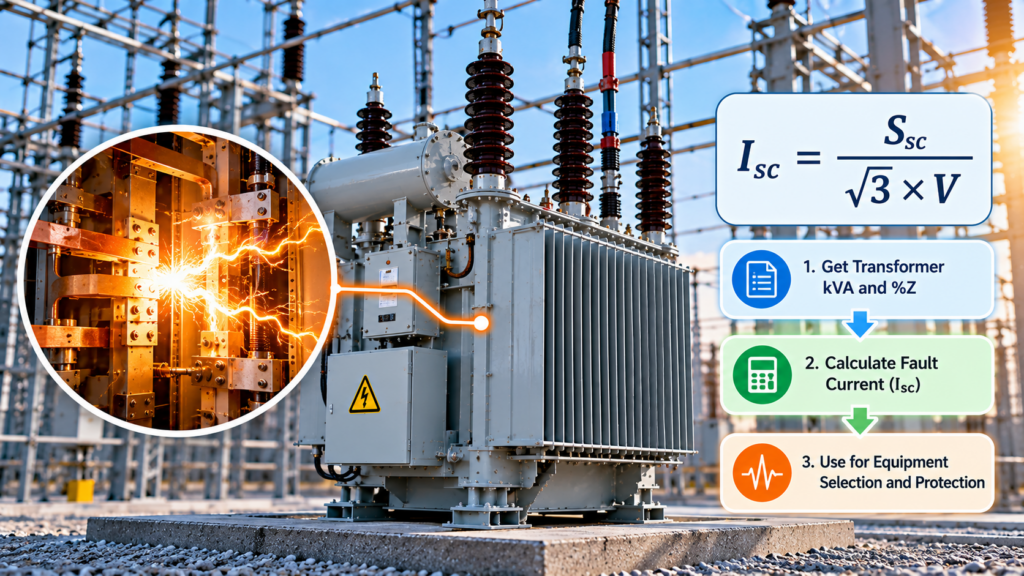
Understanding available fault current is essential for safe and reliable power system design. When a short circuit occurs, the magnitude of current that flows is largely determined by transformer impedance and system configuration. Performing a proper transformer fault current calculation ensures that protective devices are correctly rated and that equipment can withstand short-circuit conditions.
Engineers and electricians frequently need to calculate fault current at the secondary terminals of a transformer for equipment selection, breaker coordination, and arc-flash studies. This article explains how to calculate fault current for a transformer, outlines the governing formulas, and discusses practical considerations in real-world applications.
Why Transformer Fault Current Calculation Matters
Short-circuit current determines:
- Breaker interrupting rating requirements
- Busbar bracing and equipment withstand ratings
- Protection coordination settings
- Arc-flash energy levels
- Ground-fault protection behavior
If available fault current exceeds equipment ratings, catastrophic failure can occur during a fault event.
Because transformers are often the primary source of fault current in industrial and commercial facilities, accurate calculation is critical.
The Key Factor: Transformer Impedance
The most important parameter in transformer fault current calculation is percent impedance (%Z).
Percent impedance represents the voltage required to circulate full-load current under short-circuit conditions. It effectively limits the maximum short-circuit current the transformer can deliver.
- Lower impedance → Higher fault current
- Higher impedance → Lower fault current
This inverse relationship forms the basis of the calculation.
Basic Formula to Calculate Fault Current from a Transformer
The available symmetrical short-circuit current at the transformer secondary can be calculated using:

ISC = Short-circuit current
IFL = Full-load current
Zpu = Per-unit impedance (percent impedance ÷ 100)
Step 1: Calculate Full-Load Current
For a three-phase transformer:
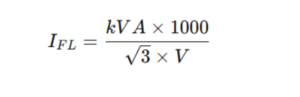
For single-phase:

Step 2: Apply Impedance

Example: Transformer Fault Current Calculation
Given:
500 kVA transformer
480 V secondary
5.75% impedance
Step 1: Calculate Full-Load Current
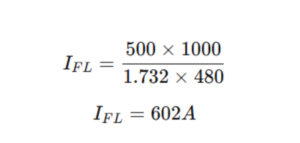
Step 2: Convert Impedance to Per-Unit

Step 3: Calculate Fault Current
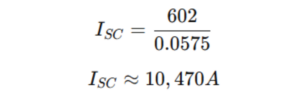
The available symmetrical fault current at the secondary terminals is approximately 10.5 kA.
Simplified Shortcut Formula

A commonly used shortcut for three-phase transformer fault current calculation is:
This combines both steps into a single expression.
What This Calculation Assumes
This method assumes:
- The transformer is the only source
- Infinite upstream source capacity
- Fault occurs at the secondary terminals
- Only transformer impedance limits current
In real systems, upstream utility impedance may further limit fault current.
Effect of Transformer Size and Impedance
Fault current increases when:
- Transformer kVA increases
- Percent impedance decreases
For example:
A 1500 kVA transformer with 5% impedance will produce significantly higher fault current than a 500 kVA transformer with 6% impedance.
This is why specifying impedance is a critical design decision. Higher impedance reduces fault current but increases voltage drop.
Calculating Fault Current on the Primary Side
To calculate primary-side fault current:
- Determine secondary fault current
- Divide by the turns ratio (voltage ratio)
Alternatively, apply the same formula using primary voltage and kVA rating.
Asymmetrical Fault Current and X/R Ratio
The previous calculations provide symmetrical RMS fault current. However, the initial fault current contains a DC offset influenced by the transformer’s X/R ratio.
Higher X/R ratio results in:
- Greater peak current
- Higher mechanical stress
- Increased breaker duty
Protection engineers must consider asymmetrical current when selecting interrupting devices.
Transformer Contribution in Larger Systems
In systems with multiple transformers or generators, fault current contributions must be summed using per-unit system methods. The simple method shown above applies primarily to single-transformer secondary calculations.
Common Mistakes When Calculating Transformer Fault Current
Frequent errors include:
- Ignoring percent impedance
- Confusing percent impedance with voltage regulation
- Using line-to-neutral voltage instead of line-to-line
- Forgetting to convert percent impedance to per-unit
- Ignoring upstream source impedance
Accurate transformer fault current calculation requires careful attention to units and system configuration.
Practical Design Considerations
When performing transformer fault current calculations, engineers must also evaluate:
- Breaker interrupting ratings
- Bus short-circuit withstand ratings
- Arc-flash incident energy
- Grounding method
- Parallel transformer operation
Higher fault current increases equipment stress but may improve protection sensitivity. Proper system design balances these factors.
Conclusion
Transformer fault current calculation is a fundamental step in power system design. By using transformer kVA, voltage, and percent impedance, engineers can calculate fault current transformer contribution accurately and ensure equipment is properly rated.
Understanding how to calculate fault current for a transformer supports safe breaker selection, proper coordination, and reliable system performance.