Updated: August 17th, 2026
Transformer fuse sizing begins with rated current, but it cannot end there. A fuse selected only as a percentage of full-load current may open during normal energization. Increasing its rating may prevent that problem while providing inadequate protection against overloads or low-magnitude faults.
The fuse must carry permitted load, withstand magnetizing inrush, interrupt the available fault current safely, and operate quickly enough to limit transformer and conductor damage. It must also coordinate with upstream and downstream devices so that a fault is isolated as close as practical to its source. These requirements make transformer fusing a time-current coordination problem rather than a single arithmetic calculation.
Why Transformers Require Coordinated Overcurrent Protection
Overcurrent can affect a transformer in two fundamentally different ways. A moderate but sustained overload increases winding losses and temperature. If the condition continues, insulation ages faster and may eventually lose dielectric strength. A short circuit develops much more rapidly. High through-fault current produces intense heating and electromagnetic forces that can displace conductors, deform windings, or damage bracing before the transformer reaches a steady thermal condition.
One fuse setting cannot always provide equally sensitive protection against both mechanisms. A primary fuse must remain intact during normal energization, which may require an ampere rating and time-current response well above normal primary current for a short interval. That same margin can make the fuse relatively insensitive to a secondary overload. Secondary overcurrent devices, winding-temperature sensors, or protective relays may therefore form part of the complete protection scheme, depending on transformer size, voltage class, application, and applicable code. Rex’s guide to transformer failure mechanisms explains how thermal and fault stresses develop into damage.
The objective is to define which device should operate for each credible abnormal condition and how long the transformer, conductors, and connected equipment can safely withstand it.

Begin with Transformer Full-Load Current
The transformer nameplate kVA and voltage establish the rated current on each side. For a single-phase transformer:
I = (kVA × 1,000) ÷ V
For a three-phase transformer:
I = (kVA × 1,000) ÷ (√3 × VLL)
Where VLL is the line-to-line voltage, and I is line current in amperes. Rex’s transformer rating guide explains how kVA, voltage, and current relate to continuous capacity.
These calculations provide the reference currents for selecting and coordinating protection; they do not determine the final fuse rating by themselves. The permitted overcurrent-protection arrangement and maximum device rating depend on the applicable installation code, transformer configuration, primary and secondary protection provided, conductor protection, and other conditions.
In Canada, the adopted edition of the Canadian Electrical Code, Part I, together with provincial or territorial amendments, governs the installation. CSA C22.1:24 is the 26th edition, but jurisdictions may adopt editions on different dates. Designers should verify the applicable local requirements rather than copying a fuse percentage from a general table.
Allow for Magnetizing Inrush Without Hiding Faults
When an unloaded transformer is energized, the core may enter temporary saturation. The resulting magnetizing current depends on the point on the voltage wave at closing, residual core flux, transformer design, source impedance, and switching conditions. Its peak can be many times rated current, but it normally decays and is not a fault.
A fuse that responds too quickly in this region may open even though the transformer and load are healthy. Simply increasing the fuse rating is not always the right correction, however, because doing so shifts the entire time-current characteristic and may reduce protection at other current levels. The appropriate check compares the transformer’s expected inrush envelope with the fuse manufacturer’s time-current curve and allows suitable margin for tolerances, ambient conditions, and repeated energization where applicable. Rex’s guide to transformer inrush current examines why the magnitude and duration vary.
Inrush must also be distinguished from load starting current. Motor acceleration, capacitor charging, uninterruptible power supplies, and other downstream equipment can create separate transient duties. Their magnitude, duration, and frequency belong in the coordination study rather than being assumed to match transformer energization.
Understand the Different Roles of Primary and Secondary Protection
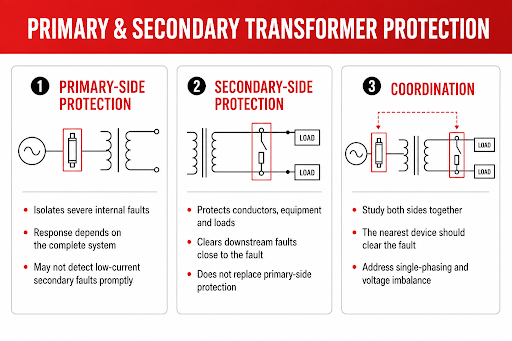
Primary-side fuses can disconnect the transformer from the source during severe internal faults and can limit exposure to some secondary through-faults. They may also protect the primary conductors when selected and installed for that purpose. Their view of a secondary fault is affected by the turns ratio, winding connection, grounding arrangement, fault type, and transformer impedance. A low-current secondary ground fault or overload may not produce enough primary current to operate an intentionally oversized primary fuse promptly.
Secondary protection is normally selected with the secondary conductors, distribution equipment, and connected loads in mind. It can clear downstream faults before the primary fuse opens and, in code-permitted arrangements, can contribute to transformer overload protection. It does not remove the need to evaluate internal transformer faults or the primary-side installation.
Coordination requires both sides to be studied together. A downstream fault should normally be cleared by the nearest device without unnecessarily opening the transformer primary. An internal fault must be isolated by devices capable of detecting and interrupting it. On a three-phase installation, one fuse opening also requires attention because sustained single-phasing or voltage imbalance may damage connected equipment without appropriate detection or isolation.
Select the Fuse by More Than its Ampere Rating
Two fuses with the same current rating can behave very differently. A complete selection considers voltage rating, continuous-current rating, interrupting rating, fuse class or medium-voltage type, time-current characteristic, current-limiting performance, and suitability for the equipment and installation.
A time-delay characteristic allows the fuse to tolerate a defined short-duration overcurrent, helping it ride through inrush while responding to sustained current. Operating time falls as current rises according to the fuse curve.
A current-limiting fuse operates rapidly when fault current enters its current-limiting range. It can reduce peak let-through current and I²t energy, lowering thermal and mechanical stress. The benefit is not automatic at every fault magnitude; published peak-current and energy data must support the evaluation. Time-delay and current-limiting are not mutually exclusive; one fuse may exhibit both properties.
The interrupting rating is a separate requirement. It is the maximum current the fuse is designed to interrupt at its rated voltage under specified conditions. It must not be confused with the ampere rating, which describes continuous carrying capability. A fuse that has an appropriate ampere rating but an inadequate interrupting rating is not suitable for the calculated fault duty.
Account for Transformer Impedance and Available Fault Current
Transformer percent impedance limits the current delivered into a secondary short circuit. As a first approximation, when upstream source impedance is neglected:
Isc = IFL ÷ Zpu
where Isc is symmetrical root-mean-square short-circuit current, IFL is full-load current, and Zpu is percent impedance divided by 100. Rex’s fault-current calculation guide explains the assumptions and limitations of this relationship.
Lower transformer impedance generally permits higher secondary fault current, raising the interrupting duty of fuses and equipment. Higher impedance reduces transformer contribution but may increase voltage drop. The study must use actual source, transformer, and conductor impedances rather than treating impedance as a fuse-selection value in isolation.
The study should consider maximum available fault current when verifying interrupting and equipment ratings. Minimum fault current also matters because it determines whether the intended device will operate quickly enough at the far end of a circuit or for a higher-impedance fault. System changes such as a larger utility service, a replacement transformer with different impedance, parallel sources, or on-site generation can invalidate an earlier result. Rex’s article on short-circuit withstand capability explains why both current magnitude and clearing time affect transformer stress.
Use Time-Current Curves to Verify Coordination
A coordination study plots device characteristics on a common time-current basis. It may include the inrush region, loading requirements, fuse and breaker curves, conductor damage limits, and transformer through-fault withstand. Currents and curves must be referred to the same side of the transformer before comparison.
Published fuse data may show minimum-melting and total-clearing curves. Selective coordination cannot be established by comparing ampere ratings alone; the applicable curves must remain separated over the required fault-current range.
IEEE C57.12.59-2015 addresses the application of overcurrent protective devices to limit dry-type transformer exposure to through-fault current. Importantly, the guide states that its through-fault recommendations are not intended to imply overload capability. This distinction reinforces why transformer fault withstand, overload protection, and conductor protection have to be checked as related but separate requirements.
Common Fuse-Sizing Errors
The most common error is selecting a fuse from full-load current alone. Others include assuming an inrush multiple instead of using transformer and fuse data; increasing fuse size after nuisance operation without identifying the event; checking only maximum fault current; or assuming a primary fuse fully protects secondary conductors and loads.
Substituting a different fuse solely because its ampere and voltage ratings match can also change the protection scheme. Fuse class, speed, current-limiting threshold, minimum-melting curve, total-clearing curve, and interrupting rating may differ. Replacement fuses should match the approved design and equipment instructions unless the protection study and equipment suitability are reassessed.
Finally, protective devices cannot compensate for an incorrectly specified transformer. Persistent overload, harmonic heating, inadequate ventilation, high ambient temperature, and unsuitable enclosure conditions must be addressed through load evaluation and transformer design. Rex’s transformer load-calculation guide covers the operating data needed before selecting transformer capacity. Protection should disconnect abnormal conditions; it should not be used to make an unsuitable duty appear acceptable.
Conclusion
Transformer fuse sizing is the process of coordinating load current, inrush, fault current, transformer withstand, conductor protection, and device operating characteristics. Full-load current establishes the starting point, but the final selection depends on the applicable code, transformer data, system study, fuse curves, and the intended division of protection between primary and secondary devices.
A well-coordinated scheme allows normal energization and permitted loading while clearing faults before damage escalates. It also isolates the smallest practical part of the system, reducing unnecessary outages without sacrificing transformer protection.