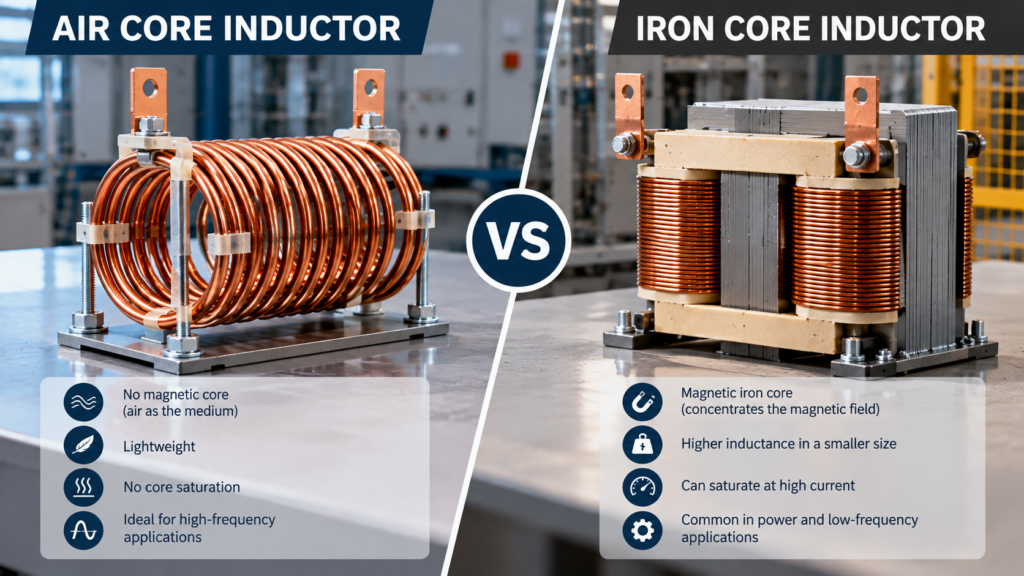
Inductors—often referred to as reactors in power system applications—are used to store energy in a magnetic field and control current flow. Their behavior is fundamentally shaped by the material used in the magnetic path.
In practical terms, most applications fall into two categories: air core and iron core (ferromagnetic core) designs. The distinction between them is not just material—it directly affects inductance stability, saturation behavior, losses, size, and suitability for specific electrical environments.
For engineers working in power systems, drives, and dry type transformer installations, understanding this distinction is essential for correct equipment selection and predictable performance.
Why Core Material Matters
Inductance depends on both geometry and magnetic permeability. Air has very low permeability, while iron-based materials significantly increase it. This allows iron core inductors to achieve higher inductance in a smaller physical space.
That advantage, however, introduces additional behaviors—most notably saturation and core losses—that do not exist in air core designs.
The selection of core material therefore becomes a trade-off between:
- Linearity and stability
- Size and inductance density
- Losses and thermal performance
This trade-off plays out differently in power systems compared to electronic circuits.
Air Core Reactors: Linear Performance Under All Conditions
Air core inductors (commonly called air core reactors in power applications) operate without magnetic material. The magnetic field is established entirely in air, resulting in highly predictable behavior.
Electrical Behavior
The defining characteristic of an air core reactor is its linearity. Inductance remains essentially constant across the full operating current range because there is no core to saturate.
This has several direct implications:
- No inductance collapse under fault or transient conditions
- Stable impedance under harmonic loading
- Predictable performance across a wide current range
In systems with significant waveform distortion or high peak currents, this stability is often the primary reason for selecting an air core design.
Losses and Thermal Performance
Air core reactors do not experience hysteresis or eddy current losses associated with magnetic materials. Losses are dominated by conductor (I²R) losses and stray effects.
Thermally, this shifts the design focus toward:
- Conductor sizing
- Cooling through natural or forced air
- Physical spacing to manage heat dissipation
Because there is no core to absorb or concentrate heat, the thermal design is closely tied to winding geometry and airflow.
Mechanical Considerations
In medium- and high-power applications, air core reactors must withstand significant electromagnetic forces, particularly during fault conditions. Mechanical integrity is achieved through:
Coil bracing systems
- Fiberglass or composite structural supports
- Careful control of winding spacing
This is a critical but often overlooked aspect of air core reactor design.
Typical Applications
Air core reactors are widely used where linearity and reliability under abnormal conditions are required. Common applications include:
- Harmonic filtering (especially with capacitor banks)
- Current limiting reactors
- Neutral grounding reactors
- Shunt reactors in transmission and distribution systems
In installations with nonlinear loads such as VFDs, air core reactors are often preferred because they maintain consistent impedance under harmonic conditions.
Iron Core Inductors: Compact and Inductance-Dense
Iron core inductors use ferromagnetic materials to concentrate magnetic flux, allowing significantly higher inductance for a given size.
This makes them well suited to applications where space, weight, and inductance density are primary constraints.
Electrical Behavior and Saturation
The defining limitation of iron core inductors is saturation. As current increases, the core approaches its magnetic limit, beyond which inductance decreases sharply.
This has several practical consequences:
- Reduced impedance at high current
- Loss of filtering effectiveness
- Increased current and thermal stress
Unlike air core designs, iron core inductors must be carefully sized to ensure operation remains within the linear region under both steady-state and transient conditions.
Core Losses
Iron core designs introduce additional loss mechanisms:
- Hysteresis losses due to magnetization cycles
- Eddy current losses within the core material
These losses increase with frequency and flux density, making core material selection (laminated steel vs ferrite vs powdered iron) an important design decision.
Thermal Implications
Because losses are generated in both the conductor and the core, thermal design must account for:
- Core heating
- Hot spot development
- Cooling effectiveness within a more compact structure
This can limit performance in higher-frequency or heavily distorted waveform environments.
Typical Applications
Iron core inductors are commonly used in applications where high inductance is required in a compact footprint, such as:
- DC link chokes
- Power supply filtering
- Motor drives (where current is controlled)
- Low-frequency filtering applications
They are generally preferred where operating conditions are well-defined and saturation can be avoided through design margin.
Air Core vs. Iron Core: Application-Driven Selection
The choice between air core and iron core designs is best understood in terms of application priorities.
Air core reactors are typically selected when:
- Current levels are high or highly variable
- Harmonic content is significant
- Linearity and predictability are critical
- Saturation cannot be tolerated
Iron core inductors are typically selected when:
- Space constraints are important
- High inductance is required in a compact design
- Operating current is controlled and predictable
- Efficiency at low frequency is a priority
This is not a matter of one being better than the other. Each is optimized for a different operating envelope.
Frequency and System Context
Frequency plays a central role in core selection.
At higher frequencies:
- Core losses increase significantly in iron materials
- Air core designs become more attractive despite larger size
At lower frequencies:
- Iron cores provide efficient inductance with manageable losses
- Air core designs may become physically large for equivalent inductance
In power systems operating at 50/60 Hz, both designs are used—but for different purposes. Air core reactors dominate in harmonic filtering and current limiting, while iron core inductors are more common in controlled, lower-distortion environments.
Relationship to Transformer Applications
Although this discussion focuses on inductors, the same core material principles apply to transformers.
Iron cores are used in power transformers to efficiently transfer energy at low frequency with high flux linkage. Air core transformers, by contrast, are limited to specialized high-frequency applications where core losses must be minimized.
This reinforces the broader principle: core material selection is fundamentally tied to frequency, efficiency, and linearity requirements.
Common Misinterpretations
Several oversimplifications frequently appear in practice:
- Assuming higher inductance always leads to better performance
- Ignoring saturation behavior in iron core designs
- Overlooking harmonic effects when selecting reactors
- Treating air core reactors as inefficient without considering application context
In reality, performance depends on how well the component matches the operating conditions—not on any single parameter.
Conclusion
The distinction between air core and iron core inductors is fundamentally a trade-off between linearity and inductance density.
Air core reactors provide stable, saturation-free performance and are well suited to harmonic-rich, high-current, and dynamic environments. Iron core inductors offer compact, high-inductance solutions but require careful control of operating conditions to avoid saturation and excessive losses.
For engineers working in power systems and dry type transformer applications, the correct choice depends on load characteristics, harmonic content, frequency, and physical constraints. Understanding these factors allows for more reliable designs and avoids performance issues that often only emerge under real operating conditions.