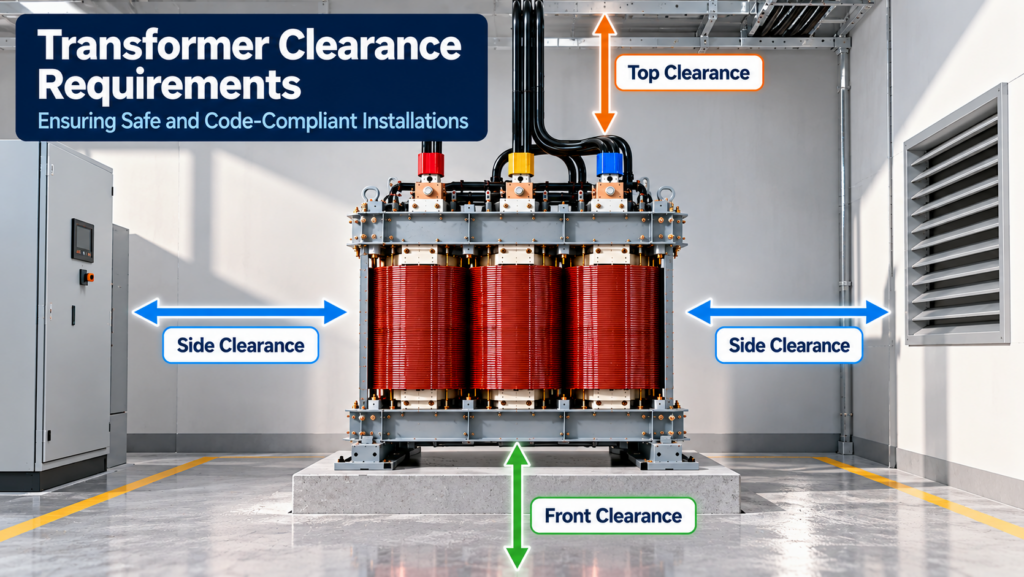
Clearances around dry-type transformers play a central role in ensuring proper operation, electrical safety, and compliance with installation codes. Because dry-type transformers rely entirely on air movement for cooling, any obstruction around the unit can affect temperature rise and longevity. At the same time, electrical codes in both Canada and the United States establish mandatory working space and approach distances to maintain safe access and prevent exposure to energized components.
In Canada, transformer installation requirements fall under the Canadian Electrical Code (CEC). In the United States, they are guided by the National Electrical Code (NEC). These codes form the foundation for safe installation practices, while manufacturer instructions provide transformer-specific ventilation and clearance requirements. For full compliance, both must be followed.
Why Clearances Matter
Transformer clearances serve three important functions:
Thermal performance: Adequate spacing ensures airflow is not obstructed, preventing overheating.
Electrical safety: Working clearances provide safe approach distances and protect personnel.
Serviceability: Sufficient access allows for inspection, maintenance, and troubleshooting.
Failure to maintain proper spacing can lead to elevated temperatures, nuisance tripping, reduced insulation life, and potential code violations.

Thermal and Ventilation Clearance
Dry-type transformers dissipate heat through natural or forced air circulation. Maintaining ventilation clearance around the transformer ensures air can enter, pass across heated surfaces, and exit freely.
Manufacturers typically specify minimum distances around ventilated surfaces. As a general guideline:
- 150–300 mm (6–12 inches) is commonly recommended around ventilated sides
- Greater spacing may be required for larger kVA ratings or enclosed installations
- Airflow paths must remain unobstructed, including top and bottom ventilation openings
While these values support airflow around the unit, room-level ventilation is equally important. In mechanical or electrical rooms, transformer heat contributes to the ambient temperature. Without adequate room ventilation, internal temperatures may exceed design assumptions even when unit-level spacing is adequate.
As a result, the design of transformer installations often includes:
- Air intake and exhaust openings
- Mechanical or forced room ventilation
- Avoidance of dead-air pockets or recirculation zones
- Electrical Safety Clearances
Electrical safety spacing is defined by local electrical code, not the manufacturer. These clearances ensure that qualified personnel have safe access to equipment and do not come into contact with energized components. Working space must comply with:
Typical minimums include:
- 1 m (3.3 ft) of clear space in front of electrical equipment
- Sufficient width equal to equipment or at least 750 mm
- Headroom of 2 m (78 in.)
These requirements apply, even if the transformer is fully enclosed, because the space is required for servicing associated electrical equipment.
Indoor Installations
Indoor installations must consider:
- Ventilation clearance from walls or partitions
- Total heat load within the electrical room
- Building code requirements for combustibility and fire protection
- Space for cable entry, bending radius, and connection access
Confined rooms may require engineered airflow solutions or additional clearance beyond minimum manufacturer recommendations.
Outdoor Installations
Even with weatherproof enclosures (e.g., NEMA 3R, 4, 4X), outdoor transformers still require ventilation spacing. Installers should maintain distance from:
- Walls and architectural structures
- Fences and screens
- Vegetation or debris
- Snow accumulation zones
Outdoor installations must also consider building code requirements related to elevation, drainage, seismic anchoring, and wind loading.
Fire Safety Considerations
Dry-type transformers do not contain oil and are classified as non-combustible electrical equipment. However, they still generate heat during operation, and clearances help prevent heat accumulation near adjacent construction materials. In some cases—particularly for large power transformers in enclosed spaces—building and fire codes may require fire-rated rooms, barriers, or enclosures. NEC 450.21 and corresponding sections of the CEC establish requirements for transformer placement relative to combustible construction, ventilation ducts, and fire separation.
Noise, Vibration, and Clearance Interaction
Clearances can influence how transformer sound is perceived. When transformers are installed too close to walls or rigid surfaces, sound reflection can increase perceived noise levels. Adequate spacing helps minimize resonance effects, and supplemental measures such as vibration isolators or sound-attenuating enclosures can be applied when necessary.
Codes, Standards, and Manufacturer Requirements
The local electrical code—CEC in Canada and NEC in the United States—sets the minimum mandatory requirements for transformer installation. These rules govern electrical safety, working space, guarding of live parts, fire protection, and ventilation.
Industry standards such as CSA C9, IEEE C57.12.01, IEEE C57.12.91, and NEMA ST-20 provide additional context on transformer design, testing, and performance but do not replace code requirements for installation.
Manufacturer installation instructions remain an equally important part of compliance. They specify airflow requirements, minimum clearances for ventilation, positions requiring access, and any restrictions related to enclosure openings, fan placement, or top/bottom airflow paths. These instructions ensure the transformer can operate within its thermal design limits and must always be followed to maintain warranty and performance expectations.
Conclusion
Clearances play a vital role in the safe and reliable installation of dry-type transformers. They support proper ventilation, protect personnel, simplify maintenance, and ensure compliance with local electrical codes. By coordinating manufacturer guidelines with the applicable installation code—CEC in Canada or NEC in the United States—designers and installers can maintain thermal performance, extend transformer life, and achieve a trouble-free installation.